
Upload a Picture
About this Site | Links | Random Pic | Advanced Search
Home | Latest Additions | Contributors
| Visitors
Fire Engine Photos
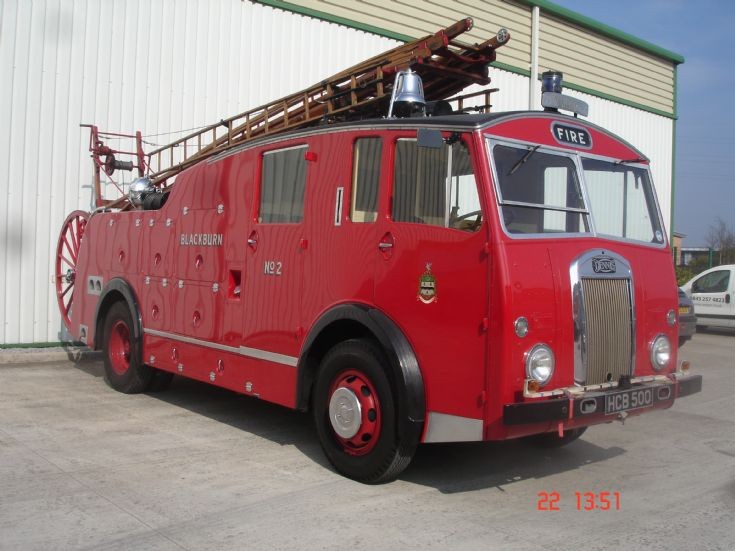
Dennis F15 Pump Escape HCB500
Taken today in the Lancashire sunshine HCB 500 a Dennis F15 pump escape - formerly of Blackburn Fire Brigade - the nameplate above the 'Fire' sign on the front is 'John Shorrock' - Blackburn, along with some other brigades had a tradition of naming appliances
Taken today in the Lancashire sunshine HCB 500 a Dennis F15 pump escape - formerly of Blackburn Fire Brigade - the nameplate above the 'Fire' sign on the front is 'John Shorrock' - Blackburn, along with some other brigades had a tradition of naming appliances
The F15 seems to ba heavier chassis altho' apparently the makers plate says F12. All the F15 seem to be water tenders(in this case WrE).
Added by Neal Glover on 27 March 2012.
Added by Neal Glover on 27 March 2012.
What a beautiful machine, love the blue lamp too!! A lot of TLC has gone into this one, well done to everyone concerned, thanks Rick.
Added by Pav on 28 March 2012.
Added by Pav on 28 March 2012.
Ok - another question, what's the white bar which appears to be clamped above the front bumper? It seems an odd way of adding indicator lamps which appear to be on either end - or does it have some other purpose?
Added by Michael G. on 28 March 2012.
Added by Michael G. on 28 March 2012.
Pav - this type of blue light is very '1950's -60's' - I think they are known as 'lantern beacons' and are glass with a blue insert in them - if you look at pic 2280 - my Derbyshire F12 has one and I also have one to fit to my Derbyshire F8 - I remember when I was at Derby training school in the mid 1970's nearly every appliance had them fitted !
Michael and Neal the F15 is an identical chassis to the F12 with the exception the F15 has heavier duty brakes fitted - possibly from carrying 400 gallons of water as water tenders do - confirming Neals thoughts !
Michael the white bar is a simple addition to carry the indicators on the front bumper - there is a concealed plug to connect to - its simply a bit of wood with two indicators, ratchet strapped to the bumper - the rear is covered by a standard trailer board !
I have to say this appliance is simply stunning - I don't think I've seen it since the FSPG Chasewater rally in 1993 - the day I took this picture it was actually quite dirty with road grime ! - I wonder how good it looks when its actually clean !!!
Added by Rick Loudon on 28 March 2012.
Michael and Neal the F15 is an identical chassis to the F12 with the exception the F15 has heavier duty brakes fitted - possibly from carrying 400 gallons of water as water tenders do - confirming Neals thoughts !
Michael the white bar is a simple addition to carry the indicators on the front bumper - there is a concealed plug to connect to - its simply a bit of wood with two indicators, ratchet strapped to the bumper - the rear is covered by a standard trailer board !
I have to say this appliance is simply stunning - I don't think I've seen it since the FSPG Chasewater rally in 1993 - the day I took this picture it was actually quite dirty with road grime ! - I wonder how good it looks when its actually clean !!!
Added by Rick Loudon on 28 March 2012.
Rick, thanks for the info. I guess the indicators were added as you mention above, to enhance the visability whilst on the road to rally's / shows, rather than an in service modification. ie easily removable and esentially keeping the F15's bodywork original.
Added by Michael G. on 29 March 2012.
Added by Michael G. on 29 March 2012.
Rick, re the front indicators - could they not be rigged into the sidelight assembly, as sometimes happens to imported cars from the US? IMHO it would look far neater...
Added by PeteG on 29 March 2012.
Added by PeteG on 29 March 2012.
This machine is now in the museum at Leyland and rarely goes out which is a shame , but at least it is hopefully safe.
Added by Neal Glover on 29 March 2012.
Added by Neal Glover on 29 March 2012.
yes It would look far neater - however, this appliance is still owned by Lancashire Fire and Rescue and this would have been the cheapest fix at the time - in these days of 95% of fire and rescue sevices having ZERO interest in preservation ( even though it could legitimatly be booked as 'community safety') Lancashire should be commended for still running the vehicle I think ?
Added by Rick Loudon on 30 March 2012.
Added by Rick Loudon on 30 March 2012.
Rick: Re-F15 / F12, I was told the main difference is that the F15 has the rear mounted pump whilst the F12 has the side mounted one. Is that not the case?
Added by Kevin on 11 May 2012.
Added by Kevin on 11 May 2012.
Some F12s have a rear- mounted pump. 1 AMX, from Staines and now preserved, is an F12 with a rear-mounted pump.
Added by Bill Edwards on 25 August 2026.
Added by Bill Edwards on 25 August 2026.
Yes! I was once given and still have a model of the famous brown painted Rutland F12 PE with its rear mounted pump. I have to say I always thought that by the 1950s this was a retrograde idea, unless it was a WTE. Mid mounted pumps started to become quite common on PEs in the thirties, and as a matter of fact the first ever municipal motor pump escape, which was delivered to Finchley by Merryweather in 1904 was actually a mid mount!
Added by Rob Johnson on 25 August 2026.
Added by Rob Johnson on 25 August 2026.
picture 21574 has the very machine on this site, identified as a F12 -although the commentary is a bit indecisive as to whether it was a F15 or just an F12 with bigger brakes. Given the over the road performance of the F12, PHN 999, from our local station in Darlington, perhaps the idea of specifying bigger brakes from the factory was not all that bad!
Added by Rob Johnson on 26 August 2026.
Added by Rob Johnson on 26 August 2026.
No one has mentioned this is a Water Tender escape.
Ed: it is referred to as a WrE in the N. Glover post above. A water tender escape must carry 400 gallons of water as well as the escape and that is a lot of weight, hence the F15 slightly heavier truck that the F12, though some F12 were WrE's as well. WrE is sometimes called a WrTE just to confuse matters. It is the same specification.
Added by Neal Glover on 27 August 2026.
Ed: it is referred to as a WrE in the N. Glover post above. A water tender escape must carry 400 gallons of water as well as the escape and that is a lot of weight, hence the F15 slightly heavier truck that the F12, though some F12 were WrE's as well. WrE is sometimes called a WrTE just to confuse matters. It is the same specification.
Added by Neal Glover on 27 August 2026.
I remember being told by a Pyrene guy at the commercial motor show one day (when he was talking about a VW light pumper with a 100 gallon tank) that “99% of all fires need less than 100 gallons of water”. I don’t know if that was true back in 1967, but I do know that in most countries at that time pumpers nearly always had much bigger tanks. 800 litres or around 180 gallons was the minimum in Germany, most new French pumps had at least 130, even if they were only compact first responders and in the USA tanks were usually around 240 IG - and quite often much larger.
So the idea of a WTE made a lot of sense. Many county brigades had them. In addition, Middlesborough county borough converted their original F 12 to a 200 gallon tank, and their F 7 (which had a longer wheelbase) to 250. This extra weight was presumably okay for these chassis, even with a wooden escape ladder. It fell short of the full 400 on a WTE, but added another few minutes to the time before a hydrant supply needed to be flowing.
Later, after steel wheeled escape ladders were adopted, which were much lighter, bigger tanks became the norm. A lot of new pump escapes with rear mounted pumps with side controls and plumbing were built with 300 gallon tanks. This configuration made pump access much easier as it became unnecessary to slip the escape to get at the pump.
Added by Rob Johnson on 28 August 2026.
So the idea of a WTE made a lot of sense. Many county brigades had them. In addition, Middlesborough county borough converted their original F 12 to a 200 gallon tank, and their F 7 (which had a longer wheelbase) to 250. This extra weight was presumably okay for these chassis, even with a wooden escape ladder. It fell short of the full 400 on a WTE, but added another few minutes to the time before a hydrant supply needed to be flowing.
Later, after steel wheeled escape ladders were adopted, which were much lighter, bigger tanks became the norm. A lot of new pump escapes with rear mounted pumps with side controls and plumbing were built with 300 gallon tanks. This configuration made pump access much easier as it became unnecessary to slip the escape to get at the pump.
Added by Rob Johnson on 28 August 2026.
Dennis


Added by Michael G. on 27 March 2012.