
Upload a Picture
About this Site | Links | Random Pic | Advanced Search
Home | Latest Additions | Contributors
| Visitors
Fire Engine Photos
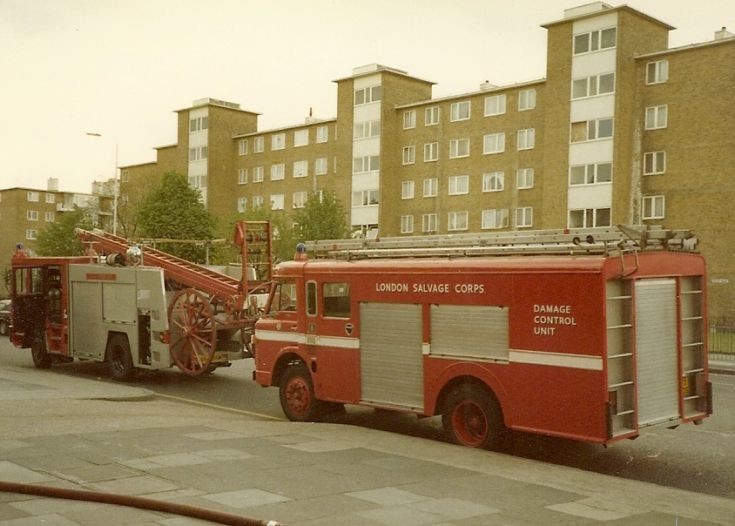
Ford D/ CFE Damage Control Unit TYO 470S
early 1980s Mile End Rd, East London. Fire at Half Moon Theatre. Compare with picture 20692 which has Hawson body. Also S&D CFE pump escape.
early 1980s Mile End Rd, East London. Fire at Half Moon Theatre. Compare with picture 20692 which has Hawson body. Also S&D CFE pump escape.
Buzz - do you know why the London Salvage Corps was closed down?
Added by Rob Johnson on 08 July 2013.
Added by Rob Johnson on 08 July 2013.
this was due to the changing nature of the London economy moving from being a great manufacturing centre to one more based on financial services and tourism during the Thatcher era. The salvage corps in three great port cities of London Glasgow and Liverpool had been funded by insurance companies and they were in effect private services. They made a commercial judgement that it was no longer viable to try to reduce insurance losses through salvage. The brigade itself took on salvage duties and sadly the salvage corps closed. A small private company carried on for a short while in London but it also stopped. You can see one of their units at picture 20792. They did not work on blue lights though. Damage control companies continue but have no fire association. Put damage control into Google.
Added by Peter Williams on 08 July 2013.
Added by Peter Williams on 08 July 2013.
the same happened in Liverpool, They started a private company. did not see them at fires but had a contract with some local councils to empty houses that were to be renovated.The Liverpool salvage Corps HQ was handed to Merseyside Fire Brigade and is still used to-day as offices and Control.It was my last posting before I retired.
Added by Dave Price on 09 July 2013.
Added by Dave Price on 09 July 2013.
London Salvage Corps closed because a majority decision by the London underwriters decided that it was not cost effective anymore. The insurance assessors guild valued the Corps worth at a ratio of 12 to 1 or in other words the Corps work at incidents would be 100 pounds per hour and the amount of savings to property would be 1200 pounds but this was a drop from the ratio in the past where it was 20 to 1 during the sixties and 40 to 1 in the fifties. Also the manufacturing and warehousing was becoming more common in other parts of the country. Fire Brigades had a duty of care at fires and floods to undertake salvage work so it was decided that the fire brigades would do it everywhere. hence the closing of the Corps. It must be said though that the Corps worked outside their respective areas Glasgow attended incidents in Edinburgh and elsewhere in the Strathclyde provence. London attended incidents in Kent, Surrey, Essex, Hertfordshire, Bedfordshire,
Buckinghamshire, Berkshire and went as far as Southampton and Bristol. Liverpool and London personnel attended a huge fire in the main government building complex in Riyad Saudia Arabia. The Saudi government asked for help and the British Government asked the Corps to attend.
The RAF did the transporting. Today the Government has issued Fire Brigades or Fire Rescue services as they like to be known with special vehicles and equipment as a standard issue throughout the country to deal with floods and damaged property from high winds and collapse structure. Funny that was exactly what the Salvage Corps used to do aswell as attend fires. Fire services in this country will probably be privatised like everything else has in the near future just like the Falck service in mainland Europe. A well what goes around comes around.
Added by Buzzlightyear on 01 January 2014.
Buzz, I totally share your thoughts. The fire brigade is very good at 'reinventing the wheel' The current USAR seems a complete waste of money and resources, hanging around for the couple of shouts a month they might get! Bring back the salvage corps! You mention privatisation, it's got to be around the corner hasn't it. With cash strapped brigades and further budget cuts being made all the time and the pensions black hole, it's only a question of time before companies start to offer their services to the government.
Added by Matt Ireland on 01 January 2014.
Added by Matt Ireland on 01 January 2014.
I visited Denmark on business quite often for several yeras, and was given the impression that in fact the Falck organization does an excellent job. There are of course also numerous public fire services in Denmark, and Falck is by no means the only firefighting resource there.
As far as other countries are concerned, I do not know of any significant privatized fire services, except for a handful of organizations in the US, but these too are few and far between. In Germany, there are protocols for many major private factory fire brigades to assist municipal services, particularly with special purpose appliances, but these are not normally called on as first responders outside their own factories.
Added by Rob Johnson on 01 January 2014.
I feel that perhaps the USAR, HVP's and similar other assets offer more resilience than the Salvage Corps ever did. With a view to equipment as a 'cash strapped' country we don't do too badly...
Added by Glenn Ramsden on 01 January 2014.
Added by Glenn Ramsden on 01 January 2014.
The thinking behind USAR was a panic reaction to 9/11.The plan was more like the old AFS with all sorts of equipment.They would have been stored at marchington after the goddess fleet was sold.They had fifty spare prime movers at Morton-in-Marsh. in the end they issued them to brigades and cancelled the other pod.As for salvage it was always a requirement under the fire service act to carry out salvage work.The insurance firms must have had to pay out a lot to keep them running as at many jobs I attended with Liverpool Salvage Corps when asked who they were insured with the answer was nearly always WE HAVE NO INSURANCE.
Added by Dave Price on 02 January 2014.
Added by Dave Price on 02 January 2014.
I see things differently, some were issued to brigades as planned and the excess prime movers sold to interested brigades. Perhaps the project wasn't perfect (as projects of this size rarely are). Had it not been for 9/11 we would have had no standard for mass decontamination, USAR, HVP, DIM vehicles, a TIC for every station and other benefits. Similarly the MAN Multilift project may have been over subscribed but at least it has led to standardisation of many brigades enabling almost any F&RS to move, know how to set up and operate each other's equipment which is a huge advantage which largely first came to light at Buncefield with the significant successful HVP operation.
With regard to salvage you will have much more understanding of Salvage Corps but if there were only 4 salvage corps in operation and the rest of the Country managed without, the rest can't have been wrong (I feel?). I understand that they were based at the larger cities but the 'smaller' areas still had/have important salvageable premises - just a thought...
Added by Glenn Ramsden on 02 January 2014.
When the Corps closed several of the senior officers were seconded to the respective fire Brigades as instructors and advisors, The London Fire Brigade took over the Corps HQ building in the City of London and trained fire service personnel on damage control and planning of dealing with major incidents , it was during this period when it was first thought of using the pod system for various types of vehicles and equipment which both London and Merseyside adopted in a big way and the various types of pods prolificated , after When 9/11 happened there was a big meeting of government, fire, police, ambulance and the insurance loss prevention bureau to see if major incidents could be dealt in a resilient way and the old plans were brought out and dusted off . The prime movers were identified as needed and the government purchased them and stored them first at Morton in Marsh and then sent them out to the various brigades. There were to be pods for quit a lot of other rolls but was scaled back because of costs and the terms USAR and resiliance was adopted . The Corps worked at two levels when they were in operation the day to day work was for attended incidents and the other was planning also the corps had reserve vehicles and equipment to call on, stored in warehouses for major incidents. Some of the equipment was mobile scaffold towers, cranes and huge pod mounted generators and flood pumps. Acrow props and forklift trucks.
Added by Buzzlightyear on 03 January 2014.
Added by Buzzlightyear on 03 January 2014.
This inventory of special module-mounted equipment sounds very much like what is found in both Germany and the Netherlands. Both of these countries also have a highly co-ordinated and standardized approach, too. The modular (AB + WLF) solution first emerged in Germany in the early 1970z, and special purpose pods are distributed very widely, with many assigned to quite small volunteer fire companies.
They have also become more common in France and some other European countries, as well as Japan, but are still comparatively rare in most other places.
Added by Rob Johnson on 03 January 2014.
They have also become more common in France and some other European countries, as well as Japan, but are still comparatively rare in most other places.
Added by Rob Johnson on 03 January 2014.
CFE


Added by Buzz Lightyear on 08 July 2013.