
Upload a Picture
About this Site | Links | Random Pic | Advanced Search
Home | Latest Additions | Contributors
| Visitors
Fire Engine Photos
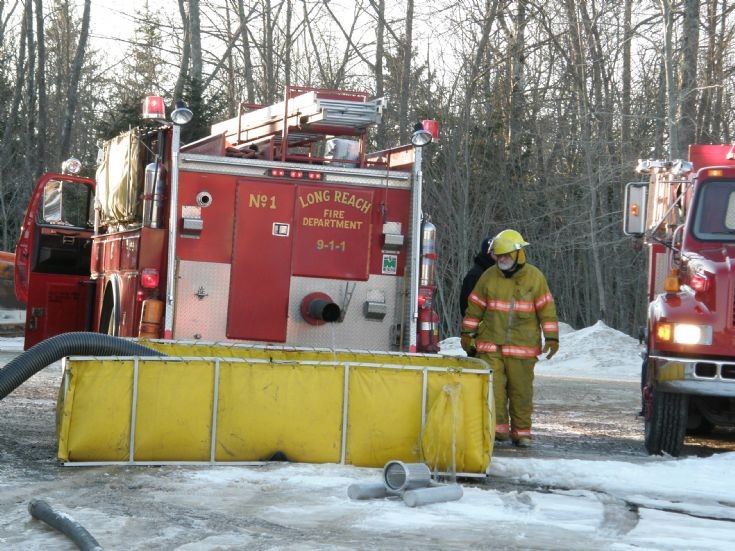
Canada - Winter - Industrial Garage Fire 6
2009; the Porta-Tank(Mobile Dam); set up in the dark, on a roughly-graded road, on a hill-side...not exactly a level spot, as you can see from the water slopping from the fabric Drain Valve, that is tied up on the right.
Just in front, is a Floating Suction Strainer - inverted in use, for drawing from a water surface.
The fire-fighter tending the Porta-Tank is a Ship's Captain; who has probably sailed across more water than you would want to think about - only here, it is a very precious commodity.
Pumper No 1 has an over-head Ladder Stowage - not too common around here - done, so a folded Porta-Tank could be stowed on left-hand side. The Hard Suction Hoses are on right - tall design as she has 1200 Imperial Gallon(5,455 litres) Water tank
See picture 22147 also
2009; the Porta-Tank(Mobile Dam); set up in the dark, on a roughly-graded road, on a hill-side...not exactly a level spot, as you can see from the water slopping from the fabric Drain Valve, that is tied up on the right.
Just in front, is a Floating Suction Strainer - inverted in use, for drawing from a water surface.
The fire-fighter tending the Porta-Tank is a Ship's Captain; who has probably sailed across more water than you would want to think about - only here, it is a very precious commodity.
Pumper No 1 has an over-head Ladder Stowage - not too common around here - done, so a folded Porta-Tank could be stowed on left-hand side. The Hard Suction Hoses are on right - tall design as she has 1200 Imperial Gallon(5,455 litres) Water tank
See picture 22147 also
Ah, David L., you are a 'Blue Water' sailor, then...
Truck 1 is a 1987 General Motors Corporation ,gas(petrol) engine, @ 375 Imperial GPM(450 US Gals, 1705 Litres per Minute) Pump; 1200 Imp Gallon(1440 US Gals, 5,455 Litres) Water Tank.
No Supply Hose - presuming you mean the LDH, Large Diameter Hose. The winters and road-salting(gritting)have taken their toll - the resulting corrosion has the tank and plumbing settling on the chassis. Her replacement is due within the year, with luck.
Yes, fresh water - in the dark, the boys found a pond up the hill. Next choice would have been sliding a Portable Pump down-hill, getting through the thick ice and pumping up brackish water, from a tidal estuary.
As there are readers here; from all over the world and with many different practices; I try to 'translate' my informations for them.
BTW, you would love the FD's name, named for a stretch of the St John River, which was the Mississippi/Rhine/Danube of the province. In 1800's, the wood-boats would drift down-river with their timber-cargo, and then have to make their way back up-river, when empty, under sail. The Long Reach stretched NE/SW, for a good length - the prevailing wind was south-westerly, so their crews had an easy go of it here, on a 'long reach' eg with the wind blowing them along, from behind. They did not have the weary process of constantly tacking, between the river-banks, against an unfavorable wind.
Er, I was a 'Coastie' for 28 years - 'Brown Water' sailor (Coast Guard - only sailed the coast, didn't get out into the deep blue sea, like the Navy; get it?!)
Cheers,
Pat_R-B
Added by Pat Rivers-Bowerman on 13 February 2010.
Truck 1 is a 1987 General Motors Corporation ,gas(petrol) engine, @ 375 Imperial GPM(450 US Gals, 1705 Litres per Minute) Pump; 1200 Imp Gallon(1440 US Gals, 5,455 Litres) Water Tank.
No Supply Hose - presuming you mean the LDH, Large Diameter Hose. The winters and road-salting(gritting)have taken their toll - the resulting corrosion has the tank and plumbing settling on the chassis. Her replacement is due within the year, with luck.
Yes, fresh water - in the dark, the boys found a pond up the hill. Next choice would have been sliding a Portable Pump down-hill, getting through the thick ice and pumping up brackish water, from a tidal estuary.
As there are readers here; from all over the world and with many different practices; I try to 'translate' my informations for them.
BTW, you would love the FD's name, named for a stretch of the St John River, which was the Mississippi/Rhine/Danube of the province. In 1800's, the wood-boats would drift down-river with their timber-cargo, and then have to make their way back up-river, when empty, under sail. The Long Reach stretched NE/SW, for a good length - the prevailing wind was south-westerly, so their crews had an easy go of it here, on a 'long reach' eg with the wind blowing them along, from behind. They did not have the weary process of constantly tacking, between the river-banks, against an unfavorable wind.
Er, I was a 'Coastie' for 28 years - 'Brown Water' sailor (Coast Guard - only sailed the coast, didn't get out into the deep blue sea, like the Navy; get it?!)
Cheers,
Pat_R-B
Added by Pat Rivers-Bowerman on 13 February 2010.
Canadian Coast Guard? One nice thing, if the cutter sinks, the Coasties can wade to shore! (A joke often told by a US Coastie friend of mine) :)
I can appreciate the name "Long Reach". Tried looking it up in Wikipedia, but didn't find any reference to it. I take it Long Reach is not the name of the local community, just the area. Did finally find the Long Reach FD website. It was a nice read.
As always, thanks for providing information on the capacities of the truck.
Added by David L on 14 February 2010.
I can appreciate the name "Long Reach". Tried looking it up in Wikipedia, but didn't find any reference to it. I take it Long Reach is not the name of the local community, just the area. Did finally find the Long Reach FD website. It was a nice read.
As always, thanks for providing information on the capacities of the truck.
Added by David L on 14 February 2010.
picture 21442 shows a Floating Suction Strainer(here, on the ground) in action.
'Long Reach' is actually an area, called a 'Local Service District'("LSD" - to everyone's amusement). In the 1960's, there were Counties' and Parishes' sort of government, relics of the Victorian area - some still had an 'Over-Seer of the Poor' and a 'Poor-House'(!?!). Reforms made, to get us into 20th century, and Rural Areas were put under the provincial(state) government - supplying the basics such as roads, fire service, garbage collection. No water or sewerage yet.....
LRFD just got on the 'High Speed' (Broad-band) Internet, so our Deputy Chief has over-hauled our Web-Site.
Added by Pat Rivers-Bowerman on 25 February 2010.
'Long Reach' is actually an area, called a 'Local Service District'("LSD" - to everyone's amusement). In the 1960's, there were Counties' and Parishes' sort of government, relics of the Victorian area - some still had an 'Over-Seer of the Poor' and a 'Poor-House'(!?!). Reforms made, to get us into 20th century, and Rural Areas were put under the provincial(state) government - supplying the basics such as roads, fire service, garbage collection. No water or sewerage yet.....
LRFD just got on the 'High Speed' (Broad-band) Internet, so our Deputy Chief has over-hauled our Web-Site.
Added by Pat Rivers-Bowerman on 25 February 2010.
Doesn't any problems use Porta-Tank in winter? Freezing?
In Finland some fire departments have Porta-Tank but it's for chemical accidents, firefighters washed in there and danger substance stay there.
Added by ArtoP on 03 March 2010.
In Finland some fire departments have Porta-Tank but it's for chemical accidents, firefighters washed in there and danger substance stay there.
Added by ArtoP on 03 March 2010.
I can't speak for Pat, but here in the US, they keep the water from freezing by recirculating the water. Either by back to the pond, or through the pumper and back to the tank, etc. That's when it is not in use.
Added by David L on 11 March 2010.
Added by David L on 11 March 2010.
ArtoP - yes, as David L. says. Keep the water moving around the system.
Sometimes, we don't use the Porta-Tank - we use only a few Tankers and transfer directly to the working Pumper at scene, by hose. Both trucks will recirculate through their tanks. With Mid-ship Pumps and piping; we use the heat from engine exhaust-pipe and extra heaters to stop freezing. Some outside valves, not in use, will freeze up, anyway....
On Mutual Aid, where other Fire Departments send Tankers to help; these Tankers will freeze up valves, if they travel for too long a time; so, if no other way to un-load their water; they will have to return to a heated Fire-Hall to thaw out the ice.
I am really impressed that you, in Finland, use the Front-Mount Pumps; by being very careful to keep the water drained out of the pump and its pipes. [I would prefer Front Mount Pump my-self, for our rural operations....]
Regards, Pat_R-B
Added by Pat Rivers-Bowerman on 12 March 2010.
Sometimes, we don't use the Porta-Tank - we use only a few Tankers and transfer directly to the working Pumper at scene, by hose. Both trucks will recirculate through their tanks. With Mid-ship Pumps and piping; we use the heat from engine exhaust-pipe and extra heaters to stop freezing. Some outside valves, not in use, will freeze up, anyway....
On Mutual Aid, where other Fire Departments send Tankers to help; these Tankers will freeze up valves, if they travel for too long a time; so, if no other way to un-load their water; they will have to return to a heated Fire-Hall to thaw out the ice.
I am really impressed that you, in Finland, use the Front-Mount Pumps; by being very careful to keep the water drained out of the pump and its pipes. [I would prefer Front Mount Pump my-self, for our rural operations....]
Regards, Pat_R-B
Added by Pat Rivers-Bowerman on 12 March 2010.
Front Mount pump is nice but new engines/tankers have now middle-mount pump or rear mount pump. I don't exactly that why front mount pumps are now out of bounds
Added by ArtoP on 13 March 2010.
Added by ArtoP on 13 March 2010.
Yes, ArtoP, Front-Mount Pumps were very common for rural(country-side) Fire Departments over here, in North America.
They were quick and simple to mount to an ordinary truck; to convert it to a Pumper. The piping was simple; except maybe leading the "Tank-to-Pump" pipe(s) from the Tank at rear, through Engine Compartment to the Pump.
The Pump Operator could easily see where all the hoses lead; and which valves; he had a good view of the fire-scene; he was also close to his pumping engine, and to the cab(for warmth and radio-communications, etc).
When setting up at water source; the Front-Pump can be "nosed in" closest to the water; to get a good 'draft' ("Suction")while the traction wheels at rear, stay on good ground (Yes, I got a Side-Mount Pumper stuck in the mud, trying to get close enough! #%$**# !!)
Added by Pat Rivers-Bowerman on 13 March 2010.
They were quick and simple to mount to an ordinary truck; to convert it to a Pumper. The piping was simple; except maybe leading the "Tank-to-Pump" pipe(s) from the Tank at rear, through Engine Compartment to the Pump.
The Pump Operator could easily see where all the hoses lead; and which valves; he had a good view of the fire-scene; he was also close to his pumping engine, and to the cab(for warmth and radio-communications, etc).
When setting up at water source; the Front-Pump can be "nosed in" closest to the water; to get a good 'draft' ("Suction")while the traction wheels at rear, stay on good ground (Yes, I got a Side-Mount Pumper stuck in the mud, trying to get close enough! #%$**# !!)
Added by Pat Rivers-Bowerman on 13 March 2010.
I know, my department have earlier appliances which have front mount pumps. But 1996 build appliances are last, which have front mount pump in Finland. I don't know why. It can be some law of European union (it's front mount pump too noise?) or trucks builders don't like set outlet to front. Water source it's now by portable pump (like Rosenbauer Fox) and then fill all tankers.
Some departments have appliances, where pump is middle/side mount pump but there is connection to front where is hose connectors.
Added by ArtoP on 14 March 2010.
Some departments have appliances, where pump is middle/side mount pump but there is connection to front where is hose connectors.
Added by ArtoP on 14 March 2010.
We still have front mounts in the US, though rarely seen. Chad took a picture of a Carroll County, Georgia appliance, Tanker 12, with a front mount pump, picture 20225.Unfortunately there is no information on its capabilities at this time.
Another one can be seen at: Lisbonvfc.org/content/apparatus/Engine42.cfm
Engine 42 has four-wheel-drive, a 1250gpm (4750lpm) pump, 750gal water tank (2850l), and has 1000' (308 meters) of 4" (100mm) supply hose. Go to the photos link and there several action shot of Engine 42 as well. The remainder of Lisbon's appliances are just as impressive.
Both Tanker 12 and Engine 42 are recent deliveries. For other front mounts that have been in use for several years, New York City, New York, US, has several volunteer fire companies located within the city limits that use front mounts pumps. Go to: FDNYtrucks.com and hit the link for "special units" and scroll down to the: Point Breeze, Rockaway Point and Roxbury Fire Departments. All pumpers are four-wheel-drive for driving on sandy beaches.
No getting stuck off-road for these appliances. :)
Added by David L on 17 March 2010.
Another one can be seen at: Lisbonvfc.org/content/apparatus/Engine42.cfm
Engine 42 has four-wheel-drive, a 1250gpm (4750lpm) pump, 750gal water tank (2850l), and has 1000' (308 meters) of 4" (100mm) supply hose. Go to the photos link and there several action shot of Engine 42 as well. The remainder of Lisbon's appliances are just as impressive.
Both Tanker 12 and Engine 42 are recent deliveries. For other front mounts that have been in use for several years, New York City, New York, US, has several volunteer fire companies located within the city limits that use front mounts pumps. Go to: FDNYtrucks.com and hit the link for "special units" and scroll down to the: Point Breeze, Rockaway Point and Roxbury Fire Departments. All pumpers are four-wheel-drive for driving on sandy beaches.
No getting stuck off-road for these appliances. :)
Added by David L on 17 March 2010.
Other


what's the pump and tank capacity, and does it carry supply hose? On a side note, I was in the US Navy for 11 years, and can appreciate the comment made about the Ship's Captain. At least this is fresh water (I presume), not salt water. :)
Added by David L on 12 February 2010.