
Upload a Picture
About this Site | Links | Random Pic | Advanced Search
Home | Latest Additions | Contributors
| Visitors
Fire Engine Photos
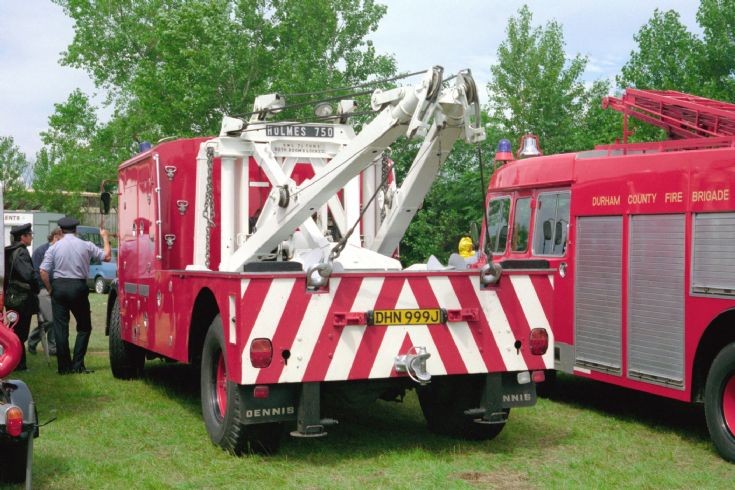
Darlington's Dennis Maxim back
As I mentioned earlier, here is a better view of the business end of Darlington's Dennis Maxim whilst it was still in service c1988.
The Holmes 600 and 700 series equipment seemed to be popular in the North East during the 70's-90's period, particularly with Bus Operators. Cleveland Transit, Hartlepool Transport and Tyne and Wear Busways all used them on their Master Breakdown Tenders. Was the Maxim supplied to the brigade from the Company Wreckers International by any chance? This Company supplied most of the Bus Company Recovery Tenders in this period.
Once again Rob, I must disagree with your comments. This was not bought as a crane ! But as a Road Accident Vehicle following on from the Land Rover 109" RaV with broom wade compressor more linked to Darlington's involvement of the North Riding Accident After Care Scheme (later BASIC's) and great development in RTC techniques lost for another 25 yrs after reorganisation ! And in its later life went back on the run to Bishop Auckland during a re vamp of the Brigade special's becoming the Heavy Rescue Vehicle following the introduction of the Rapier Rescue WrL and retirement of ET's been replaced by a 6X4 Volvo FL10 Boniface HrV, great for motorway work but not the flexibility of the Dennis on minor roads.
Added by Brett Clayton on 16 November 2017.
Added by Brett Clayton on 16 November 2017.
you can see the Maxim Dial Holmes 750 in action in non motorway setting at picture ##17617 here.
Added by Peter Williams on 20 November 2017.
Added by Peter Williams on 20 November 2017.
Brett:
Thanks for all these additional details. I really don't get why you think there is anything to disagree about here...
They don't change the fact that I was told by a DFB officer that the CFO's acquisition of this type of unit to replace the LR was motivated by the fire service cranes he saw in Germany. Nor does anything change the main point I was trying to make - that UK fire services for some reason just are not interested in the 40 to 60 tonne cranes that are found in most central and eastern European fire services.
Added by Rob Johnson on 21 November 2017.
Rob your comments are interesting. Is it not irrational though for a fire brigade to have cranes of 40-60 tons given that there are loads of private contractors around who have exactly the same thing, and any one brigade is going to use such a large crane no more than once or twice a year. It makes no sense to me. See for example the Essex FRS Scammell S24 recovery unit that was rarely used and disposed of after a few years. picture 22196. In fact the sheer amount of specialised equipment in small German towns is also a mystery to me where, in the equivalent size place in Britain, there will be one WrL. Isn't it financial wasteful?
Added by Petros on 21 November 2017.
Added by Petros on 21 November 2017.
Comment removed at request of Commentor
Thanks Petros and Andy.
I agree it is difficult to understand the differences when it comes to heavy cranes in fire service fleets in various countries.
As I mentioned, they are by no means universal, and they are far more prevalent in Germany than elsewhere.
I think there may perhaps be four reasons for this, but these are just my ideas!
1- After WWII, Germany had a level of structural damage in towns and cities which was unparalleled (except perhaps for Japan). Building collapses of partly repaired structures were very common in the 1950s and 1960s, so heavy cranes were actually needed quite often for lifesaving operations. The widespread use of Autobahn highways with related multiple heavy truck accidents added to the usefulness of these, as did the frequent streetcar (tram) accidents, often due to poorly repaired rails, previously damaged by bombing.
2- In Germany, 97% of the firefighting force are volunteers. Not only does this mean that there are twenty times as many firefighters per head of population as in the UK - (and a fire station for every 3, 500 people) but outside large cites over 80, 000 inhabitants there are no paid full-time firefighters.
As payroll accounts for around 70% to 80% of the total costs of a paid fire service, the absence of payroll costs frees up huge amounts of the budget for equipment.
3- Lets not forget both Liebherr and Faun are German companies and they both have a sales force! Just as Metz and Magirus succeeded in selling huge numbers of aerial trucks in Germany - often to fire companies in towns with less than 5, 000 population - so the crane builders probably succeeded in selling quite a few more units than may have been strictly justified.
4 - Germany was literally on the front line for forty five years during the Cold War, and they knew what HE and incendiary bombs could do on a vast scale, not to mention nuclear. So their preoccupation with large numbers of exceedingly well-equipped volunteer fire companies was understandable - and the hangover continues to this day.
Andy - German volunteer fire companies have a long tradition of taking the job very seriously, and spend a lot of time on training and exercises - which are sometimes enormous, involving up to fifty companies working together.
Some of the individual companies are given regionally-organized dedicated special service responsibilities in each State. These include specialized roles such a collapse rescue, water rescue, high-angle rescue, hazmat operations, scuba teams, etc.
In a country of rules and regulations for everything, which are usually followed to the letter, no company would let any member near a 60 ton Liebherr who was not fully qualified!
Having said all of that, many central European and some French fire services also have the big cranes, but in much smaller numbers.
Not the answer, but maybe a collection of contributory factors which go part way to explain the differences.
Added by Rob Johnson on 23 November 2017.
Recovery vehicle, not a crane. Sole use for towing broken down fire appliances to the workshops. West Mids Fire Service had one that their own workshops converted from a pump I believe.
Added by Yelp Bullhorn on 27 November 2017.
Added by Yelp Bullhorn on 27 November 2017.
Comment removed at request of Commentor
The West Midlands ERF was initially based at Brierley Hill, see #38551. It was registered PFD 777F and acquired by the County Borough of Dudley in 1968.
Added by on 30 November 2017.
Added by on 30 November 2017.
Dennis


It seems British, North American and Southern European fire services are mostly not interested in having cranes on their fleets, while they are a "must have" in Germany and nearby countries.
When I lived in Darlington, I was told the acquisition of this unit was largely motivated by the CFO's visit to the twin town of Muelheim in Germany, where even small volunteer fire companies very often are equipped with 40 tonne cranes.
Although it was on the fleet a long time, it was not replaced after it was eventually retired.
Added by Rob Johnson on 07 November 2017.