
Upload a Picture
About this Site | Links | Random Pic | Advanced Search
Home | Latest Additions | Contributors
| Visitors
Fire Engine Photos
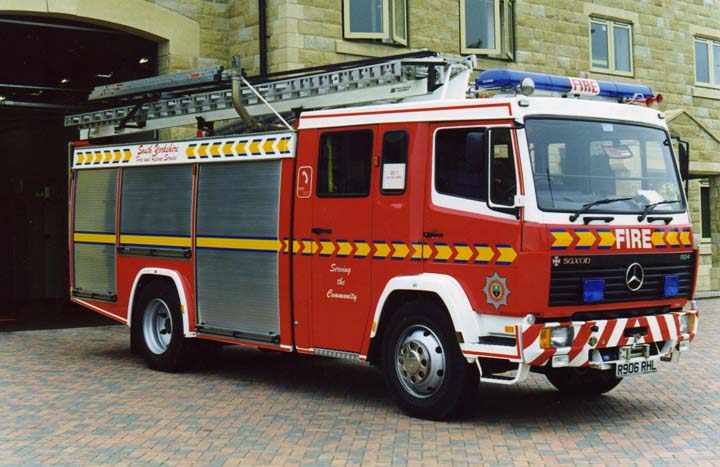
This has to be one of the best liveries of any brigade, have seen a South yorks Sania in it, but it suits those mercs better i think.
Put's North yorks livery to shame don't you think paul?
Added by John Johnstone on 16 July 2008.
Put's North yorks livery to shame don't you think paul?
Added by John Johnstone on 16 July 2008.
You're having a laugh aren't you ? Arrows and italics are hardly necessary
Added by Mark mcMullen on 16 July 2008.
Added by Mark mcMullen on 16 July 2008.
I'll agree with the last comment.Its certainly something different,
but I think the brigade went well over the top with this livery.
Added by Pete Matten on 16 July 2008.
but I think the brigade went well over the top with this livery.
Added by Pete Matten on 16 July 2008.
Far from it! look at North yorks drab livery applied to the equally drab volvo fl6!
Added by John Johnstone on 16 July 2008.
Added by John Johnstone on 16 July 2008.
this actual appliance is now 3rd away in drogheda co louth rep of ireland. check out www.blues-twos.com/Louth-UPDATED-05-04-2008
Added by Peter Jones on 17 July 2008.
Added by Peter Jones on 17 July 2008.
Does anyone know what the long grey tubular item on the roof is? It looks like a gigantic oversized exhaust silencer, but can it be?
I am guessing the elaborate paint and striping decor is intended to distract the eye from this rather inelegant attachment, whatever it is!
Added by Rob Johnson on 15 November 2013.
I am guessing the elaborate paint and striping decor is intended to distract the eye from this rather inelegant attachment, whatever it is!
Added by Rob Johnson on 15 November 2013.
The long grey tube is the exhaust outlet and not the silencer....the South Yorkshire livery style probably stems from the appointment some years ago of Jeff Ord as CFO...he was previously CFO of Northumberland who had an equally attractive livery....I guess the comment about the livery being designed to hide the exhaust was 'tongue in cheek'
Added by Rick Loudon on 16 November 2013.
Added by Rick Loudon on 16 November 2013.
All,
I'd say it's a good design feature as it keeps the exhaust fumes well away from the back and sides of the vehicle when the engine is kept running.
Regards,
Steve
Added by Steve Prosser on 16 November 2013.
I'd say it's a good design feature as it keeps the exhaust fumes well away from the back and sides of the vehicle when the engine is kept running.
Regards,
Steve
Added by Steve Prosser on 16 November 2013.
Of course! But it does seem a rather unusual location for the outlet.
Added by Rob Johnson on 16 November 2013.
Added by Rob Johnson on 16 November 2013.
Rob
You live in North America ...I believe ? have you not seen a Mack or a Pieterbilt or similar with 'stack exhausts' ?
Added by Rick Loudon on 17 November 2013.
You live in North America ...I believe ? have you not seen a Mack or a Pieterbilt or similar with 'stack exhausts' ?
Added by Rick Loudon on 17 November 2013.
A number of stations have exhaust extraction units fitted to their appliance bays these days. I suspect the exhaust location is purely for that reason.
Added by Matt Ireland on 18 November 2013.
Added by Matt Ireland on 18 November 2013.
All,
It's great to see so much discussion about a fire appliance exhaust outlet.
Regarding the suggestion by Matt, unless the extraction system fitted in the bay has a snatch release then someone will have to use a ladder disconnect the pipework before the vehicle left the station.
Is that really practical ?.
Regards,
Steve
Added by Steve Prosser on 18 November 2013.
Steve, they do disconnect as you drive off, unlike the electrical charging leads that plugged into auxiliary sockets on the machines! Come on how many people have turned out with a cable reel in tow after forgetting to disconnect!? I must just add, I haven't done it but have seen it done on more than one occasion.
Added by Matt Ireland on 18 November 2013.
Added by Matt Ireland on 18 November 2013.
Matt,
Good to hear from you.
One of my jobs was at an MOD depot that inspected and stored fire appliances for the Army and RAF.
They were all fitted with self release electrical sockets on the back end.
Also all the RAF appliances were fitted with sump heaters which I think was the main reason for the rear electrical socket.
Can't be certain but I recall that they may also have been fitted with a mains powered battery charger circuit.
Best wishes,
Steve
Added by Steve Prosser on 18 November 2013.
Thanks to all!
I think we may perhaps have exhausted the subject now.
Interesting what can get started by a question, which was actually stimulated mainly by failing eyesight due to the advancing years.
As for the livery, which I was able to see clearly, I guess its okay, as long as the crew wear giant oversize fire boots and large red noses on their BA sets.
Added by Rob Johnson on 18 November 2013.
Steve, you are correct about RAF appliances and the trickle charger. Sump heater and battery charger all in one. Also some machines had a water tank and pump element installed as well for extreme environments.
As for releasing when turning out, well it was best to manually disconnect, quite a few rear ends were left behind over the years!
Added by John Stott on 18 November 2013.
As for releasing when turning out, well it was best to manually disconnect, quite a few rear ends were left behind over the years!
Added by John Stott on 18 November 2013.
Back in the early 60's St.Helens County Borough fire service had rear charging sockets.They were floor mounted in the appliance room and a box at rear of the appliance. In the control room switches on a panel could be set and charged the batteries turned on the sump heater, and could start the appliance when the bells went down.They had a strong wire fitted along side the power cable so as not to snap it on leaving.They also had a seconds clock in control that started when the bells went down and stopped as the first appliance pulled the cord out so they could tell how long a turnout took. I have a picture of the set up but unable to post as it is not mine.
Added by Dave Price on 19 November 2013.
Added by Dave Price on 19 November 2013.
I am sure the rapier was the first appliance with a roof exhaust outlet , it was way ahead of its time and to complicated for some brigades at the time , pity as it was just about the perfect pump ladder , it just need to be slightly bigger.
Added by Alan Ramsay on 20 November 2013.
Added by Alan Ramsay on 20 November 2013.
The exhaust system was modified to work with the extraction system fitted at Aston Park, it was like a large kitchen extraction unit. The livery is indeed down to Mr Ord !!!
Added by Mike Williams on 22 November 2013.
Added by Mike Williams on 22 November 2013.
Mercedes-Benz


Added by John Mc Ateer on 12 July 2008.