
Upload a Picture
About this Site | Links | Random Pic | Advanced Search
Home | Latest Additions | Contributors
| Visitors
Fire Engine Photos
Dare I say it ' global warming' or in old language hotter summer weather meaning more grass / woodland fires ?
Very useful on motorway fires too.
Added by CraigW on 11 September 2026.
Very useful on motorway fires too.
Added by CraigW on 11 September 2026.
Thanks Craig. I think you are right. But I also think big tankers which are pretty much confined to paved roads are only part of the answer. In most countries which have seriously addressed vegetation fires the solution is to add large numbers of light 4x4 brush trucks as well. The thinking is to get comparatively small flows of water or CAF as close to the flames as possible, even in inaccessible places, backed up by big tankers to replenish them as needed. Reliance on tankers means being often limited to wetting down vegetation near roads in an attempt to stop fire spread. This seems very often to give the fire time to increase in intensity as it spreads and possibly growing beyond control. In Australia the small unit is a Toyota LC with a 650 litre tank. In France an Acmat with 1000, and in other European countries a variety of 4X4s with usually around 1000 litres too. Here in the US the most common unit is a Ford F350 or equivalent, typically with a tank around 960 liters, with less numerous heavier units commonly carrying 1800 - similar to the French CCF2000.
In almost every country I know about these light brush trucks are most often deployed in swarms of three to a dozen, with one or more 10,000 to 14,000 litres tankers as backups. Eventually I am thinking UK fire brigades will find it necessary to follow suit, even though it seems no appropriate light 4x4 chassis is available from any UK based supplier.
Added by Rob Johnson on 12 September 2026.
In almost every country I know about these light brush trucks are most often deployed in swarms of three to a dozen, with one or more 10,000 to 14,000 litres tankers as backups. Eventually I am thinking UK fire brigades will find it necessary to follow suit, even though it seems no appropriate light 4x4 chassis is available from any UK based supplier.
Added by Rob Johnson on 12 September 2026.
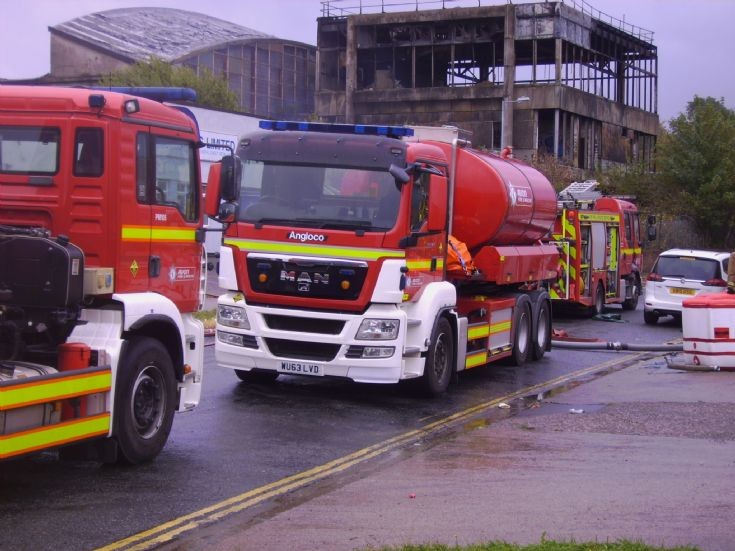
Angloco


Can anyone explain why water carriers are now becoming such a regular feature in fire service fleets?
Added by Rob Johnson on 05 September 2026.