
Upload a Picture
About this Site | Links | Random Pic | Advanced Search
Home | Latest Additions | Contributors
| Visitors
Fire Engine Photos
This was assigned to one of the three volunteer fire stations in Leutenbach, a town of 11,000 with an active volunteer force of 120. These days the three stations have a total of three LF 10 pumpers, including one 4X4, a rescue truck, a tanker, a logistics truck, two squad trucks, a command van and a staff car. This year, up to the end of September, they responded to 24 incidents including five fires.
Added by Rob Johnson on 05 October 2025.
Added by Rob Johnson on 05 October 2025.
I should add that - with a tiny handful of exceptions - German volunteers do not respond to medical calls, except sometimes to assist EMS personneli.
Added by Rob Johnson on 08 October 2025.
Added by Rob Johnson on 08 October 2025.
I should add that - with a tiny handful of exceptions - German volunteers do not respond to medical calls, except sometimes to assist EMS personneli.
Added by Rob Johnson on 15 October 2025.
Added by Rob Johnson on 15 October 2025.
The LF10 replaced the old LF8 specification. The newer unit has a slightly more powerful pump ( usually rear mounted ), continues with a nine seat crew cab and adds a water tank. Although the DIN standard calls for a 600 litre tank, many fire services have ordered them with a bigger tank as 600 liters is considered too small to be really useful. Interesting that other fire services in Paris, Madrid, Berlin and several other places have also often upgraded pumpers with smaller water tanks in recent years to 900 to 1200 litres because the older units just could not supply an attack line for the time needed to set into a hydrant. BSPP specifically recommends 360 LPM, while Berlin sets the flow at 400 LPM, and both are looking at three minutes of autonomy before water is flowing from a hydrant. The corresponding US flow rate fir an initial interior attack line is usually 125 GPM, with four minutes supply from a 500 US gallon tank as a minimum. The old LF8 had no water tank, and - although often accompanied by a water tender or tanker - this did impact its ability to mount a rapid attack, despite having a large crew working to get water on the fire.
Added by Rob Johnson on 24 October 2025.
Added by Rob Johnson on 24 October 2025.
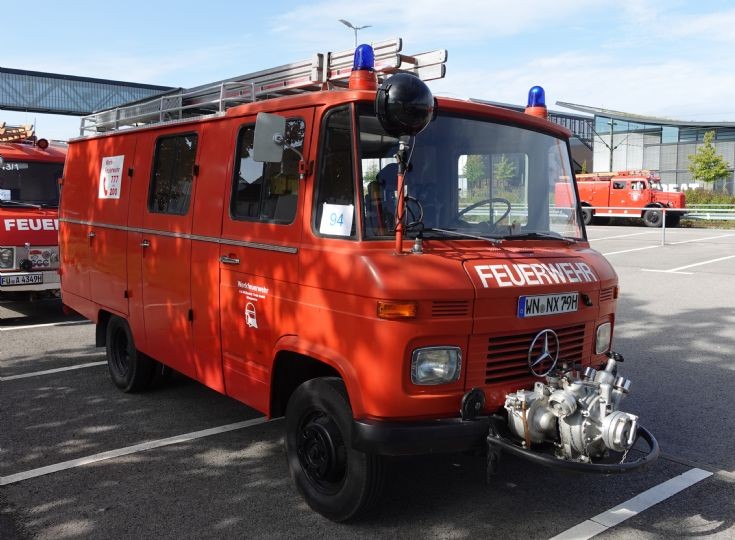
Mercedes-Benz


Added by Rob Johnson on 05 October 2025.