
Upload a Picture
About this Site | Links | Random Pic | Advanced Search
Home | Latest Additions | Contributors
| Visitors
Fire Engine Photos
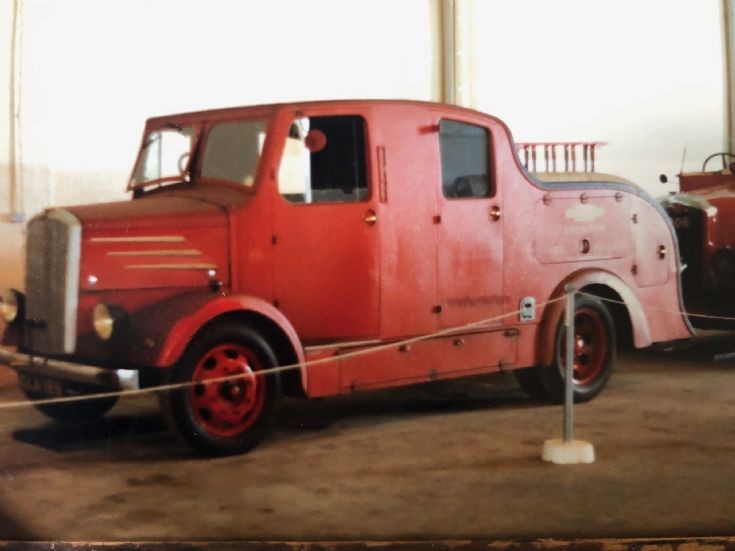
Hi Rob, yes a short hose reel on top of the body and a huge 35 gallon hose reel tank located in front of the hose locker.
The original drawing of the body survives at Surrey history centre.
Added by Peter McCombie on 06 May 2023.
The original drawing of the body survives at Surrey history centre.
Added by Peter McCombie on 06 May 2023.
Thanks Peter. I guess that before hydrocarbons were used in virtually everything a 35 gallon water tank was probably actually quite useful at times.
Added by Rob Johnson on 07 May 2023.
Added by Rob Johnson on 07 May 2023.
Just about enough to keep the reel going while connecting to a hydrant if quick. Worse with the escape as you’d have to unship that first, hence the midship pumps.
Added by Peter McCombie on 07 May 2023.
Added by Peter McCombie on 07 May 2023.
True, I believe a first aid hose reel from that era could flow around 20 gpm, so the tank would not last long. Mid mounted main pumps go back all the way to the very first Merryweather PE from 1904! But they were not generally adopted in the UK until the 1930s, and some pump escapes and water tender escapes in the 50s and 60s still had rear mounts. The rear mounted pump with side controls and plumbing first appeared in the late sixties on Glasgow’s four Magirus PEs and the prototype ERF PE for Newcastle, and was quickly adopted by other builders including notably Dennis.
Here in the US, pumps were invariably either front or mid mounted, because the hoses were accommodated flaked in preconnected lengths on a hose bed, which was accessed from the rear. Until crew cabs became common crew members rode the full width rear step, so they could easily access the hoses.
In the sixties, the “crosslay” was invented, with two or more additional hoses preconnected to the mid mounted pump and flaked across the body above the pump. These could be brought into use very quickly from either side of the pumper, and as a result many departments dropped having hose reels fitted to their pumpers.
Today fire departments specify a crosslay load according to their own preferences, but it is common to see a mixture of 1 inch, 1.5 inch, 1.75 inch and sometimes 2.5 inch hoses, usually in 50 foot lengths with a total preconnected lay of 150, 200 or 250 feet.
In Australia, a similar setup was very common, with a mid mounted pump and rear hose lockers, although their pumps had crew cabs. Even Australian rear mount pumpers still retain this feature, with rear access hose lockers stuffed with flaked hoses flanking the pump bay, but they have stuck with high pressure reels.
Added by Rob Johnson on 08 May 2023.
Here in the US, pumps were invariably either front or mid mounted, because the hoses were accommodated flaked in preconnected lengths on a hose bed, which was accessed from the rear. Until crew cabs became common crew members rode the full width rear step, so they could easily access the hoses.
In the sixties, the “crosslay” was invented, with two or more additional hoses preconnected to the mid mounted pump and flaked across the body above the pump. These could be brought into use very quickly from either side of the pumper, and as a result many departments dropped having hose reels fitted to their pumpers.
Today fire departments specify a crosslay load according to their own preferences, but it is common to see a mixture of 1 inch, 1.5 inch, 1.75 inch and sometimes 2.5 inch hoses, usually in 50 foot lengths with a total preconnected lay of 150, 200 or 250 feet.
In Australia, a similar setup was very common, with a mid mounted pump and rear hose lockers, although their pumps had crew cabs. Even Australian rear mount pumpers still retain this feature, with rear access hose lockers stuffed with flaked hoses flanking the pump bay, but they have stuck with high pressure reels.
Added by Rob Johnson on 08 May 2023.
Dennis


Added by Peter McCombie on 04 May 2023.