
Upload a Picture
About this Site | Links | Random Pic | Advanced Search
Home | Latest Additions | Contributors
| Visitors
Fire Engine Photos
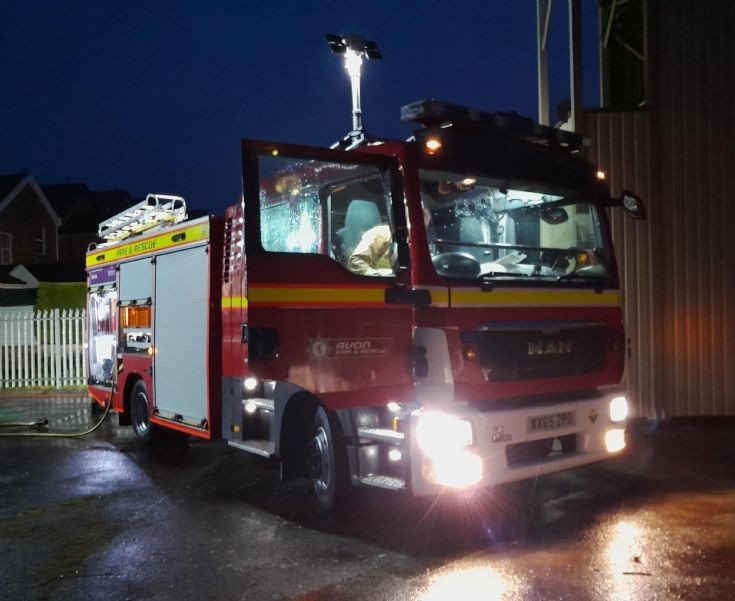
MAN TGM12.280/JDC Yatton WX65 ZPD
Yatton received MAN TGM12.280/JDC at the end of March, WX65 ZPD, was previously at Southmead until earlier this year, when replaced by a Volvo FL and is seen on it's first drill night at Yatton on Wednesday April 5th, a rather dark, wet and windy evening hampering any decent photography of the new arrival. Main driver Chris can just been seen checking the location of controls in the cab as it is put through its paces.
Like many newer appliances WX65 ZPD is fitted with individual seats in the crew cab, rather than a bench seat, which rather disappointed the retained crew as they will no longer be able to turn out in 19P1 with a crew of more than 5. The previous machine at Yatton, the slightly larger 15 tonne MAN WX58 PDK has moved to the reserve fleet
Yatton received MAN TGM12.280/JDC at the end of March, WX65 ZPD, was previously at Southmead until earlier this year, when replaced by a Volvo FL and is seen on it's first drill night at Yatton on Wednesday April 5th, a rather dark, wet and windy evening hampering any decent photography of the new arrival. Main driver Chris can just been seen checking the location of controls in the cab as it is put through its paces.
Like many newer appliances WX65 ZPD is fitted with individual seats in the crew cab, rather than a bench seat, which rather disappointed the retained crew as they will no longer be able to turn out in 19P1 with a crew of more than 5. The previous machine at Yatton, the slightly larger 15 tonne MAN WX58 PDK has moved to the reserve fleet
JDC


In the UK, four person crews seem to be becoming increasingly common among paid fire brigades, presumably as a part of the cost saving efforts being made by fire brigades in general. This is of course the practical minimum for “two in, two out”, but many brigades do not require the driver to don his firefighting gear until after arrival on scene, which may be a bad idea when the crew is only four.
Some US towns operate three person pumpers, but this limited staffing is usually associated with a very large number of units being in service, so a typical structure fire response still includes the NFPA recommended attendance of sixteenth firefighters. Four pumps, one ladder and one chief are called out, and as the fire stations are close together response times are still satisfactory.
In this context, I should mention that while cities with populations around 100, 000 in the UK tend to have one fire station, similar sized US cities typically have five.
In these days of automatic and/ or remote pump control, the role of the DPO does not necessarily immobilize him or her at the pump panel, so in a way he or she becomes a more useful crew member for other duties. Sp, if this new MAN is so equipped, it may be that the reduction in seating capacity is not a major problem.
One reason individual crew seats have become more common is occupant safety, with BA holders and fully effective integrated inertia reel seatbelts much easier to install when installed with them. Even German nine seat cabs now have individual rear seats, usually four with integrated BA backrests and three without - but all with dedicated seat belts.
I have been interested to see that in Japan - where most full size pumpers have a five man crew - the DPO is not even issued with turnout gear. His job does not involve any actual firefighting, but as and when Japanese fire services adopt automatic pump systems, this may yet change…
Added by Rob Johnson on 24 April 2023.