
Upload a Picture
About this Site | Links | Random Pic | Advanced Search
Home | Latest Additions | Contributors
| Visitors
Fire Engine Photos
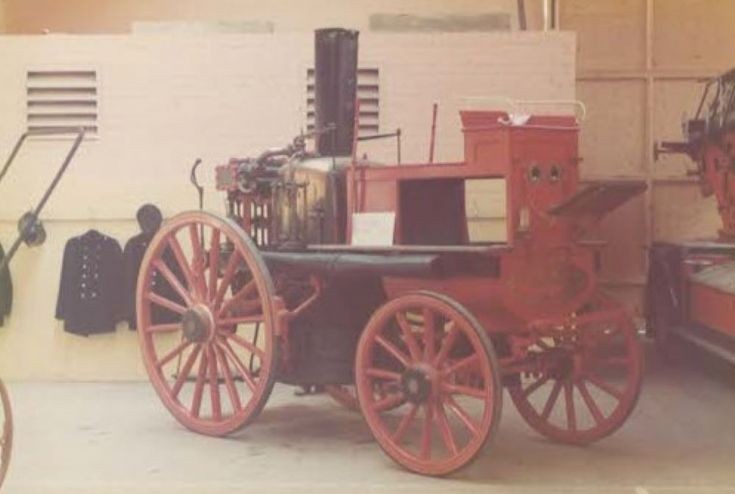
Details from the 1977 Yorkshire Fire Museum program confirm this is a Shand Mason steamer from 1876. Its an early short stroke high speed design - rated at 30hp giving 350 gpm output, and originates from the Halifax area.
Added by on 06 July 2022.
Added by on 06 July 2022.
Good to know! The high speed short stroke design was a big technical advance, and made the whole pumper more compact and lighter. They were really not all that common until the late 1880s. Fire brigades generally stopped buying steamers around WWI, but many were still used well into the 1920s and even 1930s. This was especially true of small town and village brigades, because of the cost of buying a new petrol powered pump. One solution was to tow the old steamer behind a lorry. In the USA, a lot were converted by having a front wheel drive petrol engine installed on a new subframe, and in Germany Loehner-Porsche actually built front wheel drive petrol electric hybrids carrying steam pumps. This was one of young Ferry Porsche's first automotive engineering ventures.
There are photos of some of these American steamer conversion on this site. Manufacturers included Christie and American La France.
Added by Rob Johnson on 07 July 2022.
There are photos of some of these American steamer conversion on this site. Manufacturers included Christie and American La France.
Added by Rob Johnson on 07 July 2022.
I forgot to mention that there were also a very small number of self-propelled steam powered pumpers too. In 1913 London had two - but that was only two out of a total of 63 pumps. They were acquired before petrol powered pumpers became commonly available, after around 1904. By 1913 there were already 28 motor pumps on the fleet, and no more horse drawn steamers were being considered. All of the petrol motor pumps had PTO driven reciprocating or centrifugal pumps, but some of the escape ladder carriers - which did not have pumps - were actually battery electric. These had a small water tank and first aid hose reel, but relied on a compressed air cylinder to pressurize the system.
Added by Rob Johnson on 07 July 2022.
Added by Rob Johnson on 07 July 2022.
Latest Pics


The open locker under the seat is the hose box, which also afforded limited seating for other crew members, although it was not uncommon for them to stand while responding to a call!
Added by Rob Johnson on 30 June 2022.