
Upload a Picture
About this Site | Links | Random Pic | Advanced Search
Home | Latest Additions | Contributors
| Visitors
Fire Engine Photos
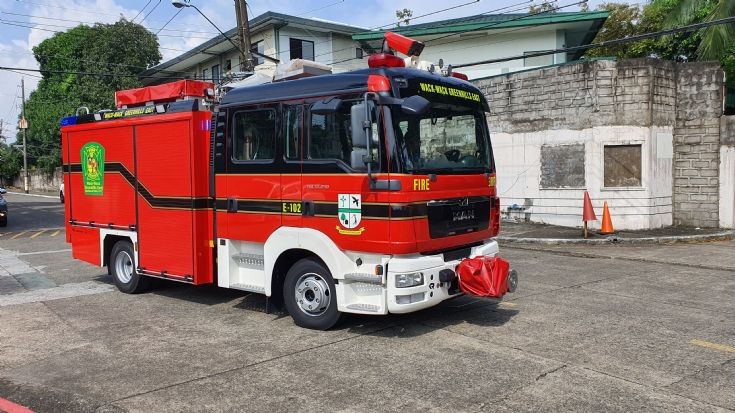
Yelp-This is the Rosenbauer CL for "Compact Line", a series designed to pack the maximum firefighting punch in a relatively small appliance. This example is a ten ton GVW MAN. With a 3500 LPM pump, CAFS, 2400 litre tank, roof mounted remote control monitor and a winch, it certainly looks well equipped as well as having its elegant Chicago style livery - which I approve of too!
Added by Rob Johnson on 22 April 2021.
Added by Rob Johnson on 22 April 2021.
Why so compact, Does Wack Wack Green have narrow streets? Licence regulations?
Added by on 24 April 2021.
Added by on 24 April 2021.
"Looks great". Not very functional in a country that does NOT have fire hydrants or any semblance of a stable water supply. They would have been better off carrying more water.
Added by on 25 April 2021.
Added by on 25 April 2021.
From what I have seen in various videos, Phillipine fire services use a combination of fairly compact pumpers - mostly of Japanese origin - with I estimate about 1500 to 2500 litre tanks, along with tandem axle tankers with around 8, 000 to 12, 000 liters.
At large fires the SOP seems to be to relay tank water to the pumpers at the fireground by later arriving units, rather than operating tanker shuttles. In addition, small pickup trucks with portable pumps are used to access open water sources such as drainage ditches.
Added by Rob Johnson on 25 April 2021.
At large fires the SOP seems to be to relay tank water to the pumpers at the fireground by later arriving units, rather than operating tanker shuttles. In addition, small pickup trucks with portable pumps are used to access open water sources such as drainage ditches.
Added by Rob Johnson on 25 April 2021.
I'm part of the wack-wack greenhills east fire brigade's committee where this truck is in service. Prior to the selection of the CL, the Brigade operated two Korean bought apparatus bought in 2000, 1 "midi" type fire engine (3000 l/min pump and 2000 l water) and 1 "mini" type engine (1000 l/min and 1800 l water).
Council approved the modernization plan to replace both apparatus. This CL will replace the "mini" while a larger 6500l apparatus will replace the "midi". Also Wack-Wack Greenhills East, being a business district and with gated communities has decent hydrant coverage with good pressure.
Added by Mikael Abaya on 26 April 2021.
Council approved the modernization plan to replace both apparatus. This CL will replace the "mini" while a larger 6500l apparatus will replace the "midi". Also Wack-Wack Greenhills East, being a business district and with gated communities has decent hydrant coverage with good pressure.
Added by Mikael Abaya on 26 April 2021.
A broad collection of 121 very mixed Philippines fire service trucks can be viewed on this site, putting into context where this unit may handily fit in.
Added by Rob Johnson on 26 April 2021.
Added by Rob Johnson on 26 April 2021.
Thanks for reply Mikael but why a 'Compact '.
Added by CraigW on 27 April 2021.
Added by CraigW on 27 April 2021.
Hi Craig, two primary reasons, firstly the physical constraints of the brigade's fire station at the time this vehicle ordered back in 2017. The fire station was integrated into a two-storey community center which only had a total space of 600 sq meters. The physical size of the of the parking space was severely limited which precluded larger trucks from being considered. Secondly, the areas where this truck would respond as a mutual aid unit are primarily narrow side streets as fires in the slums are the most common mutual aid responses.
The Compact Line would provide the length and height space saving to fit in the fire station as well as providing a more powerful pump system, a CAFS system we could utilize in large commercial mall, highrise apartment fires, and to reduce excessive water damage to room and contents fires within the gated communities. All this while still able to carry our basic response tools including vehicle extrication and a generator set.
Added by Mikael Abaya on 28 April 2021.
The Compact Line would provide the length and height space saving to fit in the fire station as well as providing a more powerful pump system, a CAFS system we could utilize in large commercial mall, highrise apartment fires, and to reduce excessive water damage to room and contents fires within the gated communities. All this while still able to carry our basic response tools including vehicle extrication and a generator set.
Added by Mikael Abaya on 28 April 2021.
Mikael: There's a saying that "no two fires are the same" and it is even more true that no two fire station response areas are the same either. All the more reason to let the firefighters who know their response areas well specify the trucks they are going to us. It is a far better idea than buying standardized units in bulk, which happens in many places. When I lived on Long Island, New York, all of the 190 fire companies' volunteers decided on the specifications of all their apparatus, and it proved to be the ideal solution.
Presumably the same is true in the Philippines, with so many volunteer fire corps?
Added by on 28 April 2021.
Presumably the same is true in the Philippines, with so many volunteer fire corps?
Added by on 28 April 2021.
I see, thanks for reply. Forgive me if I sound condescending but your command of written English is far better than many English people!
Added by CraigW on 29 April 2021.
Added by CraigW on 29 April 2021.
One important additional benefit of CAFS is that it reduces fire knockdown time by more than half in most situations.
This means that only around half as much water - or even less - is needed compared to using water alone. This is a major benefit if the fire service has problems accessing hydrants or static water supplies.
Added by Rob Johnson on 21 May 2021.
This means that only around half as much water - or even less - is needed compared to using water alone. This is a major benefit if the fire service has problems accessing hydrants or static water supplies.
Added by Rob Johnson on 21 May 2021.
Rosenbauer


Added by Yelp Bullhorn on 22 April 2021.