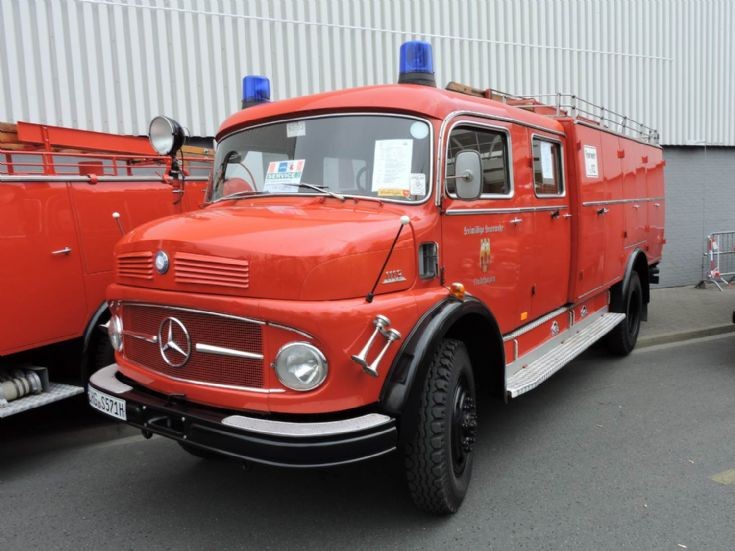
This looks a lot like an LF16, which was the standard West German pump appliance for decades between the 1950s and 1990s. Produced to a national specification, they were almost always built on either Mercedes or Magirus 11 ton chassis, although Berlin and a few other brigades preferred MAN. This Mercedes series, the "Kurzhauber" (short bonnet) was introduced in 1959 and continued in production for half a century.
The LF 16 had a rear mounted 1600 LPM pump, an 800 liter tank, a nine seat cab and carried a large two man hose cart for 75mm hose. Ground ladders varied, but were usually wood and included one extension and four scaling ladders. Despite having a water tank, there was no first aid hose reel, and the tank was used to supply a 52mm hose until a hydrant could be hooked up. BA and foam making equipment were carried in side lockers, and all chassis were available as 2X4 or 4X4.
The same chassis were used for the LFTS with a 800 LPM portable pump, which had the main pump relocated to a front mount, to make space for the PP in a rear compartment.
It also served the water tender, TLF16. This had a shorter six man cab, the same pump, a 2400 liter tank and a 23mm hose reel system, and did not carry a hose cart.
Together, one LF16, one TLF16, a 25 or 30 meter TTL (DL) and a command van formed a "Loeschzug" or fire platoon of 19 firefighters. This was the standard structure fire alarm response throughout the country in most towns and cities, although huge numbers of LF8 appliances were deployed mainly in small villages.
The 11 ton chassis, 13 ton and 16 ton versions were used for other applications too, as well as a few tandem axle 22 ton units. As a result, it was very common for even quite large brigades to run a standardized one make of appliance across virtually all applications.
Metz, Magirus, Schlingmann, Lentner were among the major bodybuilders, and of course Magirus were the only company to build appliances which were completely manufactured in house, including engine, chassis, cab, pump, bodywork and ladders.



The LF 16 had a rear mounted 1600 LPM pump, an 800 liter tank, a nine seat cab and carried a large two man hose cart for 75mm hose. Ground ladders varied, but were usually wood and included one extension and four scaling ladders. Despite having a water tank, there was no first aid hose reel, and the tank was used to supply a 52mm hose until a hydrant could be hooked up. BA and foam making equipment were carried in side lockers, and all chassis were available as 2X4 or 4X4.
The same chassis were used for the LFTS with a 800 LPM portable pump, which had the main pump relocated to a front mount, to make space for the PP in a rear compartment.
It also served the water tender, TLF16. This had a shorter six man cab, the same pump, a 2400 liter tank and a 23mm hose reel system, and did not carry a hose cart.
Together, one LF16, one TLF16, a 25 or 30 meter TTL (DL) and a command van formed a "Loeschzug" or fire platoon of 19 firefighters. This was the standard structure fire alarm response throughout the country in most towns and cities, although huge numbers of LF8 appliances were deployed mainly in small villages.
The 11 ton chassis, 13 ton and 16 ton versions were used for other applications too, as well as a few tandem axle 22 ton units. As a result, it was very common for even quite large brigades to run a standardized one make of appliance across virtually all applications.
Metz, Magirus, Schlingmann, Lentner were among the major bodybuilders, and of course Magirus were the only company to build appliances which were completely manufactured in house, including engine, chassis, cab, pump, bodywork and ladders.
Added by Rob Johnson on 21 February 2021.