
Upload a Picture
About this Site | Links | Random Pic | Advanced Search
Home | Latest Additions | Contributors
| Visitors
Fire Engine Photos
Comment removed at request of Commentor
Andy: These units - in various configurations -- have been in use in Paris for at least 30 years and are not a recent effort to cut costs. In fact, as a brigade of the French army engineering corps, the BSPP is not subject to any municipal budgetary constraints. To illustrate the point, the metro area protected by the BSPP has far more firefighting resources in terms of personnel on watch and firefighting vehicles and equipment than London.
BSPP does also have over 140 ambulances - incidentally all crewed by three, not two, firefighter paramedics and/or EMTs, and the SAMU emergency medical service organization also operates a large fleet of ambulances and paramedic intervention vehicles in Paris.
As I think you may already know, a pump rated at 1000 LPM at 15AT at 10M lift can deliver considerably higher volumes at lower pressure, especially if supplied by a nearby hydrant through low friction 100 mm hose, which BSPP use. All of the newer PS appliances have CAFS, which is usually the first "go to" solution at serious fires, and which is normally applied at around 7-8 AT pressure with a nozzle rated at 400 LPM water and 1200 LPM foam. The PS can easily supply two such lines.
As for the tank capacity, BSPP themselves acknowledge this is a limitation, but have accepted it to keep intact the compact dimensions of the vehicle. The SOP evolved by PS crews is to hook up to a hydrant immediately, except at obvious nuisance fires which can be handled by the hose reel and tank contacts - using the variable output 50-100-150 LPM reel nozzle.
Paris PS units respond to all fires - and some medical emergencies when dispatch believe they can reach an incident faster than a BSPP or SAMU ambulance. They turn out 3.8 times a day on average, including both fire and EMS calls. At structure fires they are accompanied by a FPT pumper with a 2, 000 LPM pump , 2, 900 liter tank, full suite of ground ladders and eight crew as well as a TTL or ALP with another two and a watch commander in a light utility vehicle. In this way, a well equipped medical resource is automatically on site as well as adequate personnel and firefighting equipment for initial firefighting and rescue duties. This SOP is standard practice in most other French, German and many other European countries as well as many fire departments in the US, although the combination fire pump and ambulance remains a rarity.
A few years ago I personally witnessed a PS pumping over 1500 LPM through two lines at an interior fire in Paris, and - as I recall - the digital pump panel display indicated it was operating at around 9AT with an inlet pressure from the hydrant at around 2AT. French fire services employ variable output branches, designed to operate at either 7AT or 10AT output pressures. They usually use 45mm hose, with a branch rated at 150/250/350/450 LPM, but with 65mm hose a larger branch is deployed, rated at 350/550/750/950 LPM. The smaller branch is also used with both Class A and Class B CAF.
Added by Rob Johnson on 10 January 2021.
Comment removed at request of Commentor
Interesting that fire services in the US, Canada and many South American countries have long since dropped high pressure equipment from their pumps. Of course they have very often been replaced by CAFS using 45mm or 52mm hose in the Americas, and in recent years this has also been happening in many European countries, not limited to France, the Netherlands and Germany.
As for procedures, these may vary from country to country, or even department to department, but one very effective approach seems to be to apply a CAFS jet through the door lock aperture before opening a door. According to various sources, one room knockdown is accomplished in around 30 to 60 seconds using as little as 400 liters of water furnishing 1200 liters of finished foam.
Bear in mind these PS units do not work in isolation, but in conjunction with the FPT.
Added by Rob Johnson on 18 February 2021.
Paris are now starting to replace these combo type appls with new Renault pump built by Gimaex, last time I was over in Paris I was told more of the larger pumps were needed.
Added by Mark Corfield on 07 March 2021.
Added by Mark Corfield on 07 March 2021.
Hi Mark, I will be back there later this year and check with my friends as to the new appliance mix strategy.
So far I know the BSPP are adding both more ambulances and more FPT pump water tenders, but I have not heard anything about cutting back the numbers of PS.
Added by Rob Johnson on 07 March 2021.
So far I know the BSPP are adding both more ambulances and more FPT pump water tenders, but I have not heard anything about cutting back the numbers of PS.
Added by Rob Johnson on 07 March 2021.
Another update is that the 1000 LPM pump on the latest units has been upgraded to 1500 LPM.
Added by Rob Johnson on 07 March 2021.
Added by Rob Johnson on 07 March 2021.
There is a major rethinking in the BSPP right now, which may reflect how the future fleet will be constituted. As you know, the brigade provides EMS as well as fire and rescue, and EMS calls represent over 80% of runs. The 8,500 person brigade was conceived around an annual call volume of 450,000 runs, but this is now over 550,000 - and still rising. The main contributing factors are Covid, the ageing population and the impact of shutdown on alcohol and drug abuse. None of these are materially affecting fires or accidents, but the ambulance crews are running ten to twelve hours on each twenty four shift.
As a result, burnout is becoming a serious issue and annual employee turnover has recently reached 14%! Part of the problem is that only 30% of emergency calls are really medically urgent - a lot of calls are simply lonely, drunk or drugged out citizens - or people who want a free ride to a hospital, clinic or doctor's office. So I think big changes are coming, and these may affect how the fire appliance fleet is configured. Some options being seriously considered include separating fire and EMS - and possibly moving the brigade from a military to a civilian organization.
Added by Rob Johnson on 09 March 2021.
Renault


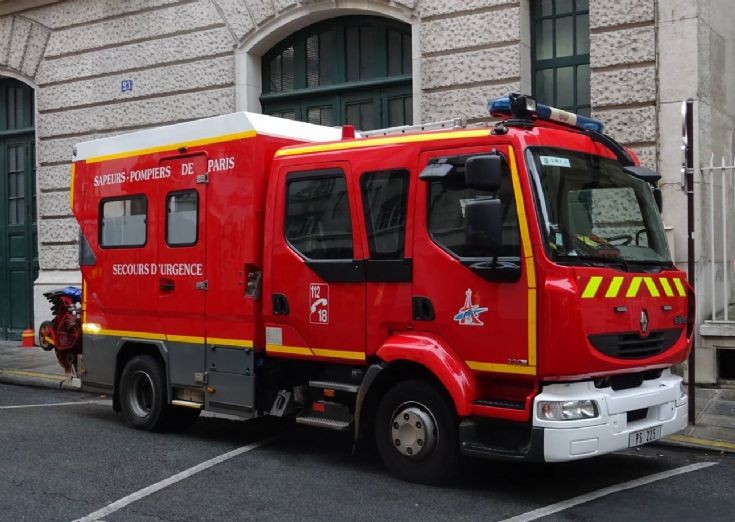
BSPP operate around 115 of these, with one or two at each of their 74 fire stations. They operate alongside around 140 ambulances, 40 dedicated pump appliances and over 30 aerial ladders and platforms - as well as a fleet of special purpose rescue and tactical units and command vehicles.
Personally I think these are a masterpiece of design, as they combine an immense amount of useful equipment into a very small envelope which is ideal for the city's narrow streets. They are able to be deployed to every kind of incident, bearing in mind that medical calls account for 80% of BSPP's runs, general service and false alarms 15%, and fires and rescue incidents less than 5%.
Added by Rob Johnson on 08 January 2021.