
Upload a Picture
About this Site | Links | Random Pic | Advanced Search
Home | Latest Additions | Contributors
| Visitors
Fire Engine Photos
Wow- so as well as the thousands of full time/volunteer fire lot with masses of fire vehicles there is another massive gang!
Added by CraigW on 01 December 2020.
Added by CraigW on 01 December 2020.
Craig: Not to forget close to 1,000 airport, harbour, factory and industrial fire brigades too!
Added by Rob Johnson on 02 December 2020.
Added by Rob Johnson on 02 December 2020.
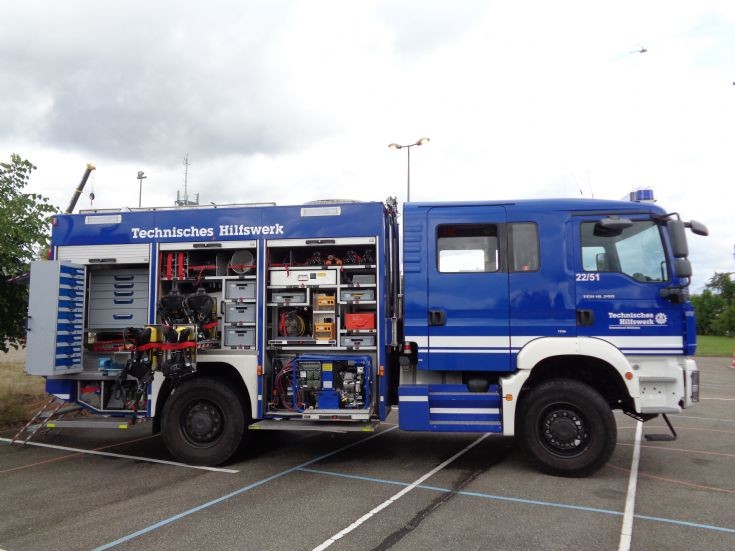
Hello, this type of appliance, Gerätekraftwagen or GKW, newest version, carries 2 dry powder extinguishers, a 10l capacity stirrup pump, and 6 lengths of hose. The latter are usually used with the submersible pumps also carried on board. All this is intended to provide first strike cover when operating disc cutter and hot cutting gear. The submersible pump also provides us with a means to clear a basement of water when we have to search it or rescue people from it.
Matthias Stockebrand THW Essen
Added by Matthias Stockebrand on 02 December 2020.
Matthias Stockebrand THW Essen
Added by Matthias Stockebrand on 02 December 2020.
Matthias: Thanks for all this information about your newest type of truck. I think this is the first time we have heard from a THW member on this website!
Added by Rob Johnson on 02 December 2020.
Added by Rob Johnson on 02 December 2020.
Given this massive domestic market for fire equipment it's not surprising the German manufacturers do so well.
Added by CraigW on 03 December 2020.
Added by CraigW on 03 December 2020.
Quite right, Craig. The same is true for Rosenbauer in Austria, which has 4490 volunteer fire companies in a country with nine million population - about the same as Greater London!
Added by Rob Johnson on 04 December 2020.
Added by Rob Johnson on 04 December 2020.
Do wonder what they all find to do !
Added by CraigW on 04 December 2020.
Added by CraigW on 04 December 2020.
Rob, 4490 volunteer fire companies. Er, surely not 4490 fire stations...Do they share bases?
Added by Steve on 06 December 2020.
Added by Steve on 06 December 2020.
Steve, I don’t actually know if there are any shared stations but I suspect not. As in Germany these go back to the days when towns and villages were very isolated - particularly in Winter - and if a fire occurred it was up to the local community to deal with it.
Although Germany has evolved into a country with large towns and cities with more than 100 full time fire brigades, Austria has only six.
Added by Rob Johnson on 07 December 2020.
Although Germany has evolved into a country with large towns and cities with more than 100 full time fire brigades, Austria has only six.
Added by Rob Johnson on 07 December 2020.
Interesting Rob. I had no idea of the ratio of volunteers to full time in Austria.
Added by Steve on 08 December 2020.
Added by Steve on 08 December 2020.
Germany and Austria are both over 97% volunteer, but almost every other country is around 70% to 75% unpaid volunteer. This makes the resources available much larger than in the UK, as payroll expenses as a proportion of total costs are much lower.
The downside is that it takes volunteers longer to gain experience if they attend fewer incidents, and standards of training, fitness as well as leadership quality are more variable than with most paid fire services in some countries.
On the other hand, I have heard of more than a few cases where effective firefighting tactics by a volunteer department were nixed by responding "professionals". These include one fire where the late responding full time companies shut down a hydrant supplying two of the volunteers' inside attack teams' lines so that they could feed an unnecessary ladder tower monitor - which achieved nothing. As a result the interior attack was abandoned and the building was a total loss!
Added by Rob Johnson on 08 December 2020.
I recently learned that the 80,000 volunteers who belong to the THF organization have around 11,000 specialized vehicles at their disposal. These include several units carrying drones, which have been deployed at several recent major fires to assist fire service incident commanders in their analysis of the fire situation and tactical decision making.
Added by Rob Johnson on 20 December 2020.
Added by Rob Johnson on 20 December 2020.
This year many German fire services have acquired drones to eliminate the need to ask THW units to respond to incidents. They are carried in ELW1, which are included in the first response assigned units to all structure and most vegetation fires.
Added by Rob Johnson on 05 May 2021.
Added by Rob Johnson on 05 May 2021.
MAN


In many situations, they respond along with fire and EMS, particularly to assist with difficult rescues and to clean up after major incidents. It is a much smaller organization than the fire service with only 668 local stations nationwide, staffed by 1,800 full time employees and around 80, 000 volunteers. As illustrated in this photo, THF livery is bright blue with white striping; all vehicles have blue lights and multi-tone air horns like other German emergency units.
Added by Rob Johnson on 30 November 2020.