
Upload a Picture
About this Site | Links | Random Pic | Advanced Search
Home | Latest Additions | Contributors
| Visitors
Fire Engine Photos
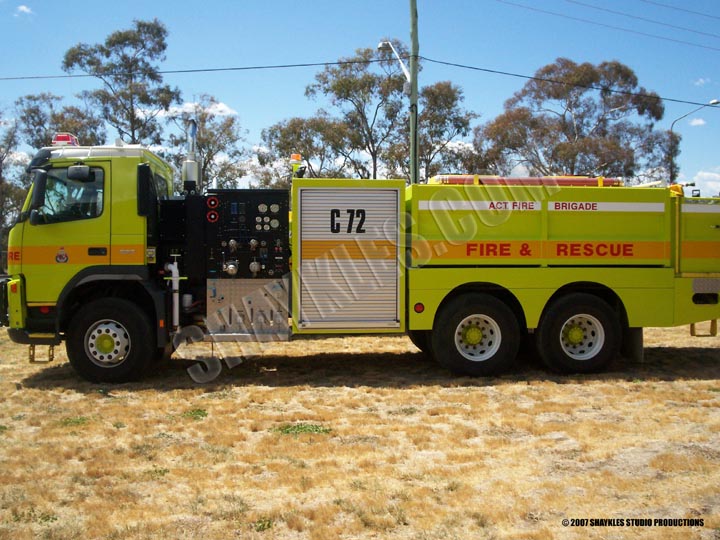
A.C.T. Fire Brigade CAFS Tanker
Here is an image of the ACTFB’s new Volvo FM9 Compressed Air Foam System tanker. These are specifically used for fighting fires in the urban and rural interfaces of the A.C.T. The appliance has a CAFS pump, a front mounted winch system, an 8,000-litre water tank, front-mounted monitor, and a working platform on the rear of the vehicle which operates two monitors. Also installed in the cab are two colour safety cameras and a Kevlar roll-down screen which protects the occupants inside from radiated heat that would usually pass through the vehicles’ windows.
The brigade has four of these new CAFS tankers, which are the first of their kind in Australia.
Photography by Shay McAuley.
These Truck are a great asset to the ACT, only thing is that the supertankers on board computer shuts down the entire engine drive line, if the gearbox gets to hot, great feature in a fire truck
Added by Ben on 05 December 2007.
Added by Ben on 05 December 2007.
Like many viewers of this site I am not a fire fighter and would be grateful if you could explain the purpose/advantages of the CAFS system.
Regards,
Steve
Added by Steve Prosser on 09 October 2013.
Regards,
Steve
Added by Steve Prosser on 09 October 2013.
CAFS is far superior to water in controlling and extinguishing fire because of its bubble structure. The uniform size of the bubbles absorbs more heat and allows for deeper penetration of wood and other fiber based materials. CAFS have been around since the middle 70s. It was invented by a man named Mark Cummins in Texas, USA. Very popular in the US and Canada.
Added by John Harris on 09 October 2013.
Added by John Harris on 09 October 2013.
John,
Thanks for the interesting feedback, it seems to me that such a system is more complicated than just using water.
In addition to the pump I presume the truck is equipped with a compressor and a foam tank.
What happens when the foam additive runs out ?.
Regards,
Steve
Added by Steve Prosser on 09 October 2013.
Steve - CAFS systems are designed so that the pump just pumps plain water if the CAFS solution supply runs out. In fact, the lines can very easily be independently switched back and forth between foam and water depending on the fire situation. The foam works with standard nozzles, as it is aeriated in the hose line. Another advantage is that the hose weighs less, as it contains both compressed air and water.
The solution consumption is much less than airfoam, so a relatively small on-board tank will suffice for a large volume of CAFS. Many US pumpers with CAFS only find it necessary to carry around 120 to 180 liters of solution, compared to 1800 liters or more of water.
A typical house fire which requires a 500 LPM handline can often be extinguished in around two or three minutes with CAFS, compared to five or six minutes using plain water. The idea is not to reduce the application rate (flow) of water, but to reduce the time needed. In this example, around 1500 liters of water will get the job done, instead of needing perhaps 3000 for the same result.
CAFS is now a standard feature of fire appliances in many European countrie as well as in north America. The BSPP in Paris now orders CAFS systems on all its first response pumpers, for example, and Berlin has recently upgraded the CAFS systems on its newest rescue pumpers to be able to deliver 1600 LPM for master steams, ladder monitors and ground monitors at large fires.
Added by Rob Johnson on 09 October 2013.
The foam formula is: water+ foam concentrate+ air = finished foam. No foam concentrate = NO finished foam. CAFS mixes the compressed air with the water/foam solution to produce CAFS. CAFS can be made mechanically with water pump and air compressor or pneumatically with compressed air only to provide both propulsion and CAFS production.
Added by John Harris on 09 October 2013.
Added by John Harris on 09 October 2013.
Rob & John,
Many thanks for taking the time to outline the advantages of CAFS.
I know that British fire brigades are somewhat conservative in their choice of innovative fire fighting methods. Have any UK fire services adopted this system yet ?.
Regards,
Steve
Added by Steve Prosser on 10 October 2013.
Many thanks for taking the time to outline the advantages of CAFS.
I know that British fire brigades are somewhat conservative in their choice of innovative fire fighting methods. Have any UK fire services adopted this system yet ?.
Regards,
Steve
Added by Steve Prosser on 10 October 2013.
Steve - there are a few, but the UK is far behind many other European countries. A reason I have heard for resisting the introduction of CAFS is that there is a concern that the foam solution concentrate is toxic.
This has been evaluated in both the US and Germany, and has been found to be a tangential issue. In Australia, it is widely used on wildland fires, with the proviso that it should not be used in situations where the runoff would go into drinking water supplies. This is, of course, hardly a situation which is likely to arise very often in any case! Chemically, the foam solution is super-concentrated dishwashing detergent plus a foaming agent, which is a common enough household product.
Because CAFS sticks to both burned and unburned surfaces, including vertical surfaces like tree trunks, it is very effective on vegetation fires, and was developed by the Forestry department in Texas just for this reason. The very first systems were installed on Royal Navy ships during WWII, because it avoided using too much water, which may destabilize the vessel.
But it is now also very well established for structural fire fighting. It is very useful in situations where a serious fire has to be tackled by the first due pumper's crew on their own for several minutes until backup arrives. The hose lines are lighter and easier to handle, and a typical 1500 to 2000 liter water tank can achieve a fast knockdown in a quite large structure fire very quickly, requiring members to be exposed to danger for a much shorter time.
The ability to use firefighter resources more efficiently, the more rapid knockdown, the reduction in water damage and the reduced risk to both fire service members and building occupants have all been very well proven during the past decade - and my personal view is that CAFS should be a standard installation on fire pumps everywhere!
If you google CAFS, you will see some much more detailed information, as well as some amazing videos showing how effective it is.
Added by Rob Johnson on 11 October 2013.
Another advantage is the weight of the hose with cafs foam versus water. One man can handle a cafs hose line.
Added by Les Davis on 12 October 2013.
Added by Les Davis on 12 October 2013.
Volvo


Added by Pavel Zaremba on 19 October 2007.