
Upload a Picture
About this Site | Links | Random Pic | Advanced Search
Home | Latest Additions | Contributors
| Visitors
Fire Engine Photos
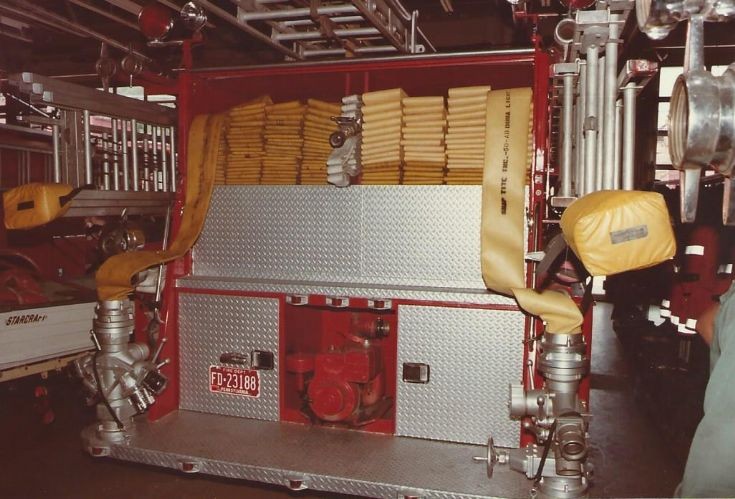
Wellsboro could move some big water. In photo 42068 you will note that of the 4 apparatus in the picture 3 have 2 master streams and 2 are carrying LDH.
Added by Richard Sees on 13 October 2020.
Added by Richard Sees on 13 October 2020.
This looks a lot like Engine 1-13, an 1980 1750 GPM ALF pump which is still in service! According to the FD website, it actually has a 2400 foot 5 inch hose load and carries two portable monitors as well as a deck gun.
It is one of four pumpers at their fire station, and part of a fleet which also includes an aerial quint, a heavy rescue, brush trucks, a tanker and three ambulances.
Added by Rob Johnson on 13 October 2020.
It is one of four pumpers at their fire station, and part of a fleet which also includes an aerial quint, a heavy rescue, brush trucks, a tanker and three ambulances.
Added by Rob Johnson on 13 October 2020.
Richard:
If you check out this department's website, you will see an impressive fleet of high capacity pumpers and a definite focus on big water. This volunteer outfit does not have any very new rigs, but they do have a lot of capacity with the units they have available!
Added by Rob Johnson on 13 October 2020.
If you check out this department's website, you will see an impressive fleet of high capacity pumpers and a definite focus on big water. This volunteer outfit does not have any very new rigs, but they do have a lot of capacity with the units they have available!
Added by Rob Johnson on 13 October 2020.
American LaFrance


Difficult to tell, but this looks like five inch. If so, a regular pump operating at 10AT can move over 3, 000 LPM all the way through this 2,000 foot hose lay - because friction losses are very low.
Five inch is by far the most popular LDH in use here, but 4.5, 4.0 and 3.5 are also carried instead in some places.
Standard 2.5 or 3.0 inch hose can be used for hydrant connection, but LDH (or six inch suction) is usually the preferred SOP.
Added by Rob Johnson on 12 October 2020.