
Upload a Picture
About this Site | Links | Random Pic | Advanced Search
Home | Latest Additions | Contributors
| Visitors
Fire Engine Photos
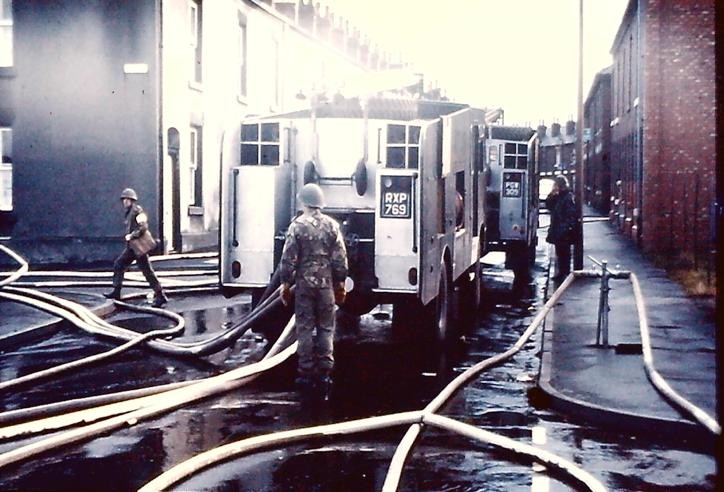
RXP769/PGW209 Bedford RLHZ strike
1977 strike picture. Probably taken in NW England.
RXP is still around at Challenger1, a company based at Bicester Heritage who offer military and emergency vehicle driving experiences.
Late Alastair Collins collection - used with permission.
1977 strike picture. Probably taken in NW England.
RXP is still around at Challenger1, a company based at Bicester Heritage who offer military and emergency vehicle driving experiences.
Late Alastair Collins collection - used with permission.
Rob ... I'm certainly with you on that, with the damage to the Fire Service as a consequence of the strike taking a long time to repair. A couple of years earlier I was present when the Queen opened the FS College at Moreton, and I recall being very proud when the Monarch told the assembled mixed ranks audience that the Country and the Royal Family would be forever grateful to the fire service for its contribution to the protection of the Nation during WW2 and since. Two years later we were on strike. My brain couldn't quite compute how within two years we went from being told by the Head of the Realm that we were the best thing since sliced bread, to then be standing outside our stations with begging tins. A very sad time
indeed.
Added by Keith Richardson on 24 April 2020.
indeed.
Added by Keith Richardson on 24 April 2020.
It seems to be continuing too, with Chiefs everywhere still struggling to keep fire cover at least somewhat intact, while being forced to cut costs right, left and center.
All a result of the infamous Bain Report, which made no comparisons of UK fire service budgets, headcount or effective fire cover with ANY other country, and simply decided that a trend indicating fewer fires over the years meant that less money should be spent on fire stations, firefighters and fire service equipment. As a result, Britain has fewer firefighters, fire stations and fire appliances per head than almost any other European country, not to mention the US and Canada - or Australia or New Zealand.
For example, since its consolidation, the London Fire Brigade has reduced its pumper fleet by 30% and its aerials by 55%.
In my view, the disastrous Grenfell Tower fire was just waiting to happen, and no small part of the problem was that the initial LFB response was so light. They dispatched around twenty firefighters with four pumps. No aerial, no rescue, no senior officer, amounting to about half the resources which would be sent to any occupied residential high rise building in the middle of the night in both the US as well as almost any other European country!
But - unlike many other fire disasters around the World - even this does not seem to have provoked the public outrage which would perhaps lead to a reversal of this continuing march towards completely gutting the British fire service. I just don't get it at all...
Added by Rob Johnson on 25 April 2020.
But if double the numbers had turned up would the result have been any different ? Flammable foam burning in a thin sandwich between an outer metal cladding and inner concrete structure, venting upwards must be very, very hard to extinguish if not impossible.
Added by CraigW on 25 April 2020.
Added by CraigW on 25 April 2020.
Comment removed at request of Commentor
Thanks for your comments on the variability of US fire cover - an entirely true observation that I have made myself several times on this site. Despite NFPA parameters and a strong influence from fire insurance companies, which rate fire departments and charge premiums accordingly, it does depend very much on local budgets. One main reason why many departments are unpaid volunteer outfits.
Fortunately, most high rises here are in cities with adequate full time fire departments to ensure a comprehensive response.
It does not change my point that high rise fires are taken much more seriously in many other countries than in the UK, not only in US cities.
Over many years, people I have talked to about fire response to high rise fires include fire service personnel in France, Germany, Luxembourg, Spain, Portugal, Belgium, Hungary, Israel, Dubai, Denmark, Sweden, Italy, Iran, Poland, Russia, Kuwait, Taiwan and Japan, as well as here and in Canada.
All of these routinely respond to night time occupied residential high rise fire calls with between 50% and 150% more personnel and equipment than LFB provided to the Grenfell Tower on the first alarm.
As for the Bain report, it is still the case that the justification and impetus for continuous cost cutting in the UK fire services was - and continues to be - the Bain report.
If you have not read it, I suggest you do. It provides all the "independent evidence" anyone could ask for to shrink fire protection, and has obviously been used exactly for this purpose and - to my knowledge - quoted as such.
The fact remains - whatever the reason - that while major cites like Berlin and Paris are continually adding resources and personnel to improve fire protection, London and other UK cites are doing the reverse.
Added by Rob Johnson on 26 April 2020.
Thanks for your comments on the variability of US fire cover - an entirely true observation that I have made myself several times on this site. Despite NFPA parameters and a strong influence from fire insurance companies, which rate fire departments and charge premiums accordingly, it does depend very much on local budgets. One main reason why many departments are unpaid volunteer outfits.
Fortunately, most high rises here are in cities with adequate full time fire departments to insure a comprehensive response.
It does not change my point that high rise fires are taken much more seriously in many other countries than in the UK, not only in US cities.
Over many years, people I have talked to about fire response to high rise fires include fire service personnel in France, Germany, Luxembourg, Spain, Portugal, Belgium, Hungary, Israel, Dubai, Denmark, Sweden, Italy, Iran, Poland, Russia, Kuwait, Taiwan and Japan, as well as here and in Canada.
All of these routinely respond to night time occupied residential high rise fire calls with between 50% and 150% more personnel and equipment than LFB provided to the Grenfell Tower on the first alarm.
AS for the Bain report, it is still the case that the justification and impetus for continuous cost cutting in the UK fire services was - and continues to be - the Bain report.
If you have not read it, I suggest you do. It provides all the "independent evidence" anyone could ask for to shrink fire protection, and has obviously been used exactly for this purpose and - to my knowledge - quoted as such.
The fact remains - whatever the reason - that while major cites like Berlin and Paris are continually adding resources and personnel to improve fire protection, London and other UK cites are doing the reverse.
Added by Rob Johnson on 26 April 2020.
Craig:
We will never know the answer to your question.
But, even if the answer is "possibly", it might have been worthwhile to respond at a level which many cites in other countries would have sent. In particular, the inclusion of at least one aerial might have been able to limit or even eliminate the exterior vertical spread of the cladding fire.
Added by Rob Johnson on 26 April 2020.
By way of an update, LFB will now respond to high rise fires with eight pumps, an aerial and a FRU, but ONLY IF multiple calls from the same address are received.
But - after Grenfell - it took several months and a new CFO to revise the residential high rise response protocol.
LFB has also ordered three additional aerials with higher vertical and horizontal reach, to add to this initial response, which is a positive step.
But - we have to wonder how long it will take one of them to actually arrive at an incident, given that high rise apartment buildings are scattered over many widespread areas of London's 600 square miles!
Added by Rob Johnson on 26 April 2020.
Several of the new aerials have now been delivered by Magirus to LFB but await commissioning I believe. Training programmes have been delayed by Covid19 according to my sources. One carries a freemasons symbols as the Freemasons charity paid for the biggest one (64m). Pictures on social media and here www.emergency-vehicles.co.uk/Emergency-Vehicles-Online/UK/UK-Fire/CountyRegional-Services/London-Fire-Brigade/Aerials/i-8sw3d8g/A
Added by Petros on 27 April 2020.
Added by Petros on 27 April 2020.
Sad that fire protection in Britain's capital city is depending on a charity to buy needed equipment!
New York did of course accept several donated pieces of equipment after 9/11, but these were partial and sometimes temporary replacements for the scores of units destroyed in a singe day...
Ed: it was an unsolicited offer made by a charity rather than a dependency I think.
Added by Rob Johnson on 07 May 2020.
Perhaps LFB would have turned down the offer if they believed they did not need the appliance?
Added by Rob Johnson on 14 May 2020.
Added by Rob Johnson on 14 May 2020.
The new published LFB Four Year Strategy plan is quite revealing. The 64M aerials are not going to be additions, except for the donated unit, as the fleet of 32M units is being reduced from 13 to only 11.
In addition, the brigade will now evaluate cross-manning all aerials, which means a further potential dilution of response preparedness.
On the same theme, but possibly even more worrisome, day manning of the second pump appliance at each two pump station is to be evaluated. If adopted, this would reduce night time availability of pump appliances from around 150 units to around 100...
The rationale is, of course, that there are fewer fires at night. The unstated reason, to my mind, is further cost savings.
Added by Rob Johnson on 15 May 2020.
You refuse to recognise the U.K. government's total reliance on compartmentation for occupant survival. As Grenfell so clearly demonstrated, there is rarely all round access for high reach appliances to such buildings and often on-street parking prevents any access at all. This new generation of high reach appliances are but a sop to public opinion and as ever will be water towers for total loss buildings. Their costs should be charged to public relations, not capital expenditure.
Added by Alan Woodward on 15 May 2020.
Added by Alan Woodward on 15 May 2020.
Not sure who "you" is or are.
I have made the same point numerous times;
ultra tall aerials are not a solution to high rise fires, but a stop gap effort where - as in most of the Third World - building codes and/or enforcement are wanting.
Almost all these are delivered by Magirus, Metz and Bronto to Third World countries, where extreme high rise towers are now very fashionable, but proper fire codes are not.
The LFB has been cited in the Grenfell investigation for routinely failing to inspect high rise towers to insure compliance with codes, and the codes themselves were - and may be still are - woefully inadequate.
To illustrate the point, very few US cities which have numerous high rise buildings - including some over 100 floors - have any aerials over 30 meters, including New York, Chicago, Los Angeles, Dallas, Boston, San Francisco, Houston and many others.
Instead, for example, in Chicago the 44 floor building where I live has the following fire protection provisions. Fire proof compartmentalization, including internal doors and outside windows, is augmented by hard wired smoke alarms in all areas, sprinkler systems with automatic alarms, multiple enclosed escape stairs, at least two smoke lobbies on each floor, automatic elevator lobby doors, separate dual riser outlets on all floors, and a building pump system capable of supporting up to eight hose lines collectively streaming around 10, 000 LPM.
I know from living here since 2009 that there have been only two high rise fire fatalities. One of these was inside an apartment, the other in a hallway after the fire apartment's owner propped the door open to let her cat escape!
It seems that it may take decades to make London's high rise buildings safe from fire for their occupants. In the meantime, 64M aerials might turn out to be useful occasionally - and certainly better than nothing. But the idea that having only three of them in a 600 square mile city is meaningful is to my mind nothing more than PR, as you say...
Added by Rob Johnson on 15 May 2020.
Comment removed at request of Commentor
LFB AC Andy Bell's official October report letter indicates that after Grenfell the brigade has in fact conducted a great number of high rise fire inspections, and will add a high rise training facility at the forthcoming third brigade training center.
BTW, there are photos on this site of LFB units attending high rise inspections on this site after 2004, and the report admits to inadequacies in this process.
I agree LFB cannot be entirely blamed for the astounding loss of 74 lives, but the very fact that AC Bell's report details so many areas for improvement in different aspects of the service does underline their numerous shortcomings when it comes to dealing with high rise fires. In my view, most of these are clearly the indirect result of budget cuts. It is almost as if the brigade's leaders had not realized that London had gradually become a city with hundreds of high rise buildings...
You can download the AC's report from the LFB website.
Added by Rob Johnson on 17 May 2020.
One further disturbing aspect of the LFB reports is that the fire extending vertically from the fourth floor window to ignite the cladding only occurred around 15 minutes after the first units arrived on scene. But the first aerial - not included in the first alarm assignment - was not on scene until more than 30 minutes afterwards.
This indicates a good chance that, if an aerial had been included in the initial attendance, it might have been in time to control or even completely extinguish the cladding fire.
It is also pointed out that flammable cladding on high rise buildings was a known fire risk to the brigade, because of an earlier incident at a 20 floor building in London, where an apartment fire jumped several floors.
However, this information was not available to the personnel attending Grenfell, despite the fact that the first responding station crews should have had this included in their pre-plan information for high rise buildings in their primary response area.
Had it been, even a hand line positioned outside the building may have saved the day.
Positioning aerial or hand lines to prevent vertical extension of fires in multi-storey building is a standard operating procedure in many countries, and it seems like it should have been at Grenfell too.
Added by Rob Johnson on 19 May 2020.
Comment removed at request of Commentor
Thanks
I am sure you will understand that I am inclined to believe the LFB official report. Your observations do not seem to be reflected in the previous cladding fire it references, and the LFB decision to add an aerial to the first response to high rise fires. As neither of us was there, let’s accept the actual data included in LFB’s own detailed investigations - and their conclusions, which objectively accept that a lot of mistakes were made.
Added by Rob Johnson on 20 May 2020.
Moderator comment - I am going to close this thread down now as there is a danger it could become ill tempered. The hypothesis that it was an impossible fire to fight is being tested both at the (suspended) enquiry and in the Metropolitan Police investigation, and it is probably not good to speculate further at this time. Petros.
Added by Petros on 21 May 2020.
Added by Petros on 21 May 2020.
Bedford


Added by Rob Johnson on 24 April 2020.