
Upload a Picture
About this Site | Links | Random Pic | Advanced Search
Home | Latest Additions | Contributors
| Visitors
Fire Engine Photos
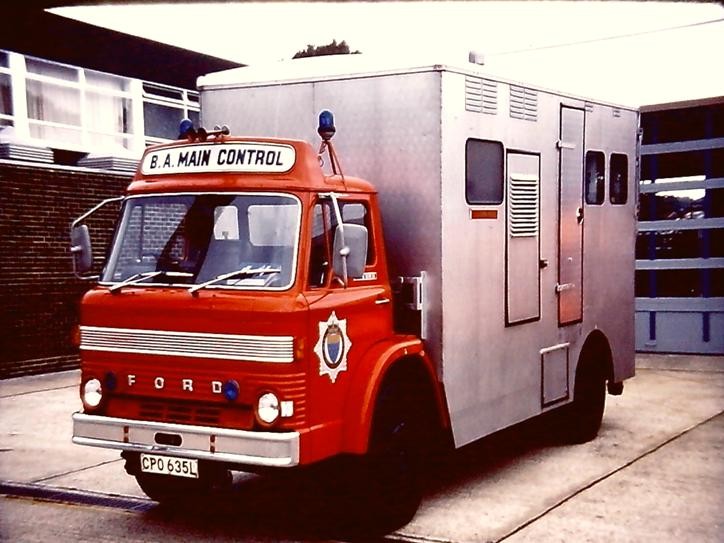
CPO635L Ford D2817/Contact BACV W. Sussex
One of 3 West Sussex BA Control Vans, CPO 635L, a Ford/ Contact (bodybuilder), introduced in 1973, originally painted in Coventry yellow livery. This appliance served at Worthing until 1993, when it was moved to Shoreham by Sea until retired in 1995, The other two machines at Chichester (CPO 637L) & Horsham (CPO 636L) had the blue flashing lights on the body rather than the cab roof and were retired a year earlier. They carried a BA compressor, spare BA sets & cylinders, BA servicing equipment, gas tight chemical suits, decontamination shower etc, the rear section opened out to perform control functions.
Late Alastair Collins collection - used with permission.
Actually this is a 28 ton Chassis, 170 BHP, I rode on one of these machines regularly, it was also badged up as such, may be visible on photos.
Added by M.West on 25 August 2020.
Added by M.West on 25 August 2020.
Sorry, the maximum gross vehicle weight for a two axle chassis in 1973 was really 16 tons, so the badge - wherever it came from - was incorrect.
Even after EU rules were changed, it was still only 18 tons.
The maximum weight for the D series with three axles was only 24 tons back then. Only the Gross Train Weight for the articulated tractor unit was 28 tons.
One of our issues marketing the D series in Europe was that although the GVW was 16 tons, which was the maximum there too (except for France and Belgium) the GCW was limited to 28, which meant it could only pull a 12 ton trailer.
In places like Germany and the Netherlands, the 16 ton Mercedes, MANs, Volvos, Scanias and DAFS could all handle the maximum legal 16 ton trailer for a GCW of 32 tons.
I worked in sales and product planning for Ford of Britain and Ford of Europe Truck Division at the time, and was involved in the rebadging marketing decision, so I can assure you that this was the true situation in those days.
Added by Rob Johnson on 26 August 2020.
Shame we cannot see the cab door badges.
Added by CraigW on 27 August 2020.
Added by CraigW on 27 August 2020.
Craig: I think there is probably an explanation for this unusual situation. The cab would have been built in that part of the Langley plant which built the cabs, and badged as a 2417 - because its build sheet said it was going to be installed on an articulated 24 ton tractor chassis. All the cabs on the 16 ton two axle chassis, the 24 ton three axle chassis and both the 24 and 28 ton articulated tractor chassis were identical, apart from the badges. When it arrived at the assembly line, it was however installed on a 16 ton two axle truck chassis, and went out of the door wearing the wrong badge.
The badge does not make it possible to magically get 28 tons on to a two axle D series (or any other make) chassis!
Added by Rob Johnson on 27 August 2020.
The badge does not make it possible to magically get 28 tons on to a two axle D series (or any other make) chassis!
Added by Rob Johnson on 27 August 2020.
Ford


The 2817 was an articulated tractor unit for a semi trailer combination, the total GCW of this tractor plus trailer totalling 28 tons.
Still, a very capable unit which could carry at least nine tons of equipment...
Added by Rob Johnson on 12 July 2020.