
Upload a Picture
About this Site | Links | Random Pic | Advanced Search
Home | Latest Additions | Contributors
| Visitors
Fire Engine Photos
No: 40374 Contributor: Eduardo Martínez Year: 2017 Manufacturer: Merryweather Country: United Kingdom
Merryweather




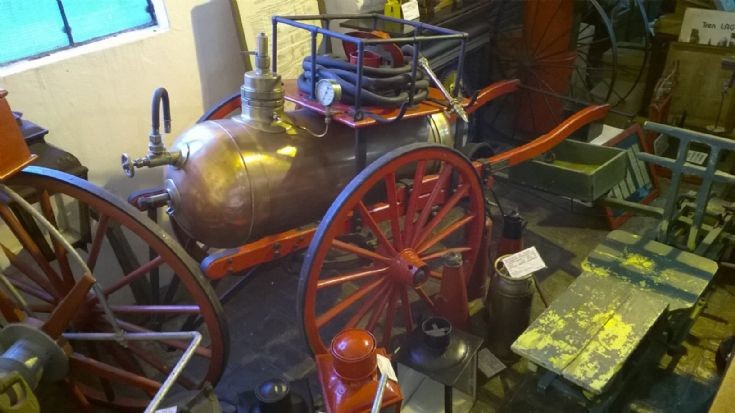
This looks like a "chemical engine", which was actually a giant over sized soda acid fire extinguisher mounted on a two wheeled cart and either pulled along by a horse or - in this case - a team of fit firefighters!
At the fire, a crank was turned to release the acid into the tank, which contained baking soda dissolved in the water. The chemical reaction created carbon dioxide gas, which pressurized the system and forced the contents out of the hose in the basket on top of the cylinder. If the tank was large enough, and the fire small enough, the job was done!
If the fire was serious, the role of the chemical engine was to try to limit its growth until the pump could be set in to a water supply and got to work. Depending on the size of the tank, this could be for three to around six minutes.
Larger, and often multiple, chemical tanks were later fitted on truck chassis, and then on motor pumpers, but died out as booster pumps were introduced in the 1920s, although a few were still installed in the early 1930s.
Added by Rob Johnson on 08 October 2018.