These early front wheel drive petrol engine units were welded onto existing horse drawn steam pumpers' frames as a more economical way of first motorizing some apparatus fleets in the US.
Both Christie and American La France built similar units - most of which were placed into service between 1910 and 1920. The Christie was a very early transverse-engine front wheel drive design, predating the Austin Mini by around fifty yeas!
These gasoline powered units were much more economical to operate than horsed units, and could travel further and faster to incidents.
But steam pumpers were expensive, and in the early 1900s there were many relatively new ones still in use - so these adaptations were a less costly alternative to buying complete new gasoline powered pumpers with PTO operated pumps.
Gradually, of course they were overtaken (in both senses of the word!) by lighter, faster purpose built gasoline pumpers, which could often also carry hoses, a full crew of firefighters and sometimes ladders and/or chemical equipment too.
These "triple combination" pumpers evolved rapidly and were widely adopted by the 1920s, and were understandably very popular because they replaced three horse drawn units - the steamer, the chemical engine and the hose wagon.

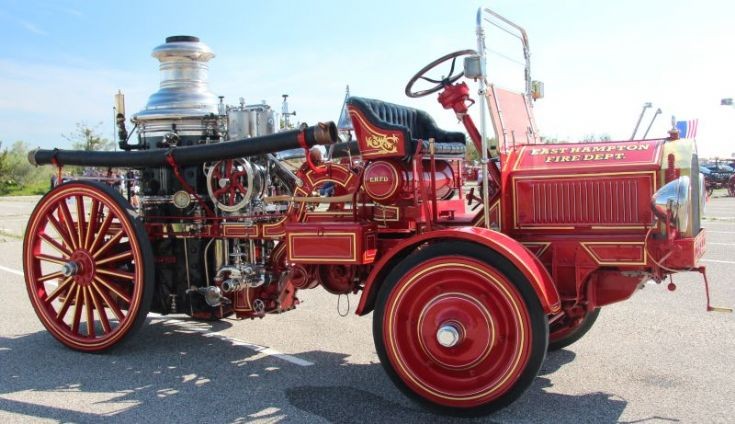




Both Christie and American La France built similar units - most of which were placed into service between 1910 and 1920. The Christie was a very early transverse-engine front wheel drive design, predating the Austin Mini by around fifty yeas!
These gasoline powered units were much more economical to operate than horsed units, and could travel further and faster to incidents.
But steam pumpers were expensive, and in the early 1900s there were many relatively new ones still in use - so these adaptations were a less costly alternative to buying complete new gasoline powered pumpers with PTO operated pumps.
Gradually, of course they were overtaken (in both senses of the word!) by lighter, faster purpose built gasoline pumpers, which could often also carry hoses, a full crew of firefighters and sometimes ladders and/or chemical equipment too.
These "triple combination" pumpers evolved rapidly and were widely adopted by the 1920s, and were understandably very popular because they replaced three horse drawn units - the steamer, the chemical engine and the hose wagon.
Added by Rob Johnson on 09 June 2017.