
Upload a Picture
About this Site | Links | Random Pic | Advanced Search
Home | Latest Additions | Contributors
| Visitors
Fire Engine Photos
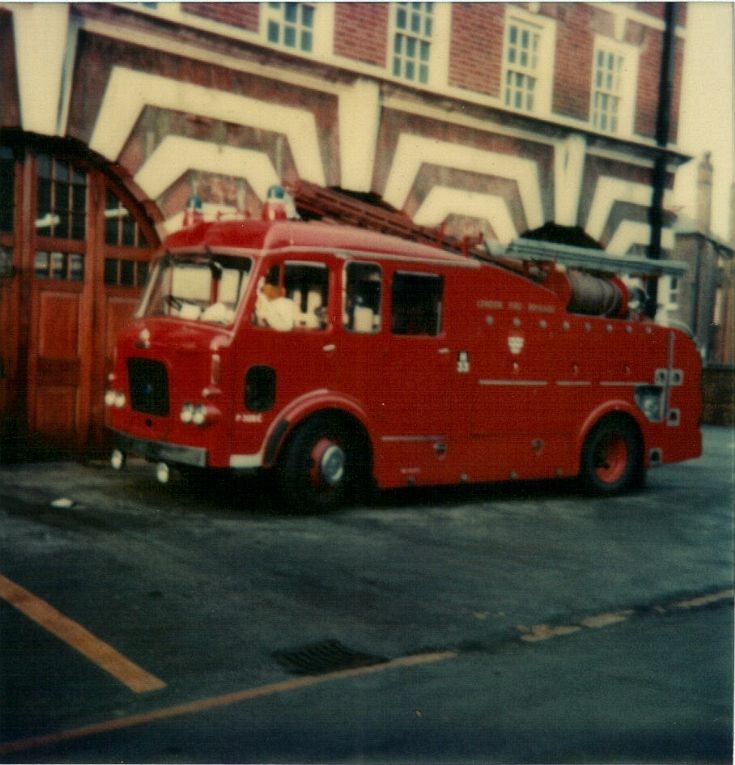
LFB Dennis 106 Pump
London Fire Brigade Dennis F106 Pump JYE308D (P308C), seen as H33 Beckenham's Pump, (it was a Divisional spare) outside H21 Bromley on 27/01/1980. This appliance was new (in 1966) to E27 Erith and ran as their Pump Ladder, (with a Merryweather 50ft Ladder), up to either 1969 or early 1970. All the ex Kent Fire Brigade Stations taken over by the GLC in 1965 had Pump Ladders. Sorry about the quality of the pic I took it with a poloroid camara!
London Fire Brigade Dennis F106 Pump JYE308D (P308C), seen as H33 Beckenham's Pump, (it was a Divisional spare) outside H21 Bromley on 27/01/1980. This appliance was new (in 1966) to E27 Erith and ran as their Pump Ladder, (with a Merryweather 50ft Ladder), up to either 1969 or early 1970. All the ex Kent Fire Brigade Stations taken over by the GLC in 1965 had Pump Ladders. Sorry about the quality of the pic I took it with a poloroid camara!
The London Dennis F106s with rear- mounted pumps were ordered by Middlesex Fire Brigade, whose CFO liked rear- mounted pumps. By the time they were delivered, Middlesex F.B. had been absorbed into London Fire Brigade.
Added by Bill Edwards on 29 July 2014.
Added by Bill Edwards on 29 July 2014.
Hi Bob, Sorry can't find out how many Dennis F106's London had, However they came in three different types, All fitted with an AEC FV470 diesel engine with 5-speed manual gear box. The three types were F106 "A" type, (fleet no would be P***A), this had a 100 gallon water tank and mid-ship mounted pump. F106 "C"type, (fleet No P***C), 300 gallon first aid tank with rear mounted pump with side deliveries. And a F106 "D"type, (fleet no P***D), with a 300 gallon water tank and rear mounted pump. Chris
Added by Chris Stone on 30 July 2014.
Added by Chris Stone on 30 July 2014.
Thanks, Bill and Chris. I can see how LFB inheriting Middlesex Dennises led to this puzzle, but I still don't really undertand why a few CFOs bought pump escapes with rear mounted pumps, although I know that quite a few did.
Added by Rob Johnson on 30 July 2014.
Added by Rob Johnson on 30 July 2014.
From the Dennis Society records I would say there were 65 F106 machines delivered to LFB
Added by Barrie Green on 30 July 2014.
Added by Barrie Green on 30 July 2014.
Rear- mounted pumps were easier to maintain, than midships- mounted pumps. That is why they were popular. Also, the midships- mounted pump reduced the available space for the water tank, thus appliances so fitted could omly carry 100 to 150 gallons, whereas appliances with rear- mounted punps could accommodate a 300- gallon tank. Don't forget that the rear- mounted pump with side controls first appeared in 1967.
Added by Bill Edwards on 31 July 2014.
Added by Bill Edwards on 31 July 2014.
I've managed to confuse myself, so if anyone can clear this up it would help! According to the info I supplied above this should be a "D"type, yet the fleet No clearly is a "C", I got the info from "The Fire Brigade Society"'s Post War London Fire Brigade booklet, which shows H21 Bromley's Pump JYE311D and lists it as a "D" type. (see photo's 37522/37523) which as they are identical machines to JYE308D, they're from the same batch, should all have the same fleet designation. So unless they were redesignated "C"types or the book's wrong ther's an incosistancy. I've got photo's of all three types and the id for the "C" type is clearly different. Having spoken to Paul Slade, (of Fire Brigade Models), he seemed to think there was 4 types "A", "B", "C" and "D". However as I have already stated I've got pics of Three different Types, And am wondering if it is a mistake in the booklet and only "A", "B"and "C"types were in service and the description for the "C" and "D" should read "B" and "C". If anyone has photo's of H27 West Wickham's Dennis F106 JYE316D on station or with H27 Stn plates I would love a copy, I've got a couple of it in later life as a Driver Trainer. Thanks.Chris
Added by Chris Stone on 31 July 2014.
Added by Chris Stone on 31 July 2014.
Baz, Does this number include or exclude the batch of "C" reg F111's which were later returned to F106 spec? Tony.
Added by Tony Jones on 02 August 2014.
Added by Tony Jones on 02 August 2014.
Rear- mounted pumps were easier to access, for maintenance, than midships- mounted pumps; they allowed for a 300- gallon water tank, whereas the midships- mounted pump only allowed for 100 to 150- gallon tanks. Note that the rear- mounted pump with side controls did not appear until 1967/8.
Added by Bill edwards on 06 August 2014.
Added by Bill edwards on 06 August 2014.
Bill - Thanks, I see the point. Now that I live in the US, I am accustomed to seeing mid-mount pumps on 99% of appliances here - but nobody complains about serviceability because no-one knows anything about rear mounts!
The rear mounted pump with side controls was clearly the best solution if you wanted a larger tank and had to carry a wheeled escape, and this idea seems to have been adopted very quickly once it started to be offered.
You may be interested to know that Middlesborough CB Fire Brigade did actually rework their F12 pump escape with a midships pump to carry a 200 gallon tank, and managed to install a 250 gallon tank on their F7 dual purpose, which also had a mid-mounted pump, bur of course this was a longer wheelbase appliance.
Added by Rob Johnson on 06 August 2014.
To your comment about the introduction of rear mount pumps with side controls, the October 1966 Commercial Motor Show exhibited two of what may have been among the earliest examples. One was the lovely dark red prototype ERF-HCB pump escape for Newcastle and Gateshead Joint Fire Brigade. The other was a Magirus-Deutz, one of two supplied to (I think) Glasgow, which were probably the first imported fire engine chassis in the UK.
Strangely enough, Magirus built a long series of pumpers and pump water tenders in Germany in the 1960s and 1970s, which had mid-mounted 1, 600 LPM pumps under the rear crew seat. These all had rear control panels, front and rear suction inlets and deliveries at the rear, located beneath the side lockers- on both sides. Many of them can be seen on this site, although the unusual pump location is not obvious. The rationale (which I believe was unique to Magirus) was two-fold; (1) The PTO pump drive shaft was shorter and therefore apparently less subject to failure and (2) the midship pump location supposedly improved weight distribution. There was no discussion of service access, however! I guess it was a case of "gentlemen, lift the seat".
Added by Rob Johnson on 07 August 2014.
P288A-291A JYH 288D, JYE289-291D (J(2) & F(2) DIV ONLY)
P292C-307C JYE 292D-JYE307D (D(2), G(3), H(1), J(1),
K(7) DIV ONLY)
P308D-319D JYE 308D-JYE 319D (E & H DIV ONLY)
Added by M.West on 08 August 2014.
P292C-307C JYE 292D-JYE307D (D(2), G(3), H(1), J(1),
K(7) DIV ONLY)
P308D-319D JYE 308D-JYE 319D (E & H DIV ONLY)
Added by M.West on 08 August 2014.
BTW the Magirus mid mount pump water tender (TLF16/25) was able to carry 2500 liters of water in its tank (550 IG). Because the main inlets, deliveries and control panel were concentrated at the rear, and the pump was under the crew seat, there was a lot of clear space on the chassis frame for these bigger tanks.
There were also a few British water tenders with mid mount pumps, although they were pretty rare. I remember seeing a Commer at Wolverton fire station in or around 1958, and there is a Bedford J mid mount photo on this site....
Added by Rob Johnson on 29 August 2019.
There were also a few British water tenders with mid mount pumps, although they were pretty rare. I remember seeing a Commer at Wolverton fire station in or around 1958, and there is a Bedford J mid mount photo on this site....
Added by Rob Johnson on 29 August 2019.
The confusing F106 batches are well explained here
flfbm.co.uk/article/history-of-the-dennis-f106-fire-engine/
Added by Petros on 08 July 2025.
flfbm.co.uk/article/history-of-the-dennis-f106-fire-engine/
Added by Petros on 08 July 2025.
Dennis


The design does not seem to offer any increased locker space, compared to the central pump designs, so it makes me wonder why they bought these? Later London Dennises had either rear mount pumps with side controls or mid-mount pumps, as did the earlier Dennises and Merryweathers.
Added by Rob Johnson on 19 July 2014.