These reciprocating "Hatfield" main pumps usually had a tall vertical air chamber to equalize the pressure in both pumping cylinders, so that the jets were solid and not pulsating. (The famous American Ahrens-Fox piston pumpers had a very distinctive chrome plated ball instead.)
But this appliance was originally specified as a pump escape - and the vertical air chamber was changed to a horizontal design, so as to reduce its height and allow room to accommodate the escape ladder carriage. The bar to accommodate the weight of the escape ladder can be seen attached to the ends of the appliance's main frame.
By 1932 the vast majority of fire pumps were "turbine" or centrifugal designs, which were much more compact and lighter. They were also small enough to be mid mounted on pump escapes, which had the advantage that the ladder did not need to be removed before the pump could be connected up and operated.
But Merryweather still built piston pumpers until 1954, when their last one was exported to Egypt.

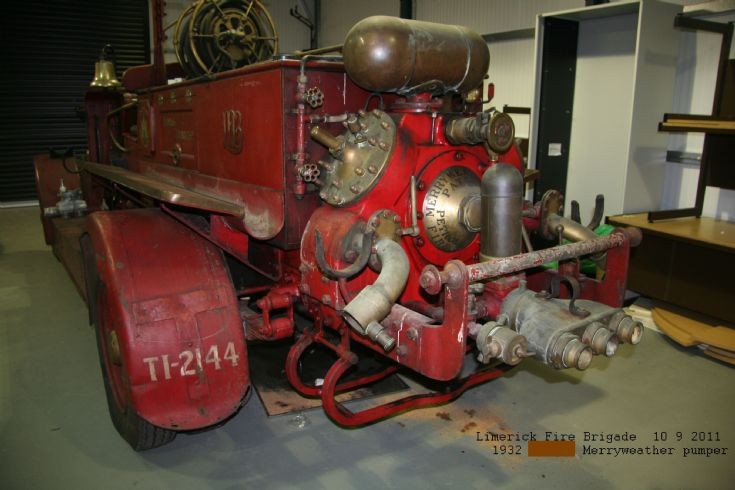


But this appliance was originally specified as a pump escape - and the vertical air chamber was changed to a horizontal design, so as to reduce its height and allow room to accommodate the escape ladder carriage. The bar to accommodate the weight of the escape ladder can be seen attached to the ends of the appliance's main frame.
By 1932 the vast majority of fire pumps were "turbine" or centrifugal designs, which were much more compact and lighter. They were also small enough to be mid mounted on pump escapes, which had the advantage that the ladder did not need to be removed before the pump could be connected up and operated.
But Merryweather still built piston pumpers until 1954, when their last one was exported to Egypt.
Added by Rob Johnson on 23 April 2018.