
Upload a Picture
About this Site | Links | Random Pic | Advanced Search
Home | Latest Additions | Contributors
| Visitors
Fire Engine Photos
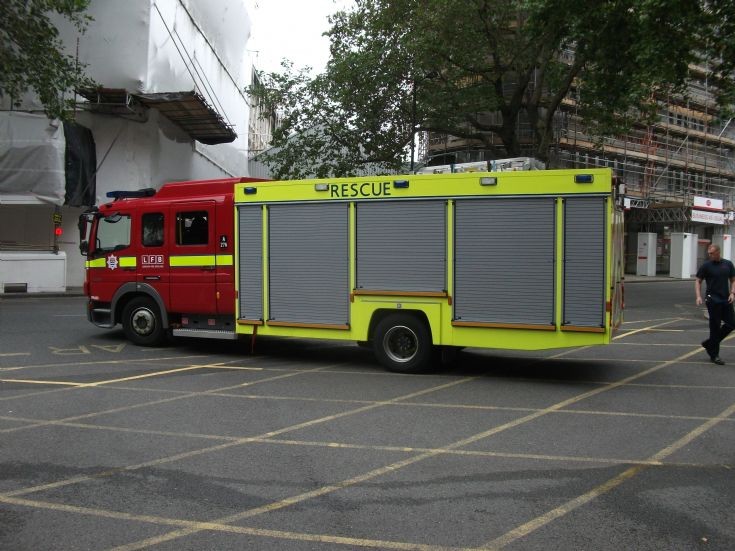
LFB A27 FRU
London Fire Brigade A27 Clerkenwell's Mercedes-Benz 1325 Fire Rescue Unit AE07HXS (FRU23) seen reversing in to the fire station on 01/09/2012
London Fire Brigade A27 Clerkenwell's Mercedes-Benz 1325 Fire Rescue Unit AE07HXS (FRU23) seen reversing in to the fire station on 01/09/2012
This picture is in the following groups
London Fire Brigade, United Kingdom
London Fire Brigade, United Kingdom
the ex Lothian and borders brigade, now part of the Scottish Fire and Rescue Service operates a Scania / Saxon heavy rescue tender at Newcraighall near Edinburgh that has a crew cab but usually it only runs with a crew of 2.
Added by D.cruickshank on 16 August 2013.
Added by D.cruickshank on 16 August 2013.
There is/was a plan to cut the number of crew on these from 6 to 5, (or was it 5 to 4) can't find the listing on the LFB web site, But it appeares that the cost cutting has had to be elsewhere and that No Station closuers(10)or Jobs cut.
Added by Chris Stone on 16 August 2013.
Added by Chris Stone on 16 August 2013.
Chris. London seems to be the only major UK fire service which has not replaced most or all of their fully crewed heavy rescues by rescue pumps.
Most US cities still operate distinct fully-manned rescue companies too, but the concept seems to have largely disappeared in most other European cities, where rescue pumpers are often standard (as in Berlin) and dedicated heavy rescue trucks are only staffed by one or two members - and often switch-manned along with other less frequently called specialist units.
The arguement for rescue pumps is strong - it clearly reduces response times if every station has a rescue pump and the service does not have to dispatch a dedicated rescue truck from a distant station. But there are some real advantages in having dedicated rescue specialists too: I was always very impressed by some of the really difficult rescues accomplished by FDNY's rescue companies when I lived in New York.
Added by Rob Johnson on 16 August 2013.
Most US cities still operate distinct fully-manned rescue companies too, but the concept seems to have largely disappeared in most other European cities, where rescue pumpers are often standard (as in Berlin) and dedicated heavy rescue trucks are only staffed by one or two members - and often switch-manned along with other less frequently called specialist units.
The arguement for rescue pumps is strong - it clearly reduces response times if every station has a rescue pump and the service does not have to dispatch a dedicated rescue truck from a distant station. But there are some real advantages in having dedicated rescue specialists too: I was always very impressed by some of the really difficult rescues accomplished by FDNY's rescue companies when I lived in New York.
Added by Rob Johnson on 16 August 2013.
Rob, Kent doesn't have any specialist heavy rescue vehicles at all, only the Rescue Pump Platforms (RPP), the Extended Pump Ladders (EPL), which carry more cutting gear than the RPL's, and Rescue Pump Ladders (RPL) if you don't inclued the Govt issued "New Dimension" Incident Response Unit's, (and they've only got 2/3 man cabs), The only specialist Rescue Vehicle is Favasham's Animal Rescue Unit which is a 3 man cabed Unimog 4x4. As for the FDNY Rescue units I spent a very busy Tour/shift with Rescue 1 in September 1996 so have a good idea on what they do. As for Europe, I don't recall seeing a Heavy Rescue unit in France, though they did have combined light rescue/pump van things for MVA's, And most German (large) towns had a "Rustwagen" though with a 3 man cab, though I only saw HLF's when I was in Hamburg. The problem seems to be in cost! Kent has a policey of "Shadow Manning" many of their 2nd Pumps and Specialist vehicles and with the new system of "On-Call" fire-fighters not every appliance (or stations) can be crewed!
Added by Chris Stone on 17 August 2013.
Added by Chris Stone on 17 August 2013.
West Sussex have 3 crew cabbed Scania Heavy Rescue Tenders that can run with a crew of between 2 & 5.
Added by Stuart Purves on 17 August 2013.
Added by Stuart Purves on 17 August 2013.
The German model was pioneered in Berlin and most large cities now have most or all of their pumps in HLF format, backed up by one or more GW1 and/ or GW2. Before the HLF concept was developed, the GW was the only kind of rescue unit, and these never were required by the DIN standards to have crew cabs, although some early ones were converted pumpers, which already did. It was assumed that every member knew how to operate all of the kit carried on the GW - no specialization here! Dutch, Danish, Swedish, Swiss, Polish, Spanish and Austrian fire services all now follow a similar model, with occasional exceptions such as Copenhagen's Econic rescue squad truck.
Paris used to have three (and only three!) heavy rescues with four man crews, but I think these may have all been replaced now by single-cab trucks. Other French SDIS have either light van-based rescues and/or larger 7.5/9.0 ton rescues, all crewed by two or three members - and Belgian fire services seem to follow the same approach.
There are also a few very well-equipped rescue pods in many major European cities, but these take time to load up and turn out, and are rather ponderous. Of course, many cities also operate dedicated dive and/or water rescue units, usually van-based but sometimes larger.
Looking at the call profiles of fire services in many different countries, the number of rescue and service calls always vastly outweighs fire calls, so the HLF concept makes total sense - but there really is a need to reinforce these with a number of dedicated rescues so that heavier equipment not carried on pumps can be quickly summoned. For example, Amsterdam has 31 pumpers at 21 stations, backed up by three light van rescues and three heavy rescues - which perhaps combines the best of both approaches. These are manned by two members dropped off a pumper, but as the standard pump crew in that city is six or seven, this does not compromise coverage too badly.
Hong Kong and Kuwait operate light rescues with a four or five man crew, but these are present in large numbers and operate along with pumpers which do not carry rescue equipment.
Added by Rob Johnson on 18 August 2013.
Paris used to have three (and only three!) heavy rescues with four man crews, but I think these may have all been replaced now by single-cab trucks. Other French SDIS have either light van-based rescues and/or larger 7.5/9.0 ton rescues, all crewed by two or three members - and Belgian fire services seem to follow the same approach.
There are also a few very well-equipped rescue pods in many major European cities, but these take time to load up and turn out, and are rather ponderous. Of course, many cities also operate dedicated dive and/or water rescue units, usually van-based but sometimes larger.
Looking at the call profiles of fire services in many different countries, the number of rescue and service calls always vastly outweighs fire calls, so the HLF concept makes total sense - but there really is a need to reinforce these with a number of dedicated rescues so that heavier equipment not carried on pumps can be quickly summoned. For example, Amsterdam has 31 pumpers at 21 stations, backed up by three light van rescues and three heavy rescues - which perhaps combines the best of both approaches. These are manned by two members dropped off a pumper, but as the standard pump crew in that city is six or seven, this does not compromise coverage too badly.
Hong Kong and Kuwait operate light rescues with a four or five man crew, but these are present in large numbers and operate along with pumpers which do not carry rescue equipment.
Added by Rob Johnson on 18 August 2013.
I believe it have to be RW-1, RW-2 or RW-3 (RW=Rüstwagen) Rob. Feuerwehr Berlin have a 2011 MAN RW3 with a crew cab.
Added by Marcel Sloover on 18 August 2013.
Added by Marcel Sloover on 18 August 2013.
Yes, the fully manned Berlin heavy rescue was commissioned when Berlin reduced their front-line rescue pump fleet a few years ago, to free up more members to crew a larger number of ambulances, which had previously been alternately-manned. Sorry about the R vs G typo!
Even so, one fully-manned heavy rescue in a city of 3.5 million people is not exactly overdoing things, especially as London has around seven for a population of 8 million.
Added by Rob Johnson on 18 August 2013.
Even so, one fully-manned heavy rescue in a city of 3.5 million people is not exactly overdoing things, especially as London has around seven for a population of 8 million.
Added by Rob Johnson on 18 August 2013.
London currently run 16 Fire Rescue Unit's (FRU)with 3 more in reserve and another 1 used for training.
Added by Chris Stone on 19 August 2013.
Added by Chris Stone on 19 August 2013.
Thanks for the update Chris. Have these additional FRUs displaced pump appliances or are they truly additional, compared to the fleet a few years back? I don't remember when I was told they had seven, but it does not seem all that long time ago.
Added by Rob Johnson on 19 August 2013.
Added by Rob Johnson on 19 August 2013.
London upped their FRU fleet after the 7th July 2005 Bombings. I also forgot to add the 5 Govt Issued Incident Response Unit's to the total, though they only have 2/3 man cabs. As for displaced pumps, not sure on that though the example pictured shares Clerkenwell fire station with only a Pump Ladder, (used to be PL, Pump)!
Added by Chris Stone on 20 August 2013.
Added by Chris Stone on 20 August 2013.
Chris I think I read it was 5-4 for crewing and reducing FRU's from 16 to 14. 10 Station closures with the loss of 14 pumps.
Added by Grant Melvile on 21 August 2013.
Added by Grant Melvile on 21 August 2013.
The Station Closures have been shelved as the LFCDA (what ever its called now) didn't approve the proposel, as for cutting appliances, not sure at the min as 27 have been "realocated" in case the FBU take strike action over the proposed pension reforms. (All are pumps from 2 pump stations, leaving them as 1 Pump, all be it a PL, but with enough personel to crew 2 machines)!
Added by Chris Stone on 21 August 2013.
Added by Chris Stone on 21 August 2013.
Have to comment that there is an international theme here. Fire services in many countries seem to be closing stations, reducing numbers of units in service and assigning smaller crews to those remaining.
There are too many examples to quote here, but some recent cutbacks are truly alarming.
Added by Rob Johnson on 22 August 2013.
There are too many examples to quote here, but some recent cutbacks are truly alarming.
Added by Rob Johnson on 22 August 2013.
Was told yesterday that the propsed Station cuts etc in London may now be going ahead as the Mayor has told the LFEPA (London Fire and Emergency Planing Authority), that they WILL implement his proposels! As for crew cabed HRU's Calais Fire and Rescue Station has a crew cabbed Renault Midlum 190/Galin reg No 4579YK62 Rescue Vehicle, I saw (and photo'd it) on Wednesday 21/08/2013
Added by Chris Stone on 24 August 2013.
Added by Chris Stone on 24 August 2013.
As far as I remember, the usual number of crew on an FRU is 4: Driver, Leading Fireman and 2 other firemen.
Added by Tiger on 05 October 2013.
Added by Tiger on 05 October 2013.
Scottish fire rescue have a crew cabbed scania but runs with a crew of two plus support pump they might use the extra space for kit it runs from easterhouse station.
Added by Colin on 23 December 2016.
Added by Colin on 23 December 2016.
Mercedes-Benz


Added by Rob Johnson on 16 August 2013.