
Upload a Picture
About this Site | Links | Random Pic | Advanced Search
Home | Latest Additions | Contributors
| Visitors
Fire Engine Photos
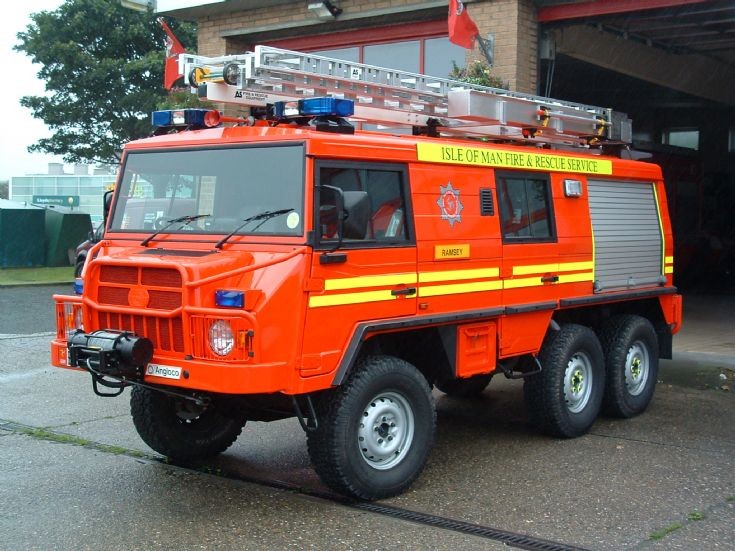
The locker space is very restricted. GMC run theirs as specials whereas North Wales have theirs as 2nd pumps with BA. They used to have a built in LPP as well as a fogging unit but now only have a hosereel pump whilst retaining the fogging unit. Not every station now has an LPP so using remote water sources must be a bit difficult.
Added by Neal Glover on 02 September 2013.
Added by Neal Glover on 02 September 2013.
I don't have the foggiest idea what a fogging unit is - not a US concept, at least not one I've ever heard of - can anyone please explain what it is?
Added by Rob Johnson on 03 September 2013.
Added by Rob Johnson on 03 September 2013.
Rob stop making me smile. I believe a fogging unit is a contraption to produce a fine water mist. I too am bemused by yet another reinvention of the humble spray nozzle. This chassis should be capable of lugging a 100 gallon water tank with a built in pto engaged pump. The Range Rover and Land Rover six leggers can. This seems to have a very large crew area for the size and purpose.
The RAF Medical Service have used these for airfield ambulances for awhile and seem impressed. They give a good account of themselves in that role, are good off road as well.
Added by John Stott on 03 September 2013.
The RAF Medical Service have used these for airfield ambulances for awhile and seem impressed. They give a good account of themselves in that role, are good off road as well.
Added by John Stott on 03 September 2013.
The only thing we had that was called a fogging unit was the F.M.C.(Food Manufactures Corp.)/John Bean High Pressure pump and Fog nozzles. They where piston pumps, putting out 900-1000 PSI at around 11 GPM. They where/are able to put out a very dense fog pattern. They have been out of production for along time.
Now, I would like a U.K. person to explain your version of a fogging unit. Also if anyone can get pictures of the pump and interior of a Pinzgauer it would be really interesting to me.
Added by Les Davis on 03 September 2013.
Now, I would like a U.K. person to explain your version of a fogging unit. Also if anyone can get pictures of the pump and interior of a Pinzgauer it would be really interesting to me.
Added by Les Davis on 03 September 2013.
Its a very high pressure water spray system similar to a pressure washer used for cleaning driveways. Used mainly for heath fires. Uses relatively small amounts of water
Added by Barrie Green on 03 September 2013.
Added by Barrie Green on 03 September 2013.
Basically an petrol engined pressure washer, very high pressure low volume pump producing high pressure fog via a lance.
Added by Neal Glover on 03 September 2013.
Added by Neal Glover on 03 September 2013.
Thanks for explaining it. Luxury, my arms still ache from beating moorland fires!
Added by John Stott on 04 September 2013.
Added by John Stott on 04 September 2013.
Thanks. Seems fashions come and go. As Les mentioned, high pressure systems were once the fad of the day here in the US but have long since disappeared. Most pumpers now do not even have hose reel systems, as the flow is considered too restricted for safe structural firefighting.
The ultra high pressure systems were invented for firefighting on ships by the US Navy, because they used very little water and therefore reduced the risk of destabilizing a ship on fire. CAFS systems were also initially developed for the same reason for use on ships.
The problem with high-pressure systems is range - the operator has to get (uncomfortably) close! This may be okay for ground vegetation fires, but can be a problem in other situations.
Here, as in Australia, newer wildland fire trucks are usually equipped with CAFS, which uses less water and also has the advantage that it works as an insulator on unburned surfaces, including vertical ones like trees and structures' walls.
Most new urban pumpers here also have CAFS, and of course CAFS systems are now standard on all new pumps in major European cities like Paris, Berlin and Madrid.
Let's see what's next!
Added by Rob Johnson on 04 September 2013.
The small fire units on Merseyside have CAFS fitted and also some of the full size appliances.
Added by Dave Price on 05 September 2013.
Added by Dave Price on 05 September 2013.
Dave:
I have heard that CAFS is being phased out in the UK for "environmental" reasons.
This seems odd, as it is being adopted with increasing enthusiasm in almost every other country.
Do you know if Merseyside are ordering more CAFS units or if they have been forced to abandon this technology?
Added by Rob Johnson on 23 March 2017.
I recently learned that Hampshire have 23 Volvo pumps with CAFS and are planning to acquire eight more, so it seems this excellent technology is still on the upswing with at least one UK fire service, as it is in many other countries...
Added by Rob Johnson on 27 March 2017.
Added by Rob Johnson on 27 March 2017.
Steyr


Added by Rob Johnson on 01 September 2013.