
Upload a Picture
About this Site | Links | Random Pic | Advanced Search
Home | Latest Additions | Contributors
| Visitors
Fire Engine Photos
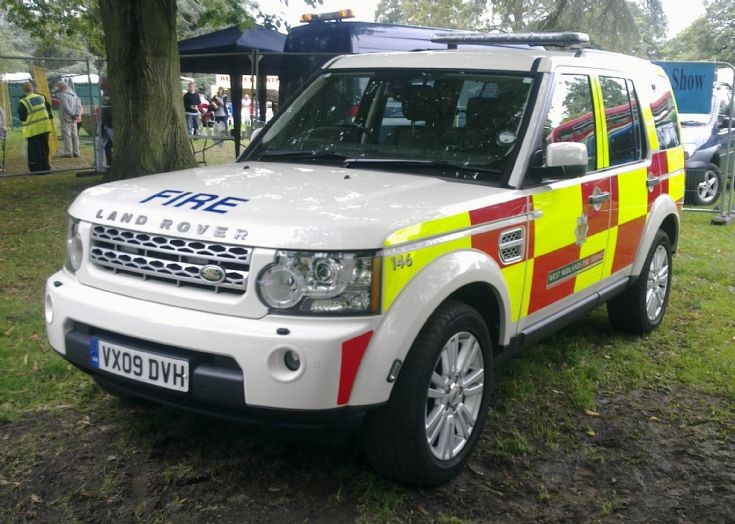
Land Rover Discovery VX09 DVH
Land Rover Discovery seen at the Himley Hall Transport Show, Shropshire, UK.
This is a new concept from West Midlands Fire Service. This vehicle carries about a minutes worth of water and will be sent to small fires to save a full crew and appliance being deployed.
Land Rover Discovery seen at the Himley Hall Transport Show, Shropshire, UK.
This is a new concept from West Midlands Fire Service. This vehicle carries about a minutes worth of water and will be sent to small fires to save a full crew and appliance being deployed.
It's a good concept, much along the line of the Targeted Response Vehicles; rapid response to small 'nuisance' fires (bins, skips, etc.) preventing them from escalating and as you say, saving the deployment of a full size PRL.
Problem is, it's primarily because of the cuts that this is having to be brought in, West Midlands Fire Service being one of the hardest hit. Worst case, this would potentially be replacing a full size PRL at certain stations.
Added by Michael Penny on 07 September 2012.
Problem is, it's primarily because of the cuts that this is having to be brought in, West Midlands Fire Service being one of the hardest hit. Worst case, this would potentially be replacing a full size PRL at certain stations.
Added by Michael Penny on 07 September 2012.
This concept is widespread in the US and many European countries. The US truck is usually based on a pickup truck chassis, like a Ford F350, and the European model is often a Sprinter, or equivalent.
It works best in big cities, where these kinds of units can handle up to 80% or more of all calls by themselves with two crew, but the problem in towns with only one fire station is that it can dilute manning on front line units. Not a problem if you have 12 or 14 people on the watch, but it gets iffy when there are only 8 or 9. It is a non-starter at a single pump station, and no help at all if you are on-call.
I hope these units have a CAFS installation - US experience tells us that it makes all the difference if you have a restricted size water tank.
Added by Rob Johnson on 07 September 2012.
What has happened to the Bremachs?
I thought that they were for these small jobs.
Still can't see how a Range Rover is value for money if West Mids are strapped for cash.
Added by Bristol Bob on 07 September 2012.
I thought that they were for these small jobs.
Still can't see how a Range Rover is value for money if West Mids are strapped for cash.
Added by Bristol Bob on 07 September 2012.
Just remembered that these are built in the Midlands, nuff said!
Added by Bristol Bob on 07 September 2012.
Added by Bristol Bob on 07 September 2012.
Again it comes down to the overall cost of these Land Rovers over their in service time span ... based on the fact that Brigades will not be paying anything like the 'normal' price for these vehicles ....been clever too as hardly any notable changes have been made to the body work ....so come auction time will fetch good money when sold on complete with full Brigade service schedule....can see the advantages as well in these tough economic times
Added by Gary bolton on 08 September 2012.
Added by Gary bolton on 08 September 2012.
It harks back to chimney vans. A good idea but as Bob rightly points out the cost! Maybe its a lease like most fleets?
The USAF had a concept of the "ramp truck", usually a Jeep pick up or Dodge. They patrolled flight lines and were on scene for engine start ups etc.
The idea is a good one and gets knocked a lot in the UK. Usually by manning arguments which is wrong in my opinion. First strike is usually fast and efficient when working practices are changed accordingly.
Added by John Stott on 08 September 2012.
Bremachs were replaced with these Land Rovers and regarding where they are based at, as follows: one based at Tipton, the other at Dudley and I think one in Coventry not 100% sure on that one.
Added by Fozaib Khan on 09 September 2012.
Added by Fozaib Khan on 09 September 2012.
It will all end in tears! Chimney vans were withdrawn over night during the 60' when a chimney fire turned out to be a house fire "persons reported" in the West Country and two children lost their lives
Added by Avonmouth on 10 September 2012.
Added by Avonmouth on 10 September 2012.
John you refer to 'first strike usually being fast and efficient' - I remember turning out in the late 1970's to a rubbish bin on fire at a block of flats with a water tender and crew of four - on arrival (within 5 minutes) we were confronted with a four storey block of flats 'well alight' in the communal staircase where the rubbish bin was and at least 7 persons trapped on the upper floors ! - we had two BA wearers, an officer in charge and a driver pump operator - we kept the fire contained AND commenced rescues by ladder until back arrived on a 'make up' imagine doing that with a crew of two ?? - the trouble is our incident was a rarity but it did happen - we arrived not expecting it - but crucially we had the equipment with us to make an initial attack ! The powers that be are relying on the rarity NOT happening !
Added by Rick Loudon on 10 September 2012.
Added by Rick Loudon on 10 September 2012.
Comment removed at request of Commentor
I appreciate there will always be exceptions. They are good examples, though sad ones. Albeit we can all quote shouts where there just was not enough. I went to many with a four man retained crew and waited up to an hour or more for muscle to arrive.
However these units work. The idea is sound, but, and a big but, they are first strike only. No one can deny a fully manned pump is desirable. The more the better. And yes Rick you are right. At least these units mean an attendance. If many powers that be had their way, well we would be having insurance marks on walls again!
Added by John Stott on 11 September 2012.
I am sure 100% it carries BA sets but if the incident turns out to be big then back will be ordered and a full equipped fire appliance will be sent.
Added by Fozaib Khan on 12 September 2012.
Added by Fozaib Khan on 12 September 2012.
Comment removed at request of Commentor
My thoughts exactly Andy you beat me to it ! John, all the incidents a fully crewed pump attends (and deals with)that are more than they were expecting never make the news as there is no major damage or lives lost, however, when one of these 'first strike units' attends and can't commit crews to deal with a rapidly escalating fire scenario that then becomes a major job - it will make the news for all the wrong reasons !
Added by Rick Loudon on 12 September 2012.
Added by Rick Loudon on 12 September 2012.
They do carry BA sets for sure and i've checked it with WMFS.
Added by Fozaib Khan on 13 September 2012.
Added by Fozaib Khan on 13 September 2012.
I agree Rick, wholeheartedly. As for the BA its a no, no in my book. Temptation is there to break rules we have had since RAF Neatishead and that tragedy, plus many others.
I think we have got to be realistic not emotive. First strike is a sound concept, but it is first strike only.
Any old RAF or AFD / MoD types will remember the three man "domestic" set up. Golden rule book. Do not commit until backup. Hard to do when you know persons are at risk.
I left my last retained job over this issue, three deemed enough to turn out. It was not, on a pump.
These units though, if used correctly can save escalation in small incidents.
Added by John Stott on 13 September 2012.
Yes John - its the 'peer pressure' on arrival that will cause problems - I seem to think my former brigade - Humberside had 'an issue' where , on arrival the job was too big - they 'made up' and did not commit to the property - the 'flak' they got from the locals and media ? caused problems I believe ?
Added by Rick Loudon on 13 September 2012.
Added by Rick Loudon on 13 September 2012.
The goal of these kinds of "minor alarm" response vehicles is (or should be) to actually preserve fire coverage for major incidents, not to dilute it.
In European cities which use them, they are mainly dispatched to special service calls, RTAs, AFAs, trash fires, car fires, and other non-structure fire events of a minor nature. They are NOT meant to substitute for full-size units with full crews, but to make sure these are still free to attend the 10% to 20% of calls where they may be needed.
Dispatch personnel have to to be trained to identify what each incident involves, so that the correct choice is made about what and who to send. If there is any doubt, they should always err on the side of dispatching a full first alarm assignment.
In a large city with numerous stations, the issue of dispatching only two or three people with a fast response unit does not preclude rapid back-up, if needed. The problem arises, if you are in a response area covered by only one station, without enough staffing to cover both the FRU and one or more fully-manned conventional pumpers. This is not the kind of place to introduce FRUs!
Interestingly, the size of these first response units has grown over the past years, since they were introduced, to increase both their general equipment load, beef up rescue and medical first aid capabilities and add to their fire fighting capacity.
European emergency services have been on quite a steep learning curve to figure out what they should be carrying (including, always, 2 or 3 BA sets).
From this, I suspect the Land Rover is simply not big enough to transport a truly useful and versatile enough equipment load for it to be effective in all but the most minor of incidents. Most of the recent German "Kleinalarmfahrzeuge" are at least long wheelbase Sprinters or Varios with a 5 to 8 tonne GVW.
If UK services are to go this way, perhaps they should take a good look at the experience of some major European cities, instead of trying to reinvent a wheel which has been happily rolling along for around twenty years.
Added by Rob Johnson on 13 September 2012.
I think you've nailed it John no point sending these units to a multiple calls on a blazing wharehouse in the middle of town but a burning pallet on some waste ground then yes ....its about deployment - but Rick has a point you have to trust that the call out is as the caller is saying not that it turns out to be a larger incident on arrival ....I guess this is were control room training kicks in .I have lost count of the number of times we were called out to really small jobs that only required a splash of water or less ....so yes I can see that the concept does have some legs subject to correct questioning of the caller
Added by Gary Bolton on 13 September 2012.
Added by Gary Bolton on 13 September 2012.
Cant beat a WrT/WrL to any incident, what has been neglected in all this is that WMFRS found that Bremachs had not got the "road visability" of an appliance. Also they do not have the flexability to be redirected from a bin fire to a house fire 1/2 mile away, reduces the ability to deal with "makeups" and really puts the OIC in a awful position if call turns out to be more than expected. Combine this with the fact that backup is 3-4 mins away is a long gone dewy eyed fantasy, this is a bean counter induced recipe for disaster that risks public and professional crews alike.
Added by Gary Simpson on 14 September 2012.
Added by Gary Simpson on 14 September 2012.
Land Rover


Range Rovers are expensive, perhaps West Mids are awash with money.
Added by Bristol Bob on 07 September 2012.