
Upload a Picture
About this Site | Links | Random Pic | Advanced Search
Home | Latest Additions | Contributors
| Visitors
Fire Engine Photos
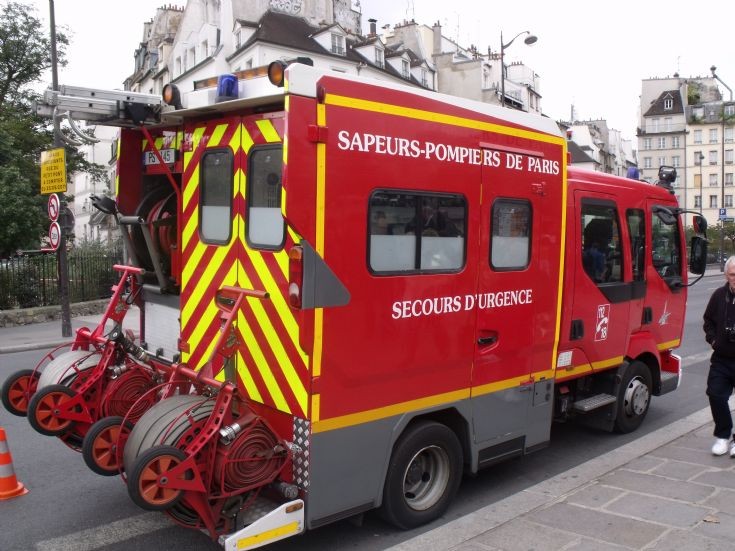
This unit's pump is rated at 1000 LPM at 15 AT. The PS has a 1000 liter water tank and a 20 liter foam tank. It has a single high pressure 23mm diameter hose reel, two one-man hose carts with both 70mm and 45mm hose, a short extension ladder and a hook ladder. Hook ladders are still carried on all Paris' pumpers, as they were originally invented in Paris and are still actually used quite often.
In addition, about half of the PS fleet - the more recently acquired ones - are equipped with a CAFS system. The PS invariably has a crew of five.
There are 72 fire and rescue stations in the BSPP area, operating 112 of these units, along with 44 2000 LPM dedicated fire pumpers, 37 aerials and around 140 ambulances, plus numerous additional special and command vehicles.
First response to structure fires includes both a 2000 LPM pumper and an aerial truck, as well as at least one Premier Secours - a total of 12 to 17 personnel.
BSPP reports that around 85% of all calls are for EMS, compared to less than 3.5% actual fires, so the PS tend to make many more EMS turnouts than fire runs. Even so, BSPP reports that these relatively small PS trucks actually deal with a high percentage of fires on their own, without needing the help of the supporting units which respond with them.
BSPP operate two main different levels of ambulances, corresponding more or less to the US ALS and BLS categories. I don't know exactly where the PS fits in, but I believe we would call it a BLS unit.
Added by Rob Johnson on 14 December 2013.
In addition, about half of the PS fleet - the more recently acquired ones - are equipped with a CAFS system. The PS invariably has a crew of five.
There are 72 fire and rescue stations in the BSPP area, operating 112 of these units, along with 44 2000 LPM dedicated fire pumpers, 37 aerials and around 140 ambulances, plus numerous additional special and command vehicles.
First response to structure fires includes both a 2000 LPM pumper and an aerial truck, as well as at least one Premier Secours - a total of 12 to 17 personnel.
BSPP reports that around 85% of all calls are for EMS, compared to less than 3.5% actual fires, so the PS tend to make many more EMS turnouts than fire runs. Even so, BSPP reports that these relatively small PS trucks actually deal with a high percentage of fires on their own, without needing the help of the supporting units which respond with them.
BSPP operate two main different levels of ambulances, corresponding more or less to the US ALS and BLS categories. I don't know exactly where the PS fits in, but I believe we would call it a BLS unit.
Added by Rob Johnson on 14 December 2013.
Thanks Rob, they are a very interesting combo unit. Paris really doesn't spend any money on emergency lighting.
Added by Les Davis on 17 December 2013.
Added by Les Davis on 17 December 2013.
Les - There is a school of thought in all European countries that limiting the number of warning lights on apparatus actually increases safety, as it reduces confusion and distraction on the part of other drivers.
It is quite the opposite here in the US. I have seen apparatus with no less than twenty-five assorted rotating, flashing and strobe lights - including red, blue, yellow, white and green on the same vehicle!
Having driven in Europe for half my life before moving here, I do tend to see the European perspective. A hi-rise first response in Chicago, where I live now, brings ten or more CFD vehicles and a few police cars. At night, when the streets are wet, all the varoius multicolored lights can be very distracting.
Added by Rob Johnson on 17 December 2013.
It is quite the opposite here in the US. I have seen apparatus with no less than twenty-five assorted rotating, flashing and strobe lights - including red, blue, yellow, white and green on the same vehicle!
Having driven in Europe for half my life before moving here, I do tend to see the European perspective. A hi-rise first response in Chicago, where I live now, brings ten or more CFD vehicles and a few police cars. At night, when the streets are wet, all the varoius multicolored lights can be very distracting.
Added by Rob Johnson on 17 December 2013.
Rob, I can see their point. But the Paris units need a few more lights. They remind me of the US military Fire trucks of 50's and 60's very few lights.
Added by Les Davis on 18 December 2013.
Added by Les Davis on 18 December 2013.
Theres 77 Stns, nearer 60 aerials, BSPP runs around 66 EMS ambs.
Added by Mark Corfield on 23 December 2013.
Added by Mark Corfield on 23 December 2013.
Mark - you seem to be quoting Wikipedia, which has incorrect information. As an example, the site does not even mention their enormous fleet of these unique pumper-ambulance units.
Added by Rob Johnson on 19 April 2017.
Added by Rob Johnson on 19 April 2017.
Hi Rob, that was on a leaflet given to me by Paris FB not Wiki
Added by Mark Corfield on 08 March 2021.
Added by Mark Corfield on 08 March 2021.
Mark - the BSPP website is usually pretty much up to date as far as the fleet composition goes.
Added by Rob Johnson on 09 March 2021.
Added by Rob Johnson on 09 March 2021.
Because of a major increase in medical calls during and following the Covid pandemic BSPP are now phasing out these combination trucks, replacing them with increased numbers of separate dedicated ambulances and compact fire pumpers. The increase in medical calls was tying up too many of these dual purpose units and reducing their availability to respond to fire emergencies. The new compact pumpers have essentially the same firefighting capacities as the combination units, but with a larger water tank and some additional equipment. They have a five person crew.
Added by Rob Johnson on 10 July 2023.
Added by Rob Johnson on 10 July 2023.
picture 43841 illustrates one of these new light pump water tender trucks recently placed into service in Paris in lieu of a discontinued PS combination unit.
Added by Rob Johnson on 10 July 2023.
Added by Rob Johnson on 10 July 2023.
Renault


Also what are the tank and pump spec. and do you have any other info. on them.
Added by Les Davis on 11 October 2011.