
Upload a Picture
About this Site | Links | Random Pic | Advanced Search
Home | Latest Additions | Contributors
| Visitors
Fire Engine Photos
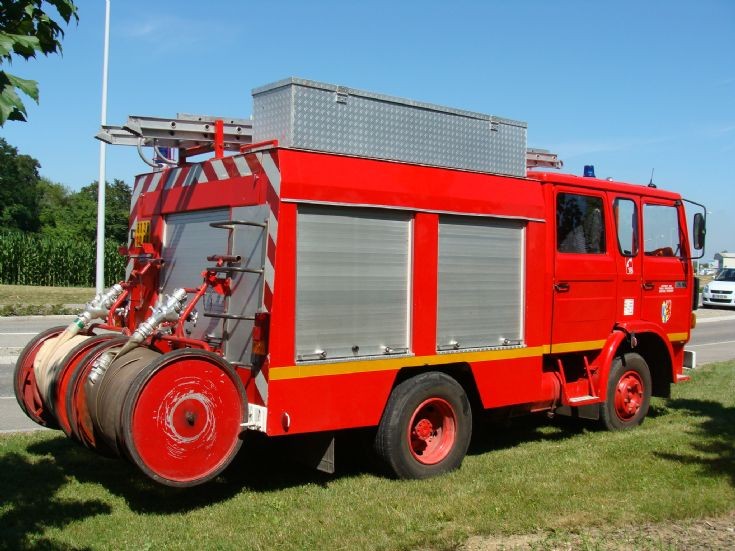
The 70 MM hose is in ten lengths of 20 meters on each hose cart. For a short run, all you do is uncouple at the length nearest the pump, and hook up. The carts are very useful if you need to run hose around corners, typical of many French towns, where you often can't get the truck into the narrow streets. They also increase the locker space for other equipment, and are used by other European brigades, including Germany, where similar challenges are commonplace. Because these hoses have Stortz couplings, one cart can be taken to the hydrant while the other is used to lay out the first attack line. The three-way, which is pre-attached, allows one or two 45MM attack lines to be used for small fires and inside work, and/or a further extension of the 70 MM line, if needed.
Added by Rob Johnson on 28 July 2011.
Added by Rob Johnson on 28 July 2011.
French firefighters are especially trained for this kind of situation, and know their place fire hoses in a very short time. As in most countries I think this operation is often repeated, almost daily.
Added by Lambert Arnaud on 28 July 2011.
Added by Lambert Arnaud on 28 July 2011.
Michael,
By regulation in France every drum needs 200m of hose, because this is the distance between each fire hydrant in a city, by law.
You don't need to unwind the hole drum you can just use part of it, as the drum is made of many connected hoses.
Otherwise there are also individual hoses in the trunks.
Hopes that description helps
Cheers
JP
Added by Jacques PETER on 28 July 2011.
By regulation in France every drum needs 200m of hose, because this is the distance between each fire hydrant in a city, by law.
You don't need to unwind the hole drum you can just use part of it, as the drum is made of many connected hoses.
Otherwise there are also individual hoses in the trunks.
Hopes that description helps
Cheers
JP
Added by Jacques PETER on 28 July 2011.
Thanks for the replies. I thought it looked as if it may work like a hose reel, I couldn't figure out how you could get water through a flat hose wound on a drum, or how it would connect up, with one one free end on the outer edge !
Added by Michael G. on 29 July 2011.
Added by Michael G. on 29 July 2011.
JP - it seems 200 M is a long way between hydrants - about twice what is common in other countries. I have seen both above ground and below ground hydrants when I lived in France - is there any standard? Paris pumpers (excluding PS) seem to also carry 200 M of 110 mm soft suction. Is this used with standard hydrants? Also, do regulations require a minimum pressure in the water mains, as 200 M of 70 MM supply line will incur quite a considerable friction loss in the hose?
I know this is an English language site, but, neanmoins, bonne journee!
Added by Rob Johnson on 29 July 2011.
I know this is an English language site, but, neanmoins, bonne journee!
Added by Rob Johnson on 29 July 2011.
I have since learned that standard French hydrants are deemed low capacity (under 1000 LPM), medium (1000 to 2000) and high capacity (over 2000 LPM); they are fitted with one or two 65mm and/or one 110mm outlets accordingly. The 110mm hoses are used both to hook up to high capacity hydrants and for water relays between pumpers when needed. When the pump does not carry 110mm hose, twinned 65mm lines are used whenever the hydrant has dual outlets.
Added by Rob Johnson on 04 January 2018.
Added by Rob Johnson on 04 January 2018.
Note also the hook ladder on the roof. Invented by the Paris fire battalion in the 1820s, these are still in daily use all over France and are a standard feature of French pumpers.
They seem to have disappeared from British appliances, although at one time hook ladders were very common.
Added by Rob Johnson on 22 November 2019.
They seem to have disappeared from British appliances, although at one time hook ladders were very common.
Added by Rob Johnson on 22 November 2019.
Renault


Added by Michael G. on 28 July 2011.