
Upload a Picture
About this Site | Links | Random Pic | Advanced Search
Home | Latest Additions | Contributors
| Visitors
Fire Engine Photos
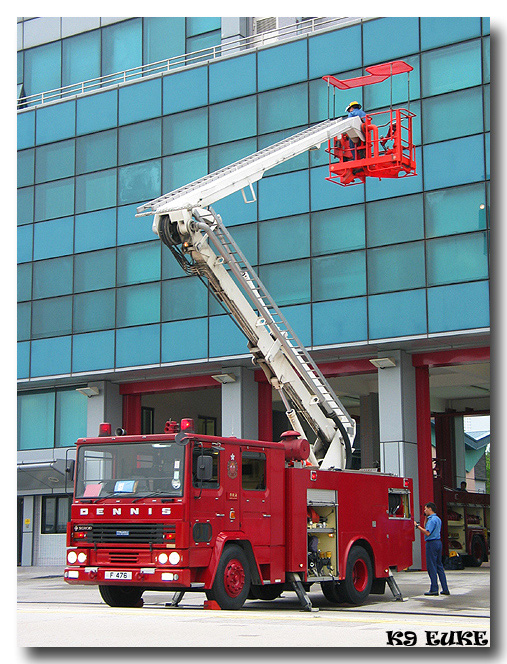
The 50 or 55 foot snorkel combined with a standard pump appliance was a short-lived idea.
I know of no fire service anywhere who replaced them with more of the same types of units.
They were heavy, relatively slow, had a high center of gravity, and had a quite restricted operating range. Like the more recently introduced and even bigger CARP appliances, they offered more compromises than practical usefulness.
Added by Rob Johnson on 25 July 2017.
HKFSD replaced the Dennis RS Hydraulic Platform with Scania 94G Hydraulic Platform started from 1999, then P series, with around 50 being delivered by 2016. I think Hong Kong is the only place to put a hydraulic platform on a type B appliance, with a smaller water tank. The problem of high C of G being very true, when Scania HP was first being introduced, the little tsunami in a half empty water tank caused the appliance to overturn whilst travelling at speed to a shout, they were prepared for the demand for a pump appliance, but not HP, they never prepared for that, the added height (C of G) and also the platform itself and the swaying motion like fish makes the appliance easy to lost stability, FSD lost 2 brand new appliance within a year. Rumoured was Dennis Sabre/Carmichael also made a quote but didn't got shortlisted, wonder would they be any better.
I think HKFSD still kept 16m Hydraulic Platform is in the old urban areas, HK Island/Mong Kok, old buildings without stairs were of that height and the platform comes handy for an evacuation, turntable ladder and ALP used up more space with their jacks, with the 'ïf is not break don't fix it' mentality, it remains their mainstay, used in some stations that don't require the high level rescue.
Added by Kevin Lo on 31 December 2021.
Comment removed at request of Commentor
Comment removed at request of Commentor

Thanks for this update. I was not aware that Hong Kong persisted with these, nor that they were the original buyers. My comment was based on research in the UK, where there were no incidences of these being replaced by similar units that I could find. Indeed there were many cases where they were prematurely placed on reserve status, relegated to second due roles or quite often sold off after only a few years. Several fairly new 50 foot Snorkels ended up in the Irish Republic, after being sold off by British brigades at what I suspect would have been bargain prices.
A similar fate awaited the 50 foot aerial quint in the USA, along with the similar Telesquirt. Both suffered the same problems of being a compromised design which looked good on paper but had limited usefulness. Chicago FD does operate four 55 foot aerial platforms, but these are associated with Rescue Companies and are not fitted with pumps, tanks or hose beds. Unusually, they do not have crew cabs either. No other large American city has these.
Added by Rob Johnson on 03 January 2022.
One of Chicago's 55 foot platforms is illustrated in picture 40923. This example is in yellow livery as it is based at O'Hare Airport; the others are standard black over red.
Added by Rob Johnson on 03 January 2022.
Added by Rob Johnson on 03 January 2022.
Didn't know they removed the SCA160A from their appliance although one of the last Dennis RS (re-engined Cummins ISC) (Oct last year) and the first life expired Scania 94G did have their platform with them when they went to breakers.The reason why they persist with them, (the in charge officer usually ride the HP to the scene) is that for every shout, they send 4 appliances to the scene, a Major Pump, a Hydraulic Platform, Sprinter/MAN TGL sized Light Rescue Unit (without water) and maybe a turntable ladder, the Major Pump supplies water to the HP although HP could do it on its own if it is based in a HP only station, so water capacity is not a major issue, MP uses up less road space with different jacks and could go up to older low buildings with no staircase, it could comes handy after a typhoon when trees needed to be hit, size B length, also make it maneuverable in even inner city back street. In fact, they have tried TP318NUP platform but it was unsatisfactory, that batch was grounded and have not entered service 10 years later
Added by Kevin Lo on 06 January 2022.
Added by Kevin Lo on 06 January 2022.
Dennis


Added by Terence Lung on 12 August 2007.