
Upload a Picture
About this Site | Links | Random Pic | Advanced Search
Home | Latest Additions | Contributors
| Visitors
Fire Engine Photos
FYI 99% of all fire engines in the U.S. have the majority of their hose already connected and laying (stowed) up top, where it is ready to be pulled off the rear of the apparatus (cross lays are the exception). Aside from a 50 foot length here or there our hose is never stored in compartments. Hope this helps
Added by Todd on 25 April 2011.
Added by Todd on 25 April 2011.
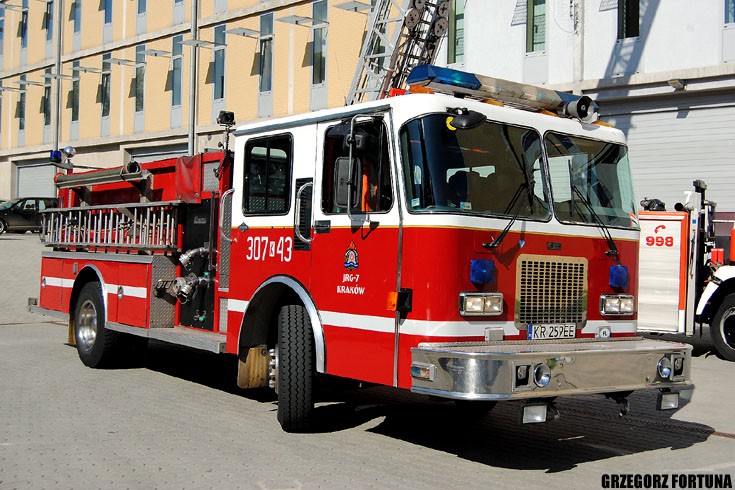
Thanks Todd, but I already know that having been a volunteer firefighter and driver in the US. This truck is being operated in Poland, and I was wondering if they were stowing the hose the same way we do in the US. I was also wondering if the truck is being used primarily for long lays and as a water supply pumper, than a rescue pumper. Unless there are full height compartments on the driver's side, trucks like these can't carry as much rescue equipment as the European engines can.
Added by David L on 25 April 2011.
Added by David L on 25 April 2011.
My bad David. I did not know you were from the U.S. All great questions that I can not wait to hear the answers to.
Added by Todd on 25 April 2011.
Added by Todd on 25 April 2011.
Are US trucks common in Poland? I've not known of one before this, I'd be interested to hear how this style of vehicle works alongside European style appliances, whats its purpose, what equipment does it carry etc etc.
Added by Monkey Boy The 3rd on 26 April 2011.
Added by Monkey Boy The 3rd on 26 April 2011.
This is in fact a rescue pumper. The number "43" indicates a rescue truck. It carries primarily rescue equipment (a Holmatro hydraulic tools set, a Partner saw, a manual winch and so on)and a very limited amount of hose, which is stored in the compartments (in 'dutch rolls'). I actually do wonder why nobody ever thought of using it as a pure hose carrier/water supply pumper.In Cracow, they use a trailer pump and a 4x4 hose unit on Star 944 chassis for such purposes. The Spartan was a 'regular' pumper for years (the truck was delivered in 1992 as one of only two Spartans ever bought by the Polish State Fire Service - the other one was allocated to Częstochowa). After a few years, it became a 'reserve' vehicle (I wrote this in inverted commas as we do not have vehicles with official reserve status in this country) and changed stations a few times. Curiously, when a 1988 Steyr/Rosenbauer rescue pumper had to be withdrawn from service at Station 7, the station's commander chose the Spartan over a 1999 Mercedes 1124 as a replacement.
There were more American 'rigs' delivered in 1992-3, inbcluding E-One Hush pumpers, E-One Hurricane quints, Ford/E-One light and heavy rescues, Ford/E-One RIVs and a single Ford Explorer/E-One commander's car. They proved to be cumbersome, inefficient (horribly high fuel consumption for European standards, while only limited water/storage/pumping capacity in return) and hard to used in the narrow streets of our cities. They're great for parades, open days and such, but inadequate in the day-to-day service. Their introduction was an experiment that - all things considered - failed. But at the beginning, E-One were actually planning to open an assembly line in Poland - in Mielec.
Hope this helps ;)
Added by Konrad Nowak on 26 April 2011.
Thanks for that Konrad. Very interesting. I would love to see some more photos of these trucks or even in action at a fire!
Added by Dermot Duffy on 26 April 2011.
Added by Dermot Duffy on 26 April 2011.
Good work Konrad, well done and thank you. I would also like to see more of these American rigs in Poland if anyone has anything similar to share.
Added by Monkey Boy The 3rd on 27 April 2011.
Added by Monkey Boy The 3rd on 27 April 2011.
That's okay Todd. I appreciate your answer.
To Konrad: thanks for providing that information. I find that really amazing, seeing how the US style trucks are designed to make 300 meter or longer hose lays. Instead of using it for that, they use it as a rescue pumper. In the city that this truck serves, doesn't it have rivers, lakes, or cisterns, if not large capacity hydrants for large fires?
If Grzegorz is reading this, would it be possible sometime to get and upload: left side, rear view, and top side photos of this truck? Would be interesting to see how equipment is stowed on the rest of the truck. Nice photo of the right side by the way.
Thanks
Added by David L on 27 April 2011.
Spartan


Added by David L on 25 April 2011.