
Upload a Picture
About this Site | Links | Random Pic | Advanced Search
Home | Latest Additions | Contributors
| Visitors
Fire Engine Photos
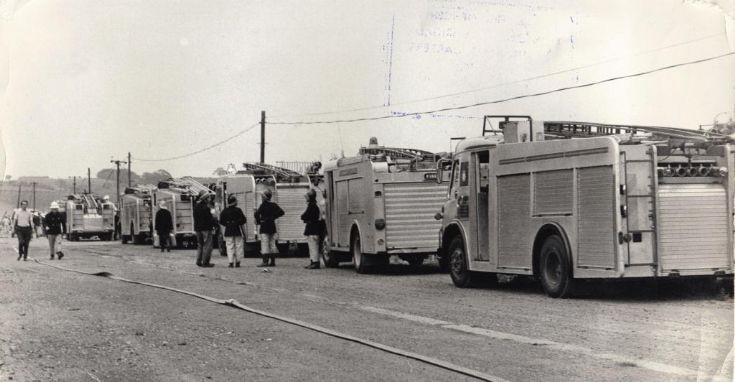
Hi Glenn. Many thanks for sharing these very interesting shots. I know a pump went from Tadcaster, I think it will have been a Dodge Water Ladder
Added by Paul Warnock on 01 April 2011.
Added by Paul Warnock on 01 April 2011.
Thanks for sharing this Glenn. My stepfather attended with the PE from Grimsby and commented on the smoke that was visible for a considerable distance. As you have already mentioned, the Humber Bridge was not built and the road structure was nothing like what it is today. All I can say is that it must have taken some considerable time to muster all these appliances from far and wide.
Added by Mike Burnett on 02 April 2011.
Added by Mike Burnett on 02 April 2011.
Glenn, thank you for the summary of this incident,
i remember the press coverage of it and I think FIRE magazine had an in depth supplement, (i may be wrong about that, it was a long time ago)
Added by Bristol Bob on 02 April 2011.
i remember the press coverage of it and I think FIRE magazine had an in depth supplement, (i may be wrong about that, it was a long time ago)
Added by Bristol Bob on 02 April 2011.
Furher to what Glenn has said, the folowing times might give some idea of the incident size and effects.
1653: TOC:
1654: Leaving Station: Make Pumps 5.
1656: HP & FoT Required
1701: Make Pumps 10. (2 miles distant)
1702: En-route: Make Pumps 20.
1729: HL Required.
1732: Make Pumps 30.
1750 All retained personnel in A & B Divisions to remain on standby
1822: Control Unit Required. (Yes, they had to ask for it !)
Added by Ian Moore on 02 April 2011.
1653: TOC:
1654: Leaving Station: Make Pumps 5.
1656: HP & FoT Required
1701: Make Pumps 10. (2 miles distant)
1702: En-route: Make Pumps 20.
1729: HL Required.
1732: Make Pumps 30.
1750 All retained personnel in A & B Divisions to remain on standby
1822: Control Unit Required. (Yes, they had to ask for it !)
Added by Ian Moore on 02 April 2011.
Dear Mr Ramsden, Thank you very much for the Flixborough pictures, very interesting.
Added by Steve King on 02 April 2011.
Added by Steve King on 02 April 2011.
Glenn,
Interesting about Normanby Steel Works. Whilst the report to "FIRE" mentioned 10 pumps as being sent too, the brigade attendance only showed seven.
Added by Ian Moore on 03 April 2011.
Interesting about Normanby Steel Works. Whilst the report to "FIRE" mentioned 10 pumps as being sent too, the brigade attendance only showed seven.
Added by Ian Moore on 03 April 2011.
The Normanby Park works attendance included a pump from Denton in Greater Manchester - the risk to the blast furnaces was considerable and the general consensus is that if the furnaces had exploded it would have been a larger incident than the 50 odd pumps that attended Flixborough, I joined Humberside in January 1976 and the site was still a scene of devastation - we had many small jobs there - at the time of the blast I was at the local steelworks annual gala in Scunthorpe aged 17 - I remember hearing the explosion and the resulting confusion all around town - we lived in the next street to the fire station in Scunthorpe at the time - some shops in the town centre 5 miles away from the explosion had their windows shattered in the blast wave - when I went to work on the Monday morning (I worked in a drawing office at the time) the office wall nearest the blast (4 miles) was a row of bookshelves - every book was at the opposite end of the office !
Added by Rick Loudon on 03 April 2011.
Added by Rick Loudon on 03 April 2011.
Thankyou Glenn, a very interesting summary. I can remember the reports on the television.
Added by Andy Holtham on 03 April 2011.
Added by Andy Holtham on 03 April 2011.
I think Scarborough were stood by in Hull. I think they got 2 HLs out of HO stores as well as West Ridings ex AFS HL which may have been on 31/2" hose. The future in laws heard the bang in Anlaby on Hulls western boundry.
Added by Neal Glover on 03 April 2011.
Added by Neal Glover on 03 April 2011.
Quite right Neal - two HLs did indeed come from HO Stores.
Rick: It would seem probable that the 50 pumps you mention probably included the first reliefs, since I agree with Glenn, that last make-up from the job was to 30 pumps.
Added by Ian Moore on 04 April 2011.
Rick: It would seem probable that the 50 pumps you mention probably included the first reliefs, since I agree with Glenn, that last make-up from the job was to 30 pumps.
Added by Ian Moore on 04 April 2011.
I think some hose laying kit came from the store at Goxhill too, anyone clarify this?
Added by Glenn Ramsden on 04 April 2011.
Added by Glenn Ramsden on 04 April 2011.
what was the consensus on me posting other Flixborough pictures guys? Not many that have got fire engines on them but all interesting....
Added by Glenn Ramsden on 04 April 2011.
Added by Glenn Ramsden on 04 April 2011.
I've no problems Glenn ! and Ian the job was always referred to as a 'fifty pumper' but in truth probably included specials in the fifty
Added by Rick Loudon on 05 April 2011.
Added by Rick Loudon on 05 April 2011.
I understood that the HL equipment came from Goxhill along with two Green Goddesses. This I have only heard from fireman and reports that I have seen and read.
Added by Mike Burnett on 05 April 2011.
Added by Mike Burnett on 05 April 2011.
I would be very interested in seeing more photos please Glenn.
Added by Paul Warnock on 05 April 2011.
Added by Paul Warnock on 05 April 2011.
Glenn, maybe ask the Marcels for their thoughts.
I am sure a number of people would be interested in the pictures, including me, but this is a fire
engine site, not a fireground picture site, sorry if this sounds a bit negative.
Added by Bristol Bob on 05 April 2011.
I am sure a number of people would be interested in the pictures, including me, but this is a fire
engine site, not a fireground picture site, sorry if this sounds a bit negative.
Added by Bristol Bob on 05 April 2011.
Glenn - yes, I'd heard mention of Gloxhil, as well. Never had it confirmed 100% though.
The Grimsby PE - and its speed - are almost legendary, yet strangely enough they don't show up in the attendance details. Probably this was due to what Lancashire term "Zone Mobilisation" and we know as "District Mobilisation", or in other words, otb pumps (and remember Louth did much of the mobilisation) sometimes come from brigades other than that from which they are requested.
Added by Ian Moore. on 05 April 2011.
The Grimsby PE - and its speed - are almost legendary, yet strangely enough they don't show up in the attendance details. Probably this was due to what Lancashire term "Zone Mobilisation" and we know as "District Mobilisation", or in other words, otb pumps (and remember Louth did much of the mobilisation) sometimes come from brigades other than that from which they are requested.
Added by Ian Moore. on 05 April 2011.
It must have been a mobilising nightmare. Each brigade presumably ring round in ever wider circles trying to find stand by's. I suppose at least there would be half a dozen or so fewer brigades than pre April 1st, assuming they had got all the control rooms sorted. I wonder if the mobilising records survive? Probably been computerised out of existence.
Added by Neal Glover on 05 April 2011.
Added by Neal Glover on 05 April 2011.
It would make sense to send EPs as base pumps. At that time there would still be people around who had worked with HO gear. How far is Goxhill from Flixborough?
Added by Neal Glover on 05 April 2011.
Added by Neal Glover on 05 April 2011.
Where did the Grimsby PE start braking? I did hear of a Dennis ET with a B81 in it getting to 102 on the M6 on the way to a shout at Manchester Airport. The fuel tanks must have been near lt empty on arrival. 2 MPG? at that speed.
Added by Neal Glover on 05 April 2011.
Added by Neal Glover on 05 April 2011.
Rick,
Yes, I know it was often referred to as a 50 pumper, but I have the official brigade log, and the highest make-up was 30 as Glenn has already said. In all probability the figure of 50 included the first reliefs. The specials attending were in fact remarkably low in number.
Added by Ian Moore on 06 April 2011.
Yes, I know it was often referred to as a 50 pumper, but I have the official brigade log, and the highest make-up was 30 as Glenn has already said. In all probability the figure of 50 included the first reliefs. The specials attending were in fact remarkably low in number.
Added by Ian Moore on 06 April 2011.
Neal
Knowing Dave as I do he probably didn't brake !!! the PE would have been 'nicely warmed up' being a petrol engine and having travelled 30 miles or so from Grimsby - I remember turning out to the steelworks one night after having just come back from a shout there (when 'the full circus' went on pda)and the old Bedford ET, BBE 157B flew there - again nicely warmed up - usually it would pop and bang and hiss at us till it was warm !
Added by Rick Loudon on 06 April 2011.
Knowing Dave as I do he probably didn't brake !!! the PE would have been 'nicely warmed up' being a petrol engine and having travelled 30 miles or so from Grimsby - I remember turning out to the steelworks one night after having just come back from a shout there (when 'the full circus' went on pda)and the old Bedford ET, BBE 157B flew there - again nicely warmed up - usually it would pop and bang and hiss at us till it was warm !
Added by Rick Loudon on 06 April 2011.
Rick Loudon has now published a comprehensive book on the disaster which I am just reading. His email address is above - just click on the blue hyperlink. It makes very interesting reading as we come up to the 50th anniversary of the disaster.
Added by Petros on 26 April 2024.
Added by Petros on 26 April 2024.
Other


The Nypro plant was about four and a half miles north west of Scunthorpe on the east bank of the River Trent. At more than 60 acres in size the factory provided employment for approximately 560 people, manufacturing their main product Caprolactum, a basic material used in the manufacturing of textiles and carpets.
Following a direct fire alarm call, fire engines from Scunthorpe Fire Station set off for the factory and because of the huge plume of smoke over the plant an assistance message was sent requesting five fire engines to attend. As the crews headed towards the Nypro plant it soon became clear that this was something much more than an everyday industrial fire. Many of the houses and buildings up to four and a half miles away from the site were badly damaged, on seeing this devastation a further assistance message was sent asking for a fleet of ambulances to be sent to the scene.
Much later it was discovered that some panels from the plant had landed in the village of North Ferriby more than 10 miles away on the north bank of the River Humber.
Still two miles away, the Station Officer on the first fire engine requested 10 fire engines to attend the scene, a message which stood for only a few minutes because when he arrived at the incident, he asked for 20 engines stating “the whole area is devastated”. The rendezvous point for the Nypro plant was the car park, when the first fire engines arrived the car park was none existent except for a couple of twisted, burning remains of workers cars.
Not long after their arrival at the fire, assistance was requested for 30 fire engines… Just a quick note here, remember this was before the Humber Bridge was opened and the journey round from Hull took some considerable time.
Many of the areas not affected directly by the severe fires were extensively damaged by the blast. It was also essential to cool some of the tanks and spheres not yet affected to prevent further explosions and loss. Huge quantities of water were needed not only to combat the blaze but also to help with the cooling operation but it soon became clear that the factory water mains and pump had been ruptured in the explosion. The nearest water supply was the River Trent, a tidal river so a barge had to be commandeered to provide a floating platform for ten light pumps.
Six inch hose was laid as soon as possible to supply more water to the heart of the operation. At the height of the incident the equivalent of 19 miles of firefighting hose was used to combat the Nypro fire.
Additionally the pipeline supplying the blast furnace cooling at the nearby Normanby Park Steelworks had been shattered in the explosion creating an extreme risk of an explosion. A further 10 fire engines were sent to the site to provide the urgently required water supplies.
Breathing apparatus played a big part in the search for survivors in the initial stages but in view of the chances of survival being remote and the dangers of further explosions, fire crews were withdrawn for their own safety.
A constant threat was the huge toxic cloud that hung over the site and in view of this over 3, 000 people had to be evacuated from nearby villages and further people had to be evacuated on the North Bank of the Humber as the cloud drifted.
Whilst it any chance of survival was clearly ruled out, three days after the explosion fire fighters investigating the explosion found three kittens alive and well near to the factory control room. Others in the litter sadly didn’t survive.
A tall distillation tower had been dislodged by the explosion and posed a further risk to fire crews and it started to sway about, as there was a danger of collapse, an specialist crane was brought on to the site and the 80 tonnes tower was laid on it’s side.
The last fire to be extinguished on the site was a flange fire in a cyclohexane tank which was left burning for 16 days, once this fire had been put out it was necessary to fill all of the tanks and pipework on the plant with inert foam to prevent further explosions.
The insurance claim for the incident was in excess of £37m (remember this was 1974) and interestingly it cost a further £29m to import enough Caprolactum into the UK to replace lost production.
Added by Glenn Ramsden on 01 April 2011.