
Upload a Picture
About this Site | Links | Random Pic | Advanced Search
Home | Latest Additions | Contributors
| Visitors
Fire Engine Photos
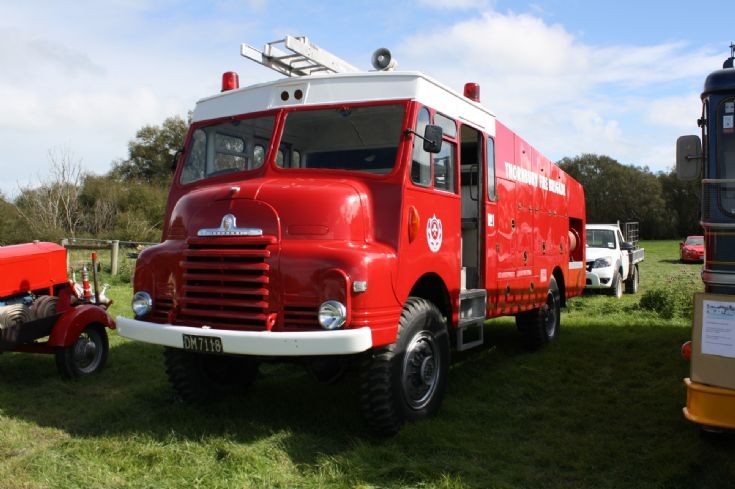
In about 1975-6 The NZ Fire Service imported 42 of these Green Goddesses. I believe they were all purchased through Vass. All were 4x4 and all are of this configuration. None were rechassied. About 4 remain in preservation, most repainted green
Added by John Walker on 21 March 2011.
Added by John Walker on 21 March 2011.
That raises the question. Were the first 4x4 goddesses the same configeration as the 4x2s, with the main batches fitted with 350gall tanks as a result of experience??? What size tanks are the New Zealand ones?
Added by Neal Glover on 21 March 2011.
Added by Neal Glover on 21 March 2011.
hi
The 4x2 make had a 400 gallon tank, and 4x4 make had a 300 gallon tank.The difference is the hose reel for a 4x2 is at the back, and a 4x4 is in the middle, ie just in front of the back wheel.4x2 make was the frist road green goddess mid 50s make, then the 4x4 make came in late 50s.As we no in 1968 when the AFS was dispand the early green goddess was sold off or srap.The 4x4 ones was put stores.
Added by Mark Whiteley on 23 March 2011.
The 4x2 make had a 400 gallon tank, and 4x4 make had a 300 gallon tank.The difference is the hose reel for a 4x2 is at the back, and a 4x4 is in the middle, ie just in front of the back wheel.4x2 make was the frist road green goddess mid 50s make, then the 4x4 make came in late 50s.As we no in 1968 when the AFS was dispand the early green goddess was sold off or srap.The 4x4 ones was put stores.
Added by Mark Whiteley on 23 March 2011.
That is what makes this one an oddball, as a 4x4 it should have the hosereel in the middle indicating a 300 gall tank(for 350 above read 300 [late at night]) On this piccy the hosereel is at the back indicating a 400 gall tank. According to The Green Machine some EPs exported to Tazmania were re chassied locally but no mention of ones for New Zealand. It may have been done by Vasses who had a large amount of ex Government gear probably including some cab & scuttle only Green Goddesses. It is of course easy in this case to make 1+1=3!
Added by Neal Glover on 23 March 2011.
Added by Neal Glover on 23 March 2011.
All of the GG that came here were of this configuration and all were 4x4. There is no possibility that these were rechassied as all showed signs of use albeit limited and the cost even back then would have made the importation too expensive. You can see some of these on our local appliance website www.111emergency.co.nz go to museum and vintage appliances years 50-59. Is there an ID plate on these vehicles that might shed some light on the body builder
Added by John Walker on 24 March 2011.
Added by John Walker on 24 March 2011.
Some bodybuilders had plates some just transfers in the cab, most of ours have disappeared. It might be possible to cross check the chassis number in "The Green Machine"
Added by Neal Glover on 24 March 2011.
Added by Neal Glover on 24 March 2011.
The smaller tank was installed on 4X4 GGs because they had single rear tires, which limited the weight which could be borne by the rear axle.But R series 4X4s with dual rear tires and later TKMs could safely handle a 400 gallon (or even larger) tank - and a handful of these were operated by a few county brigades.
Cambridgeshire however had several RL 4X4 water tenders with single rears and a 400 gallon tank, as well as a 1000 gallon bowser! Some airfield RLs were similarly overloaded, too....
As for the GG mix, I have documented this earlier on this site, and no longer recall the exact numbers. All of the earlier 2X4s were allocated to fire brigade AFS cohorts, as were about a third of the newer 4X4s. The rest were placed in storage, and occasionally taken out during strikes, major floods or leased to fire brigades as backup units when needed.
It is quite possible that some early single rear tire 4X4 RLs were built to the original design, like this example, with the 400 gallon tank, until someone realized the rear axle and tires were overloaded.
It would not be the first or last time a fire engine body builder overloaded a manufacturer's weight or axle weight safety limits!
Added by Rob Johnson on 30 June 2018.
Cambridgeshire however had several RL 4X4 water tenders with single rears and a 400 gallon tank, as well as a 1000 gallon bowser! Some airfield RLs were similarly overloaded, too....
As for the GG mix, I have documented this earlier on this site, and no longer recall the exact numbers. All of the earlier 2X4s were allocated to fire brigade AFS cohorts, as were about a third of the newer 4X4s. The rest were placed in storage, and occasionally taken out during strikes, major floods or leased to fire brigades as backup units when needed.
It is quite possible that some early single rear tire 4X4 RLs were built to the original design, like this example, with the 400 gallon tank, until someone realized the rear axle and tires were overloaded.
It would not be the first or last time a fire engine body builder overloaded a manufacturer's weight or axle weight safety limits!
Added by Rob Johnson on 30 June 2018.
My understanding is that the 4X4s did have a 400 gallon tank but with the overflow cut back to only allow 300 gallons. In the hot summer of 1976 we had several of these as spare appliances in Surrey and in order to carry the full 400 gallons tied a plastic bag over the overflow . The procedure was to normally run with 300 gallons and when refilling at an incident to tie the plastic bag over the overflow in the tank to allow full 400 gallons for use on the commons. Whether this was official brigade policy or just a local practice, I do not know.
Added by Keith Symes on 04 July 2018.
Added by Keith Symes on 04 July 2018.
Keith:
Very interesting!
I guess some genius who has never been to a fire thought that chopping the overflow pipe was a "fool proof" way of reducing the tank capacity - without the cost of changing the tank structure.
Nobody reckoned with just how innovative the "fools" on the Surrey fire brigade could get!
The fact that chopping down the overflow pipe was the factory's "engineered" solution to reducing the tank capacity adds to my suspicion that this was done as an afterthought, once somebody (probably at Bedford) pointed out that the rear tires would otherwise be overloaded.
By the way, overloaded is overloaded regardless of whether you are on or off road.
Added by Rob Johnson on 04 July 2018.
Very interesting!
I guess some genius who has never been to a fire thought that chopping the overflow pipe was a "fool proof" way of reducing the tank capacity - without the cost of changing the tank structure.
Nobody reckoned with just how innovative the "fools" on the Surrey fire brigade could get!
The fact that chopping down the overflow pipe was the factory's "engineered" solution to reducing the tank capacity adds to my suspicion that this was done as an afterthought, once somebody (probably at Bedford) pointed out that the rear tires would otherwise be overloaded.
By the way, overloaded is overloaded regardless of whether you are on or off road.
Added by Rob Johnson on 04 July 2018.
Bedford


Added by Neal Glover on 20 March 2011.