
Upload a Picture
About this Site | Links | Random Pic | Advanced Search
Home | Latest Additions | Contributors
| Visitors
Fire Engine Photos
Recent studies from Berlin confirm data from the USA, Netherlands and Paris that over 90% of structure fires are confined to one room and can be extinguished within less than three minutes using a 45 or 52 mm hose line delivering 1600 LPM of wet (0.1 to 0.3%) class A compressed air foam. As this requires only a 400 LPM water flow, a 1,200 litre water tank does the trick in most situations, without needing to set into a hydrant hydrant - although the SOP is usually to do so anyway. Berlin, Vienna and most Netherlands fire services are now specifying 1200 litre water tanks on CAFS-equipped urban rescue pumpers, leaving extra room and payload allowances for additional equipment -rather than continuing to specify a bigger tank.
Units which are expected to respond in areas without quick access to hydrants in these countries usually have a tank around 3,000 litres, and are often backed up by 4, 5 or 6,000 litre water tenders or tankers around 10 to 12000 litres. The more outrageous claims for CAFS effectiveness seem to be dying out. Current estimates are that for equivalent water flow, wet foam expands around fourfold and extinguishment time is reduced to between one quarter and one half of the time needed using the same quantity of plain water.
Added by Rob Johnson on 06 November 2022.
Berlin has a long history of fitting CAFS to all its pumpers. The earliest versions had a system for 400 litres of water = 1600 litres of compressed air foam. Later versions doubled this capacity, and now it has been tripled. During this evolution, the service abandoned the practice of fitting their pumpers with high pressure 23mm hose reels. All incidents which require more than a hand extinguisher are now always addressed using a 52mm pre-connected flaked attack hose line with a 400/1600 LPM shutoff branch, which also has a variable flow feature so that it can be used from 50/200 LPM upwards.
Pumpers are also equipped with branches to handle flows up to 800/3200 LPM, which are usually deployed using 75mm hose, although for short lines the smaller hose can still be used - as friction losses with compressed air foam are much lower than with plain water.
Berlin now uses CAFS on almost all classes of fire, as it brings about quicker extinguishment times and uses less water, as well as the advantage of hose lines being lighter and easier to move around.
Added by Rob Johnson on 07 November 2022.
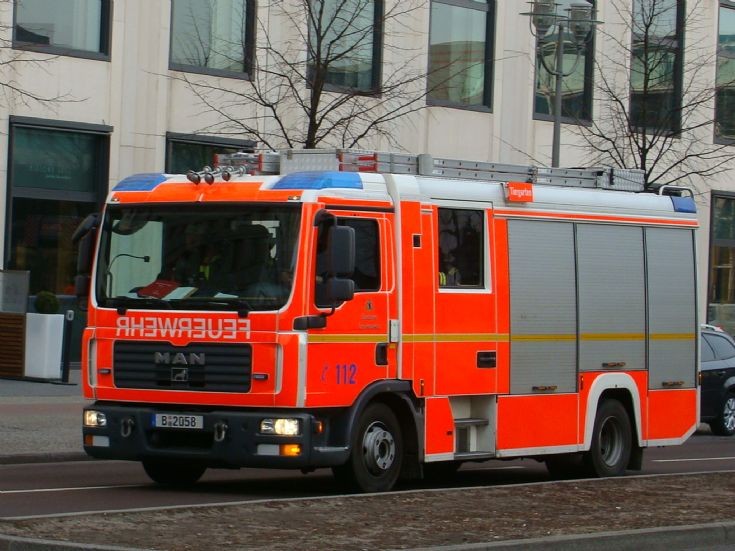
MAN


It is one of the busiest of Berlins 35 full-time fire stations, and also houses a reserve pumper, which can be jump manned if needed.
This unit has a 2, 000 LPM pump, a 1, 600 liter tank, class A and B CAFS, a comprehensive schedule of rescue and firefighting equipment and ladders, and has a six person crew. Like all Berlin's fleet, it is on a MAN chassis.
Added by Rob Johnson on 03 September 2017.