
Upload a Picture
About this Site | Links | Random Pic | Advanced Search
Home | Latest Additions | Contributors
| Visitors
Fire Engine Photos
Pav:
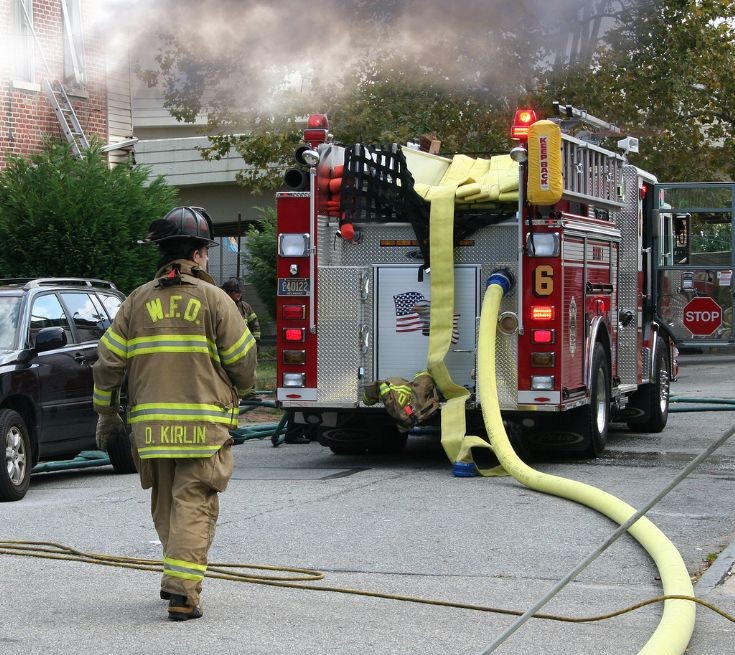
It does take a while to repack the five inch line, but the point is that you can lay it out very fast, if you drop it (and one crew member) at the nearest hydrant before you drive the pumper up to the fire - just as you see here.
Almost all US fire hydrants have a 4.5" outlet - the "steamer connection", so called because it was where the old steam pumps hooked up with their suction hoses. Using the 5" hose with this permits a very high rate of water flow over quite long distances with minimal friction losses.
The net result is that the pumper can take full advantage of the mains capacity even if it is several hundred feet away from the hydrant, and can deploy relatively short and manageable attack lines (and its deck gun to good effect, if needed), as it can be positioned virtually on top of the fire.
The old SOP of using suction hoses meant the pumper had to be next to the hydrant, not the fire!
In the old days, before 5" was used, some departments dropped twin 2.5" or 3.0" lines at the hydrant, and the second due pumper hooked up with its suction hoses and supplied the first unit.
There are videos on Youtube of this 1950s practice, with Los Angeles fire engines deploying this way.
In Chicago, I think all of the old hydrants with 2.5" outlets have been replaced. The ones we see everywhere now have dual 4.5" outlets and the minimum water main is 8" diameter, although a few 6" mains in older residential areas are still awaiting an upgrade.
The amount of five inch carried depends on the department. Most seem to have between 600 and 800 feet pre-connected in the bed, but some have 1000 feet or more.
With normal mains pressure, you can get every last gallon needed to run a 1500 GPM pump flat out with a 300 foot five inch line, which is pretty good considering that hydrants are usually much less than 600 feet apart!
Often CFD will use dual five inch supply lines from a single hydrant, especially if they need a lot of water to supply aerial and/or ground monitors at really major fires. Typically, their engines have four pump inlets - front, back and both sides. They (and many others) also store five inch on the front bumper, which can be manually laid out if they stop short of a hydrant which is a bit nearer, so-called "spotting".
Added by Rob Johnson on 05 March 2018.
Pierce


Added by Pav on 11 March 2011.