
Upload a Picture
About this Site | Links | Random Pic | Advanced Search
Home | Latest Additions | Contributors
| Visitors
Fire Engine Photos
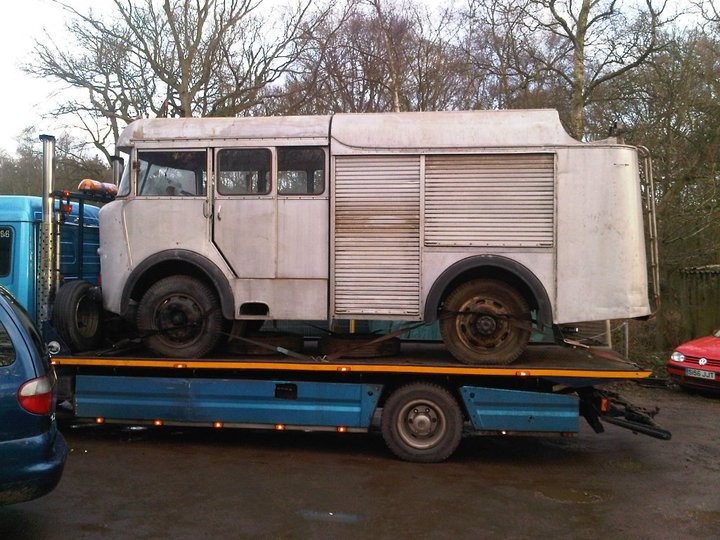
sorry the wheels are Commer/Dodge not Bedford. The hubs don't look like Bedford. So its a Rootes group chassis for me.
Added by Alan on 23 January 2011.
Added by Alan on 23 January 2011.
Looking at the picture, it looks as if the outer rear wheels are removed, maybe they are the ones laying underneath. This makes the rear hubs look different from how they would appear if the wheels were on.
Added by Michael G. on 23 January 2011.
Added by Michael G. on 23 January 2011.
Davey: Even though it has the Bedford preasing at the front, this is indeed a Dodge, with an HCB body.
Added by Ian Moore on 24 January 2011.
Added by Ian Moore on 24 January 2011.
The registration is always handy and might help.But when I first saw this picture I thought it was like an appliance I once drove and it was a Bedford J5/HCB WrT, effectionally known as the'Baby Bedford'.
Added by Pete Matten on 24 January 2011.
Added by Pete Matten on 24 January 2011.
Pete: I think, (repeat think) this is 11 COD.
Added by Ian Moore on 24 January 2011.
Added by Ian Moore on 24 January 2011.
Pete, I think your right with this one, definately HCB and Bedford J5. Take a look at picture 710.
Added by Matt Ireland on 24 January 2011.
Added by Matt Ireland on 24 January 2011.
I Believe what we have here is a very rare Dodge
HCB of Totton Home Office B type Water Tender.
This appliance is an all alloy composite construction using alloy and steel in its construction and build The design commenced in the year 1958 and Devon was one of the first brigades to take delivery of this style of appliance, the chassis would be either the budget "Dodge" chassis or possibly a Bedford TD4 or later variations could be a Bedford J5 HCB they converted the original chassis specification from normal control to forward control which sometimes made the gearstick seem miles back from the driver on some modifications of this design and model. This handsome little appliance would have sported the rather unusual all alloy finish applied to the front with the pump wheels, and ladder gantries painted in either silver/alloy or again jet black avoiding the use of red. The concept of this style of finish was when the appliance was negotiating the narrow country lanes branches and hedgerows would not scuff or scrape the paintwork thus saving tax payers money on paintwork. Devon and the Scottish Brigade Grampian were the only two Brigades to adopt this livery but it never really caught on and after a very short period of time was discontinued. Devon were the only Brigade (I am sure) that had this design on the unique "Dodge" Chassis I do believe the original orders was for one or possible three
Users of this website will be aware that "Devon" introduced us all to the all alloy Dennis F.8.
Please will the owner of this smashing little pump tell us how they found it, where they found it, and how they learned of its existence I, would so like to know, I will add many of these all alloy appliances were repainted to red on selected areas of the bodywork in later years.
Added by BOB CARVER on 24 January 2011.
Just thought I should confirm, yes this ia a Dodge 123A/HCB and they were first introduced from 1958.Devon and Essex recieved the bulk of the orders for these forward-control Dodge which HCB constructed with their standard design.
One thing to note with this ex-Devon County Fire Service Dodge appliance is that this brigade favoured an all over unpainted body.Theres not a drop of fire engine red anywhere.Pete.
Added by Pete Matten on 24 January 2011.
One thing to note with this ex-Devon County Fire Service Dodge appliance is that this brigade favoured an all over unpainted body.Theres not a drop of fire engine red anywhere.Pete.
Added by Pete Matten on 24 January 2011.
I think it pretty likely that this is 11 COD, as this was recently reported as on the move. If so it is one of 15 Dodge HCB WrTs that Devon had. They also had twice that number with the same HCB bodywork, but on Bedford J4 and J5 chassis.
Added by Tony Morris on 24 January 2011.
Added by Tony Morris on 24 January 2011.
Tony, You are a gent who has a massive amount of knowledge about the Fire Service in your home county. Please am I right in saying they were pioneers in the extensive use of the 45FT Merryweather Steel Ladder. Please could you confirm they were not an operator of the Wheeled Escapes, only someone has suggested they had a Bedford J4/5 operating with a wheeled escape I, have no knowledge of this. If this was the case what was the reason for these/this isolated appliance if so must have been a longer wheelbase.
Added by BOB CARVER on 25 January 2011.
Added by BOB CARVER on 25 January 2011.
Hi Bob, well they did use a lot of 45 ft Merryweathers, but they also had two Bedford J4s with escapes (999 JTA & 993 NUO). Surprisingly they were not longer wheelbase and as WrEs I imagine the engine struggled with the weight. Devon also bought a Bedford TK WrE in 1968 for Torquay. This replaced MUO 788, a Dennis F12 PE. I guess this was kept as an escape for the many hotels in Torquay, but I don't know why they had the J4 ones at Tiverton (1960) and Crediton (1963). It may be that they were not fully committed to the 45 ft ladder at that time, although they were certainly using some by 1962.
Added by Tony Morris on 25 January 2011.
Added by Tony Morris on 25 January 2011.
I have added a new picture of the front of the engine-Matt
Added by Matt Rolls on 26 January 2011.
Added by Matt Rolls on 26 January 2011.
That sliding door looks rather tight. Did these brigades have a gross weight restriction on their members?
Added by Rob Johnson on 18 August 2019.
Added by Rob Johnson on 18 August 2019.
That sliding door looks rather tight. Did these brigades have a gross weight restriction on their members?
Added by Rob Johnson on 18 August 2019.
Added by Rob Johnson on 18 August 2019.
I now own the Dennis f7 muo788, any interest or info great fully appreciated.
Added by Steve on 04 October 2019.
Added by Steve on 04 October 2019.

Dodge


However, It appears to me that what you have is a Bedford Miles.
Added by Davey G on 23 January 2011.