
Upload a Picture
About this Site | Links | Random Pic | Advanced Search
Home | Latest Additions | Contributors
| Visitors
Fire Engine Photos
The good thing is that the fire fighting spirit is very strong in Japan, both career and volunteer. And their equipment is pretty much set up for disasters such as this. I wish them all the best.
Added by David L on 12 March 2011.
Added by David L on 12 March 2011.
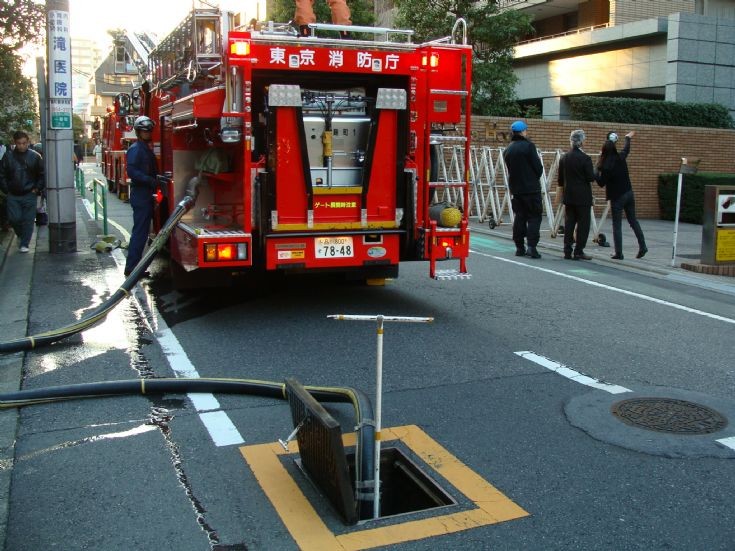
The large diameter hard suction hose is used both to access hydrants and also large underground water storage tanks, both of which are used for firefighting.
The tanks are strategically positioned for use if water mains breakages due to earthquakes prevent the use of hydrants, although they are used regularly too - whenever they are more accessible.
This is another excellent photo by Jacques Peter, which also shows the hose cart mounted at the rear of the vehicle. This is another standard feature of Japanese pumpers, although in this case it has not yet been deployed.
Because the pumpers have to be positioned very close to the hydrant or water tank due to the relatively short suction hoses, they do need to carry a lot of delivery hose, and be able to lay it out quickly - hence the large hose carts, some of which are motorized ride-on versions.
This configurations helps explain why most do not have water tanks - these appliances are quite small to fit into the typically very narrow streets and there just isn't room!
The pump operator is wearing a crash helmet instead of a fire helmet. This is another standard practice in Japan, as it is considered advisable to protect all occupants of fire trucks responding to alarms in the event of road accidents...
Added by Rob Johnson on 16 June 2018.
The tanks are strategically positioned for use if water mains breakages due to earthquakes prevent the use of hydrants, although they are used regularly too - whenever they are more accessible.
This is another excellent photo by Jacques Peter, which also shows the hose cart mounted at the rear of the vehicle. This is another standard feature of Japanese pumpers, although in this case it has not yet been deployed.
Because the pumpers have to be positioned very close to the hydrant or water tank due to the relatively short suction hoses, they do need to carry a lot of delivery hose, and be able to lay it out quickly - hence the large hose carts, some of which are motorized ride-on versions.
This configurations helps explain why most do not have water tanks - these appliances are quite small to fit into the typically very narrow streets and there just isn't room!
The pump operator is wearing a crash helmet instead of a fire helmet. This is another standard practice in Japan, as it is considered advisable to protect all occupants of fire trucks responding to alarms in the event of road accidents...
Added by Rob Johnson on 16 June 2018.
Hino



Wishing the Fire-Crews all the best as they respond to the March 11 Earth-quake.
Regards, from Canada,
Pat_R-B
Added by Pat Rivers-Bowerman on 12 March 2011.