
Upload a Picture
About this Site | Links | Random Pic | Advanced Search
Home | Latest Additions | Contributors
| Visitors
Fire Engine Photos
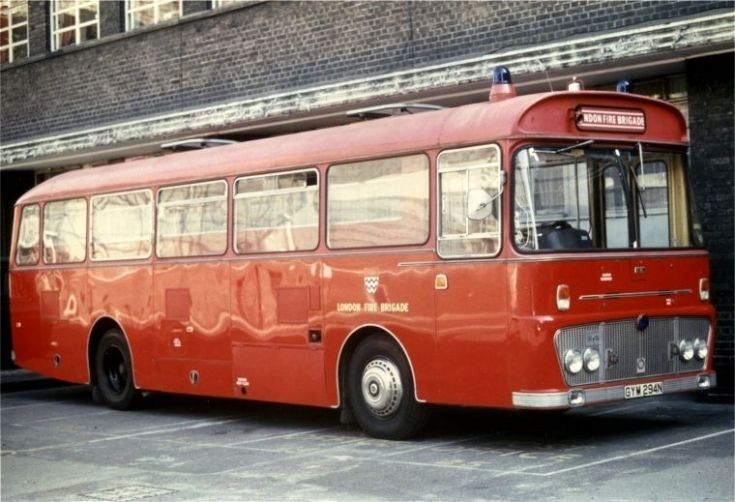
London - BAT - GYM 294N
Here's one of the two Willowbrook bodied BAT's (on Ford R1014 chassis) that London had for a short time. As has already ben mentioned, they had union troubles with them, and I think I'm right in saying that the only time at least one of the pair was used, was as at the Moorgate Tube disaster.
Here's one of the two Willowbrook bodied BAT's (on Ford R1014 chassis) that London had for a short time. As has already ben mentioned, they had union troubles with them, and I think I'm right in saying that the only time at least one of the pair was used, was as at the Moorgate Tube disaster.
This picture is in the following groups
London Fire Brigade, United Kingdom
London Fire Brigade, United Kingdom
BAT - Breathing Apparatus Tender, used for servicing, cleaning and recharging of BA cylinders at large incidents.
Added by Andy Daley on 09 December 2010.
Added by Andy Daley on 09 December 2010.
BAT = Breathing Apparatus Tender.
Never did really get to the bottom of the trouble that the FBU had with these things.
Added by Ian Moore on 09 December 2010.
Never did really get to the bottom of the trouble that the FBU had with these things.
Added by Ian Moore on 09 December 2010.
Any idea of the fleet number of GYM 294N and the registration of the other one?
Added by Bill on 10 December 2010.
Added by Bill on 10 December 2010.
how long were they on the run??
Added by Soren Heeks on 10 December 2010.
Added by Soren Heeks on 10 December 2010.
The London Fire Brigade operated 2 of these 1974 Ford R1014/Willowbrook BAT's(Breathing Apparatus Tenders).This one was GYM294N(BAT.1), and the other was GYM295N(BAT.2), they both were located at Brigade Headquarters-Lambeth.
Sorry, I don't know how long they were operational for, or when they went out of service.
Added by Pete Matten on 10 December 2010.
Sorry, I don't know how long they were operational for, or when they went out of service.
Added by Pete Matten on 10 December 2010.
Were these built as BAT's, or converted from ordinary buses?
Added by Mike Feldman on 10 December 2010.
Added by Mike Feldman on 10 December 2010.
Pete: I'm not sure that either of them ever actually made it as far as Lambeth. I know that the response to Moorgate was made from Ruislip Workshops.
Mike: Not converted buses - they were built as BATs.
Added by Ian Moore on 11 December 2010.
Mike: Not converted buses - they were built as BATs.
Added by Ian Moore on 11 December 2010.
My recollection is that these two Ford Willowbrooks never went on the run due to the opposition from the FBU. The LFB Willowbrook CU now owned by Simon Rowley is elsewhere on this site.
Added by Peter Williams on 12 December 2010.
Added by Peter Williams on 12 December 2010.
Hello Ian, I must say that I'd never seen this BAT before or new anything about them.The information was taken from the Fire Brigade Handbook on'Special Appliances'Volume 1, I didn't mean to mislead anyone.
Added by Pete Matten on 12 December 2010.
Added by Pete Matten on 12 December 2010.
Pete:
I'm sure nobody ever thought you were trying to mislead - we all know you too well. In honesty, not all of the information in the handbooks on 'special appliances' is 100% accurate.
Added by Ian Moore on 13 December 2010.
I'm sure nobody ever thought you were trying to mislead - we all know you too well. In honesty, not all of the information in the handbooks on 'special appliances' is 100% accurate.
Added by Ian Moore on 13 December 2010.
I'm still curious why the union would've objected. Can anyone over on the British side of the Pond venture a guess about this? Was it about driving the things, or something about the BA equipment, or what? From here in the States, it doesn't seem there's much to object to.
Added by Mike Feldman on 13 December 2010.
Added by Mike Feldman on 13 December 2010.
You're not wrong there Ian. Some of the pre '74 North Wales info is duff.
Added by Andrew Middleton on 13 December 2010.
Added by Andrew Middleton on 13 December 2010.
but you still haven't told us why the FBU opposed the operation of these buses and what was the Moorgate tube disaster?
Added by Tiger on 20 January 2011.
Added by Tiger on 20 January 2011.
Moorgate was a particularly nasty crash on the London Underground c1975. Basicly a Tube train was wrongly sent on the wrong road to dead end siding. Around thirty people lost their lives. The rescue was a difficult and prolonged one. If you google it you will find further details.
Added by Chris Hall Teesside UK on 23 January 2011.
Added by Chris Hall Teesside UK on 23 January 2011.
The Moorgate disaster was on 28 February 1975. It was caused by the Motorman failing to stop at the last station on the Northern City Line (the platform the accident occurred at is now closed).
Added by George A'court on 24 January 2011.
Added by George A'court on 24 January 2011.
Thanks for that George and Chris very helpful however does anyone know why the fire brigade's union apposed the operation of these buses?
Added by Tiger on 30 January 2011.
Added by Tiger on 30 January 2011.
Hey George and Chris does why would the fireman's union oppose the operation of these buses? Does anyone know why?
Added by Tiger on 29 June 2011.
Added by Tiger on 29 June 2011.
From what I have read, I understand that the then Chief Fire Officer, Mr. Joe Milner, felt that these two appliances would not be used often enough to merit their being permanently crewed, and so he wanted them to be 'switch- crewed' with other appliances. This meant that, each BAT would share a crew with another appliance- Mr. Milner did not specify whether this was to be a pumping appliance or a special appliance- and so, whenever the BAT was mobilised, the other appliance would come off the run. This is what the union objected to; quite rightly, in my view.
Added by Bill Edwards on 27 November 2012.
Added by Bill Edwards on 27 November 2012.
Dont know how any brigade anywhere could afford to create extra posts for an appliance that was rarely used , 8 new posts plus sickness/holiday cover , I think the union got it well wrong this time and deprived the rest of the troops the benifits these would have brought
Added by Bill on 30 December 2012.
Added by Bill on 30 December 2012.
Bill,
I have to agree with you, whilst the FBU have done some sterling work over the years (I was a member for 30yrs), in my humble opinion, the flip side is that they have prevented the British fire service from diversifying as their counterparts have in the rest of Europe. The BA Tender story must serve as one of the first examples of a saga that continues to this very day.
Added by Glenn Ramsden on 30 December 2012.
I'm still curious about something.
Andy wrote back in 2010 "BAT - Breathing Apparatus Tender, used for servicing, cleaning and recharging of BA cylinders at large incidents." At large incidents, surely this function is necessary, so if these two vehicles were not put in service, how is the function carried out?
Here in the States, some departments do have a vehicle like this. Sometimes it's combined with a large generator with lots of scene lighting, so the apparatus might be called "Air and Light Vehicle" or some such thing. I don't know how it's typically crewed.
Added by Michael Feldman on 31 December 2012.
Perhaps this has to do with the more extensive role which is defined by legislation in many EU countries, including EMS and ambulance service. This necessitates a variety of additional special-purpose units, many of which have nothing to do with firefighting per se.
Some European services spend as little as 7.0% of their time on calls on actual fire fighting. This variety of tasks and different vehicles led to the invention of the transporter/pod concept (in Germany in the 1960s) but has also led to dual-manning - which is now a standard SOP in many countries (including here in the US).
However, a few years ago, Berlin decided to abandon dual manning between pumper and ambulance crews, largely by reducing the number of pumps in service, but keeping pump crews at six. By contrast, Paris has no dual manning, but operates over 100 combination pump-ambulances with five-person crews. These have only rather basic firefighting and medical capabilities, but are backed up by "full-size" fire trucks and ALS ambulances.
Here in Chicago, highly specialized firefighting units are staffed by fire crew members who switch from their principal assigned rides, which are either engines or ladder trucks. These specials usually need only a driver, so the five-person crew is not too seriously compromised.
Added by Rob Johnson on 31 December 2012.
Rob, thanks for the clarification. But my question remains: since in London, those BAT's are not operated in service, how does LFB carry out the large-incident bottle-and-mask functions the BAT's were supposed to do?
Added by Michael Feldman on 01 January 2013.
Added by Michael Feldman on 01 January 2013.
I believe they use BA pods, carried on transporters, which can of course also be used to carry other types of pod - such as hazmat, foam, hose layer, command unit, dry powder, special rescue, rehab, flood response, decontamination, etc.
This is effectively "dual manning", because a single transporter can be used for numerous different roles. Invented in Germany, the concept is now widespread in France, Netherlands, Belgium and the UK, but is still pretty much unknown in North America.
Added by Rob Johnson on 01 January 2013.
This is effectively "dual manning", because a single transporter can be used for numerous different roles. Invented in Germany, the concept is now widespread in France, Netherlands, Belgium and the UK, but is still pretty much unknown in North America.
Added by Rob Johnson on 01 January 2013.
Merseyside got pods many years ago.The station I was on had a prime mover and two pods.Primary pod was the SPECIAL RESCUE UNIT that replaced the E.T.the second pod was known as a secondary pod and was left off till required and was OPERATIONAL SUPPORT.The trouble was the prime mover took the OPP support out to a job for a low level strainer only to be required for a rescue.this required a SRU from many miles away having to be sent.
Added by Dave Price on 02 January 2013.
Added by Dave Price on 02 January 2013.
Re switch-crewing. In 2006, arsonists started a fire in a restaurant on the ground floor of a five- storey building, in Chatham, Kent, UK. Four pumps were sent, as persons were reported, one from Chatham, two from Medway and one from Gillingham. On arrival, firefighters found that the occupants of the restaurant, seven in total, had been unable to escape, so they had gone to the top floor as this was the furthest away from the fire that they could go. An aerial ladder platform was requested, however the nearest ALP, from Medway fire station, was unavailable as it was switch-crewed with that station's second pump. An ALP was sent, instead, from Thames- Side fire station taking nearly thirty minutes to arrive. In the meantime, firefighters rescued four people by pitching a 45' extension ladder 2' from the building, with six men to hold it steady. (I am sure Health & Safety would love that one.) Unfortunately, they were unable to rescue the other three, and by the time the ALP arrived it was too late- they were dead.
SWITCH-CREWING COSTS LIVES- THAT IS A FACT.
Added by Bill Edwards on 02 January 2013.
SWITCH-CREWING COSTS LIVES- THAT IS A FACT.
Added by Bill Edwards on 02 January 2013.
In most European services, SOP is for the transporter to take the pod to the incident where it is required, drop it there, and then immediately return to quarters. Pods are designed to be largely self-sustaining, so there is no need for the transporter to remain on scene. (Hoselayers are probably the sole exception.)
This enables the transporter to be used for a subsequent alternative pod delivery, if required. It can also easily be recalled by radio from the first incident, if it is still there.
Amsterdam has probably the most sophisticated protocols, with around 20 transporters and 44 pods; in most cases, these are paired off with a 7-man pumper crew, with one member dropping off to drive the transporter if it is called out. Most types of pod are duplicated, so that substitutes can be dispatched if the nearest station's crew(s) are on a shout.
Added by Rob Johnson on 02 January 2013.
Bill and Rob, thanks for the further clarification. In the case of a breathing-air vehicle or pod, what size crew would be necessary to operate it at the site of a large incident? How would they do it in A'dam -- it's one thing for a single crew member to drop off and drive the transporter, but quite another to provide a crew to operate the bottle-filling, mask-cleaning, etc. tasks on site.
Amazing that A'dam runs with 7-man pumper crews. Here in Portland a crew is 4, and some think that is too many.
Added by Michael Feldman on 02 January 2013.
Amazing that A'dam runs with 7-man pumper crews. Here in Portland a crew is 4, and some think that is too many.
Added by Michael Feldman on 02 January 2013.
The Amsterdam Fire department uses a Mercedes Benz Atego as a Breathing Apparatus unit and not a pod.
Added by Marcel Sloover on 02 January 2013.
Added by Marcel Sloover on 02 January 2013.
Marcel - I think they have one or more pods as backup as well.
Added by Rob Johnson on 02 January 2013.
Added by Rob Johnson on 02 January 2013.
According to their website Amsterdam has both an Atego 1017 BAT and a Vario 815 BAT; three of their pods also carry extra BA sets, in addition to other equipment. Very few European cities rely on pods for BA support, mainly because the BA tender is an increasingly busy backup unit, now that almost all incidents require BA, so one or more dedicated BATs are justified.
Regarding staffing, FDNY used to have full crew cabs on their Mask Service Units but now have a standard cab with only a driver (plus a second member if available). Chicago makes do with only a driver, and - although some German volunteer departments have single-purpose BA tenders with two or three person crews - most European cities with dedicated BA tenders operate with either a driver or a two person crew. This is the same as the original London plan for the Ford Willowbrook, which were intended to operate with two staff.
Added by Rob Johnson on 03 January 2013.
THe Chatham incident reveals two lessons:
1- The fire was in a structure which was too high for the 135 ground ladders; therefore, the Medway ALP should have been dispatched on the initial call - the prep-plan was faulty. It used to be SOP to dispatch a TL (or ALP) to all structure fires in buildings over three floors - and still is in many European cities.
2- If Medway had a recall protocol for off-duty personnel, an ALP driver could have been summoned more quickly, insteads of relying on a distant station.
Added by Rob Johnson on 03 January 2013.
Ford


Added by David Jones on 08 December 2010.