
Upload a Picture
About this Site | Links | Random Pic | Advanced Search
Home | Latest Additions | Contributors
| Visitors
Fire Engine Photos
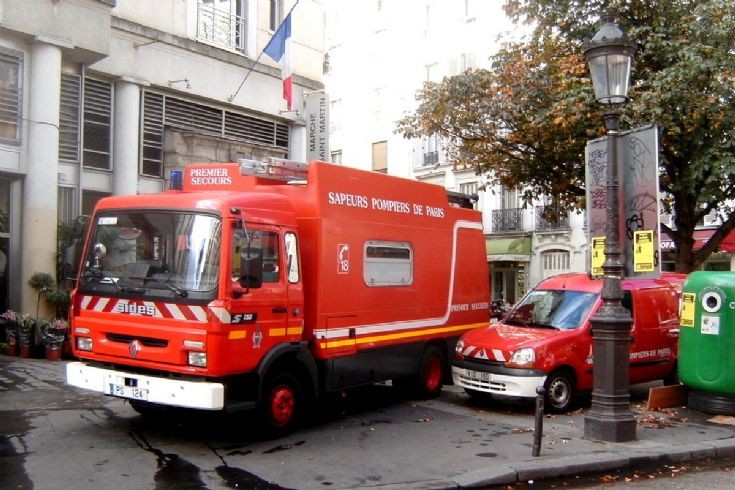
This is a "first aid" truck, which combines the role of emergency ambulance and light pumper. The left side of the rear body (with the occluded windows) is the ambulance section. The right side accomodates three crew, a water tank, hosereel and firefighting equipment. It has a 1000 LPM pump, a small ladder on the roof and a one-man hose cart at the rear. Paris fire service gets many more medical calls than fire calls, and these units are dispatched to medical emergencies and traffic accidents when it is thought they will get there sooner than an ambulance. They are also dispatched to social service calls and to fires as first responders, and can often deal with most fire calls before the backup units arrive. I believe this design is unique to Paris.
Added by Rob Johnson on 23 June 2011.
Added by Rob Johnson on 23 June 2011.
In the USA, these trucks are very rare. I have read of a few departments that run engines that are transport capable. Pierce made one out of a 10 man crew cab, where the stretcher was slid in from the left side. The stretcher was then situated across the width of the cab, instead of lengthwise in an ambulance. The engines were American sized ie: 1500 to 2000gpm side mounted pump, 500 gal, "standard" hose and equipment carried. Rosenbauer is reported to have a new design. Braun has a light pump version.
Added by David L on 25 June 2011.
Added by David L on 25 June 2011.
In the past few years several US manufacturers have displayed "All Emergency Trucks". These vehicles can fight fire, extricate, and transport.
Crimson, Toyne, and Ferrara are some. They are about the size of a standard engine. The trucks you spoke of are generally refered to as "pumpalances" and were first used in Florida in the late 80s. Uselly on commerical chassis with a small ambulance box behind the cab and then the pumper body. They were not popular because of the expense to operate one on just an ambulance type call.
Added by John Harris on 25 June 2011.
This design has now been superceded by a slightly larger truck with a standard five-man four-door crew cab. This has the medical module and stretcher on the right side, with rear entrance doors, and the firefighting equipment in a left side locker. There are now two one-man hose carts, a 23mm high pressure hosereel and a preconnected 45mm attack line - all accessed from the rear. The latest Mark V version also has a CAFS installation.
Each of the BSPP's 74 stations has one or two, and the 102 PS units respond along with 142 conventional ambulances, 39 conventional fire pumpers and 63 aerials.
Over 80% of calls are EMS, and are attended by the nearest ambulance with a three person crew or a PS with five. Only 3% are fires. A structure fire call gets two pumpers, including at least one PS. and a ladder.
Most of the remaining 17% of calls are handled by a small van, as illustrated in this photo. These are loaded with whatever equipment the service call indicates may be needed, then dispatched with one or two members of the duty watch.
Added by Rob Johnson on 25 August 2014.
Renault


Added by Tiger on 23 June 2011.