
Upload a Picture
About this Site | Links | Random Pic | Advanced Search
Home | Latest Additions | Contributors
| Visitors
Fire Engine Photos
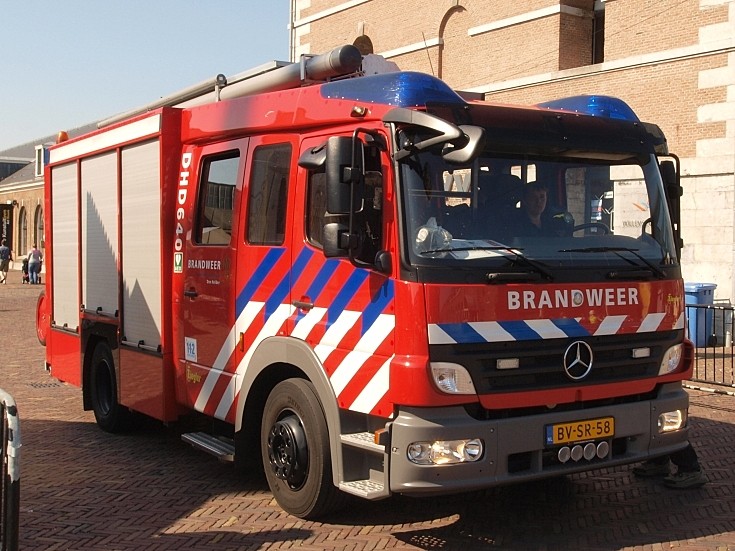
The Continentals seem to have gone full circle with the hosecarts attached to the rear of fire engines. The French I believe utilised them in the sixties through to the eighties.
Added by Andrew Middleton on 10 July 2010.
Added by Andrew Middleton on 10 July 2010.
French brigades started with them a century ago and are still using them, as are more and more German brigades. Now that so much other kit, such as rescue equipment, is being carried, the hose has to go somewhere! Berlin started to reverse the trend by putting them back on their HLF (Hilfeloeschfahrzeug), or pump rescue trucks, about ten years ago. They are very easy to roll out, especially if one is used for the initial attack line and the other to set in to the hydrant. Another idea to add to available locker space is to have a single high pressure reel above the pump bay, instead of one on each side, which I think is a step backwards. The power ladder rack on these more modern European pumps lowers the ladders beyond the hose carts, so they do not need to be removed to get at the ladders - but the pump operator has to move them out of the way, even if only using the first aid reel, unless he has a wireless remote pump control unit. These are now increasingly popular, as they free up the operator for other duties and do not tie him up, having to stand around next to the pump. The pressure is on in all countries to address an ever-widening array of emergency situations with fewer firefighters and a smaller fleet of more versatile trucks. First alarm structure fire attendence in most German cities is now 14 men compared to 19 thirty years ago, and most big French cities have dropped from around 17 to 13, or even fewer. In some US cities, it is even worse, with three person crews quite commonplace on both engines and ladder trucks, so a first alarm house fire may see a response with only 9 or 10 people. When my own house got on fire, the first due engine had only three men, so I ended up helping stretch the 1.75" crosslay from the pumper to the door!
Added by Rob Johnson on 10 July 2010.
Added by Rob Johnson on 10 July 2010.
Is the Historisch weekeind at Den Helder an annual event, if so what is the date it is held on, where about in Holland is Den Helder?. Thanks
Added by Gordon Smith on 11 July 2010.
Added by Gordon Smith on 11 July 2010.
Hi Gordon,
Yes it's a anual event. Den Helder is just where the islands begin. For info of the event see www.historischweekend.nl
Added by Alf Van Beem on 12 July 2010.
Yes it's a anual event. Den Helder is just where the islands begin. For info of the event see www.historischweekend.nl
Added by Alf Van Beem on 12 July 2010.
Rob, Berlin's appliances aren't called HLF (Hilfeleistungslöschfahrzeug), but LHF (Lösch- und Hilfeleistungsfahrzeug), which is an exception of course ;) The brigade's name is 'reversed' too - 'Berliner Feuerwehr' instead of the usual 'Feuerwehr Hamburg', 'Feuerwehr München' and so on.
Added by [email protected] on 15 July 2010.
Added by [email protected] on 15 July 2010.
Mercedes-Benz


Added by Rob Johnson on 09 July 2010.