
Upload a Picture
About this Site | Links | Random Pic | Advanced Search
Home | Latest Additions | Contributors
| Visitors
Fire Engine Photos
Petros and Dave Price, I've never seen a collector head like that ever! Was that something the Liverpool Brigade invented too? Thanks,, By the way, the escape looks extremely well cared for,,
Added by Pav on 15 June 2010.
Added by Pav on 15 June 2010.
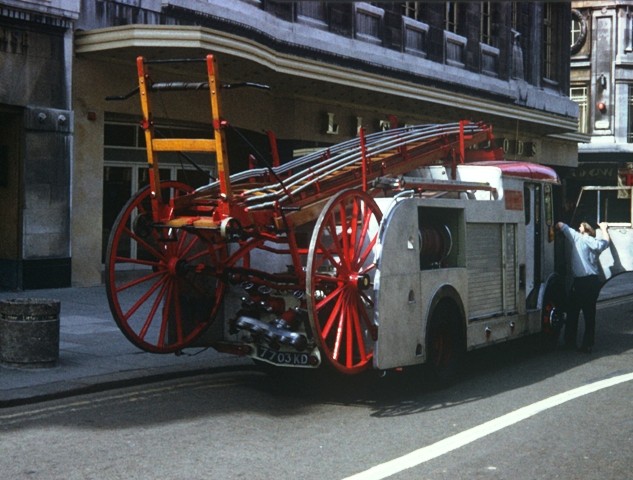
Pav the picture is slightly distorted but yes all Liverpool appliances had a five inlet collecting head but the pump had only four delivery outlets.
Added by Dave Price on 15 June 2010.
Added by Dave Price on 15 June 2010.
The escape ladder were very unusual, the winding gear high up on the leavers was to alter the angle of the ladder on the carrage, the second winding gear at the side of the ladder between the large wheels was for extending the ladder. The ladder winch had no brake fitted so you had to be very careful when bringing the ladders down, one slip and they would come crashing down with the handle spinning wildly.
Added by Dave Price on 16 June 2010.
Added by Dave Price on 16 June 2010.
seeing this picture lets not forget that 50years to-day 22/06/2010 at 14.20 Liverpool Fire Brigade responded to its worse peacetime fire at Hendersons department store that resulted in the loss of eleven lives.
Added by Dave Price on 22 June 2010.
Added by Dave Price on 22 June 2010.
Yes let's not forget. It's moments like the Henderson's blaze that puts our interests, Hobby and lifes work into perspective. Having seen the footage of RKB 500 and other classic fire engines of the time let's not forget the unfortunate eleven who went out on a day and never returned home.
Added by Andy Middleton on 22 June 2010.
Added by Andy Middleton on 22 June 2010.
I seem to remember the F24 had a #3 pump, which was rated at 900 GPM at 100 PSI (4095 LPM t 7 AT).
Did Liverpool have hydrants which could yield only 820 LPM each? Sounds pretty feeble. In most countries a minimum output of 1, 000 LPM is mandated, with 1, 500 or 2, 000 LPM for hydrants in any built-up areas other than single family residential homes.
In the US anything below 1, 800 is deemed inadequate, and in downtown Chicago, where I live now, we have hydrants with dual 115 mm outlets which can supply over 10,000 LPM!
I can't imagine how long it would take to set into five hydrants, or even three, with two twinned lines...
Added by Rob Johnson on 10 July 2017.
Did Liverpool have hydrants which could yield only 820 LPM each? Sounds pretty feeble. In most countries a minimum output of 1, 000 LPM is mandated, with 1, 500 or 2, 000 LPM for hydrants in any built-up areas other than single family residential homes.
In the US anything below 1, 800 is deemed inadequate, and in downtown Chicago, where I live now, we have hydrants with dual 115 mm outlets which can supply over 10,000 LPM!
I can't imagine how long it would take to set into five hydrants, or even three, with two twinned lines...
Added by Rob Johnson on 10 July 2017.
Liverpool had quite a few hydrants that suction hose could be fitted to the outlet. I used one on my recruit course as they a one at the training school, you just had to watch the pressure as suction hose was not made for high pressure. they also had one on the Wirral that had a special delivery box that had a number of outlets. ( post Merseyside).
Added by Dave Price on 12 July 2017.
Added by Dave Price on 12 July 2017.
Dave: Until very recently FDNY always used hard suction to connect up to hydrants, but I don't know if they specified hoses with reinforced materials to cope with the extra pressure.
Now they more often use 5 inch (125 mm) flat hose, which has been adopted in most fire departments for hydrant supply (and water relays) for many years now. This means the engine can be up to 900 feet (300 meters) from the hydrant, given normal mains pressures which run between 3.5 and 6 AT.
As hydrants are normally around 100 to 170 meters apart, this means that under most conditions four to six pumpers can gather right on top of the fire - even more if any of the hydrants are the high capacity dual outlet types, which deliver over
The standard hydrant here is the pillar type with either two 65 mm and one 115mm outlets, or dual 115mm outlets, with a 150mm or 200mm supply line from the mains. The city center hydrants in Chicago can deliver over 10, 000 LPM.
Added by Rob Johnson on 13 July 2017.
Now they more often use 5 inch (125 mm) flat hose, which has been adopted in most fire departments for hydrant supply (and water relays) for many years now. This means the engine can be up to 900 feet (300 meters) from the hydrant, given normal mains pressures which run between 3.5 and 6 AT.
As hydrants are normally around 100 to 170 meters apart, this means that under most conditions four to six pumpers can gather right on top of the fire - even more if any of the hydrants are the high capacity dual outlet types, which deliver over
The standard hydrant here is the pillar type with either two 65 mm and one 115mm outlets, or dual 115mm outlets, with a 150mm or 200mm supply line from the mains. The city center hydrants in Chicago can deliver over 10, 000 LPM.
Added by Rob Johnson on 13 July 2017.
Dennis


Added by Dave Price on 07 June 2010.