
Upload a Picture
About this Site | Links | Random Pic | Advanced Search
Home | Latest Additions | Contributors
| Visitors
Fire Engine Photos
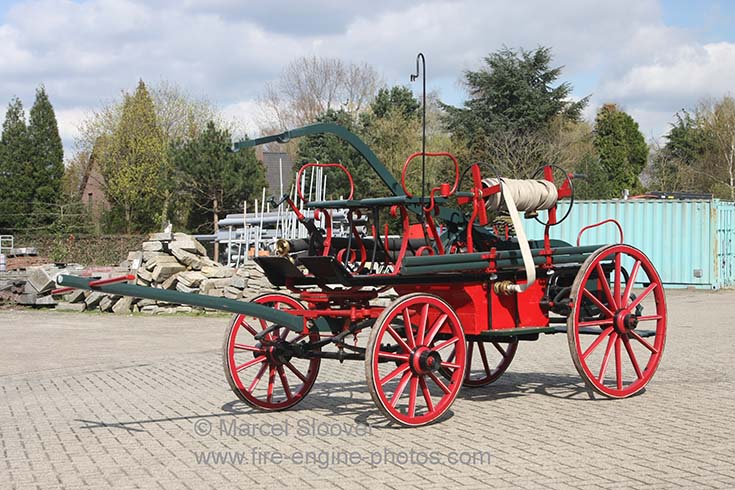
This style looks like that of Knaust in Austria in the late 19th century but there were likely several other manufacturers around Europe making very similar machines around the same time. The design differences between European vehicle manufacturers in that period have always seemed to me to be quite subtle. It appears to have many of the fittings to be horse drawn however that cross bar shaft on the front is designed to be hand drawn. Could be a later modification maybe for parades and such. Something of this size would likely have been pumped by around 8 to 12 men.
Added by Josiah Wagener on 12 September 2010.
Added by Josiah Wagener on 12 September 2010.
Hi Marcel,
I was surprised to see our pump on your site. I'm member of the fire-brigade Hunsel and I did with a lot of others from our fire brigade the restoration of this pump. It is an two-piston pump whit in de middle a big copper pressure-tub to keep a constant preasure on the hose.This is a Flader pump, that was manufactured in Jöhstadt, The former eastern-Germany in 1904. Before world-war-2 it was one Germany and a part of what is now Poland was also belonged to Germany. That was the reason that we found this pump in Poland in a place called Pogorzéla. Our town has friendship relations whit the fire brigade in Poland and they found this pump for us, in a terrible shape, Some parts where broken other where painted so that you couldn't see it was copper or bronze(probably because of the war. Now that it is ready it is a beauty-full pump and almost original. We go to shows whit it and we ride whit this pump in historical parade's of old fire-trucks.
If you want more information please let me know.
ps. How did you got to our fire-brigade, and where you're from??
Added by Johan Thijssen on 24 December 2010.
Hi Johan,
Yhank you for your information, it's great to read what kind of effort you guys put into this restoration.
This photo was made during our visit with the VBB when we had our photo tour. I'm from the western part of Holland.
Added by Marcel on 25 December 2010.
Yhank you for your information, it's great to read what kind of effort you guys put into this restoration.
This photo was made during our visit with the VBB when we had our photo tour. I'm from the western part of Holland.
Added by Marcel on 25 December 2010.
Other


End-Stroke style, as the "brakes", or Pumping Arms are parallel to the chassis. Possibly, a Piston Pump fitted to each Pumping Arm, so that each down-stroke produces water.
I am thinking it is horse-drawn; Driver's Seat with a Screw-on Brake; and Running-Boards for the crew to ride on.
On arrival at fire, the horse-team would be uncoupled and led away; the long, black, bars unshipped from left-hand side and fitted cross-ways into the sockets on the Pumping Arms for the crew, in 2 rows, to alternately raise and lower in front and rear; the rigid suction hoses on right-hand side connected to water source; canvas hose and nozzle (branch) unreeled.
And away they went - perhaps, up to 60 strokes a minute. Men would be changed out on these long bars, without stopping the Pump.
Somewhere within, an Air Chamber to even out the 'spurts' of the Piston Pumps.
Eventually replaced by the Steamer(Steam Pumps) in big cities, but continued in small communities, until a small Motor Pump arrived.
Nice picture, nice restoration.
Regards, from canada,
Pat_R-B
Added by Pat Rivers-Bowerman on 24 May 2010.