
Upload a Picture
About this Site | Links | Random Pic | Advanced Search
Home | Latest Additions | Contributors
| Visitors
Fire Engine Photos
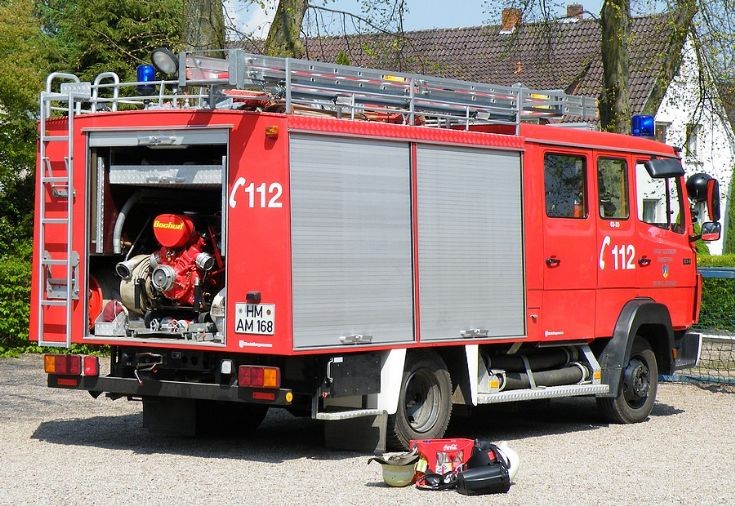
No: 23240 Contributor: Chris Hall, Hameln, Germany Year: 2010 Manufacturer: Mercedes-Benz Country: Germany
Despite its age the alloy looks good, I assume they dont use salt or its better quality alloy than ours, in any case what a good use of money keeping them if they dont need replaced unlike us , anyway looks good for its years, could do with a polish but black wheels yuk! I assume their volounteers are similar to our retained?
Added by Alan on 05 June 2014.
Added by Alan on 05 June 2014.
German volunteer dire companies are very long established, and many go back two or more centuries. Akmost every small town or village has a volunteer station, and the membership is often passed from father to son. The personnel are not paid, but they tend to devote a lot of timw to training, and many of the larger ones have specialized sections such as rescue, hazmat, dive team, high angle rescue, etc. Although smaller companies are limited to pumpers and tankers, larger towns' volunteers often have a lot of highly specialized trucks.
Unlike the UK, all large cities also have volunteer fire companies and stations. Berlin, for example has 36 full-time stations and 54 volunteer companies. While many professional fire services in Germany operate EMS, the volunteers do not. Other EMS services are provided by the Red Cross and additional specialist full-time and volunteer organizations.
Added by Rob Johnson on 05 June 2014.
Mercedes-Benz


This DIN specification pumper was mainly intended for small-town volunteer fire companies which had to contend with response areas without hydrants, hence the portable pump to access open water sources. It did not carry any water, but was usually accompanied by a TLF or water tender/tanker.
This specification has now been superceded, but many of these units are still in service, because German volunteer fire companies tend to keep many of their pumpers in front line service for 20 years or longer - sometimes much longer!
Added by Rob Johnson on 02 June 2014.