
Upload a Picture
About this Site | Links | Random Pic | Advanced Search
Home | Latest Additions | Contributors
| Visitors
Fire Engine Photos
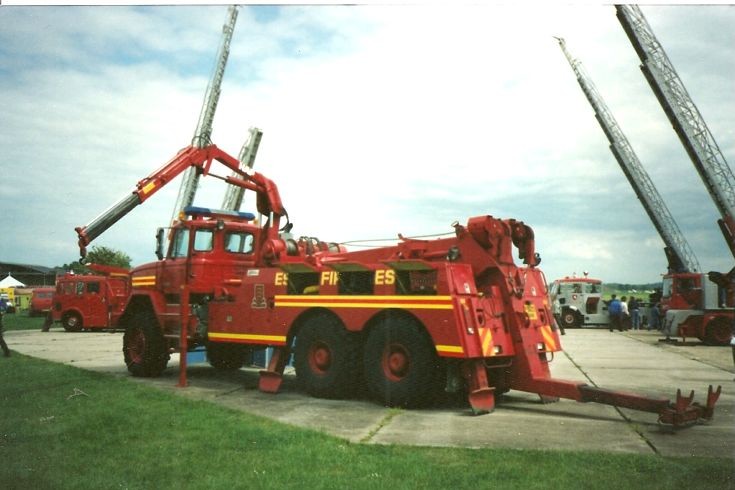
Scammell S24 Rec Veh Essex F920NHK
Taken at Duxford rally about 1990. Why a fire service would want to buy such a sophisticated piece of kit is a bit of a mystery. It was sold in the mid 1990s to a recovery operator in Somerset and then sold on to one near Shrewsbury, repainted blue. Essex knick named it "Big Foot" for obvious reasons. Served at Chelmsford and was called Extra Heavy lift vehicle (EHLV).
Taken at Duxford rally about 1990. Why a fire service would want to buy such a sophisticated piece of kit is a bit of a mystery. It was sold in the mid 1990s to a recovery operator in Somerset and then sold on to one near Shrewsbury, repainted blue. Essex knick named it "Big Foot" for obvious reasons. Served at Chelmsford and was called Extra Heavy lift vehicle (EHLV).
seems to be big in my opinion, all you need is a hi-ab on the back of a RT/ET nothing of this size.
What did they think they were going to pick up?
Added by Michael on 25 April 2010.
What did they think they were going to pick up?
Added by Michael on 25 April 2010.
i think this was also used to recover broken down fire engines as well as attend rta,s
Added by Ian Mc on 25 April 2010.
Added by Ian Mc on 25 April 2010.
Ever since the Polish State Fire Service started using similar appliances, they proved invaluable at RTCs involving HGVs, tankers... there are things that a regular Palfinger crane at the back of a rescue tender won't handle. And it's not about the crane itself, it's also about the winches, at least two of them, 20-30t.
These vehicles are also widespread in, among others, Austria and the Czech Republic.
Added by Konrad Nowak on 25 April 2010.
These vehicles are also widespread in, among others, Austria and the Czech Republic.
Added by Konrad Nowak on 25 April 2010.
Brunei FRD too owns a 1980s Dennis and Mitsubishi Heavy Recovery Vehicles which are rarely used at incident site. Now it is used for HGV training.
Added by Bomba Boy on 25 April 2010.
Added by Bomba Boy on 25 April 2010.
This did an apperance in Truck and Driver many years ago.
Andrew.
Added by Andrew Wright on 25 April 2010.
Andrew.
Added by Andrew Wright on 25 April 2010.
40, 50 and even a few 60 tonne cranes are quite common in Germany, and are found in numerous fire stations, including units which are strategically based at volunteer fire stations in small towns. The major manufacturers are Liebherr and Krupp.
Major cities often have two or more - Berlin for example operates three. They are usually stationed with a crane tender, which carries all the various supplemental equipment needed to ensure that they can be operated in every situation - but sometimes this is a pod, which may be based at the same or a different nearby station.
Germany has an extensive Autobahn network and - as Konrad mentions - these cranes are indispensable at accidents involving HGVs, which can pose major problems requiring heavy vehicles to be moved to facilitate victim extrication in other vehicles.
They are also very useful as well at train crashes, urban light rail and tramcar incidents, building collapses, vehicles in water, bridge rescues and similar events.
I have also even seen video of one being used as an improvised water tower at a massive recycling dump fire, although this is an extreme case!
They are also to be found in fire service use in other Northern and Central European countries and in Japan, although they do not seem to be in use with fire departments in Southern Europe, Russia, China or the Americas.
Added by Rob Johnson on 22 May 2017.
there are excellent video clips of this beast in action on you tube. Just search on Basildon pump engine crashes en route Hospital - a rare sight indeed. Surely better to hire in cranes from specialist contractors. Why does Germany have so much money for fire service to buy such rarely used bits of kit. I have just been to North Germany and small towns have large fleets. Is there a county model where resources are shared? Isn't the British system more efficient?
Added by Petros on 24 May 2017.
Added by Petros on 24 May 2017.
Petros:
Indeed, the German approach is to distribute special purpose units like cranes and other rarely deployed types across geographic areas, with various different types dispersed geographically in each Landkreis.
This explains why many are assigned to volunteer stations.
Germany has around 145 professional full-time fire services with approximately 1, 000 individual fire stations, but over 22, 000 additional volunteer fire companies. No, this is not a misprint. One for every 3, 500 people!
Berlin, for example, has both 35 full time and 57 volunteer stations, covering a population of around 3.5 million. With respect to specials, Tech I has 54 vehicles, containers and trailers covering a very wide range of special risk response categories. Tech II has around 30 more.
The reasons for this structure are mainly historic. Going back one or two hundred years (or more!) to the days when fire engines were manual, every village had its own volunteer fire service - and most still do. There are many families with four or five generations of volunteer firefighters...
The absence of payroll expense - which is around 70% of the cost of a professional paid service - means that a rather large budget is available for these volunteers to buy vehicles and equipment.
Because individual volunteer companies respond to a relatively small number of calls, the equipment lasts a long time, and replacement cycles of thirty or even forty years are not uncommon.
As regards the large numbers of both pumpers, ladders, tankers and special purpose units, Germany has been on the front line of the Cold War for many years. As a result, fire service capabilities were specifically aligned to the needs of a wartime fire service for decades up to 1990 - and this is still largely true!
Hope this explanation is helpful. I personally think the German approach is excellent, and it has been the model for several other Northern and Central European countries, as well as being very similar to the kind of fire service structure we have in the US.
Added by Rob Johnson on 25 May 2017.
Scammell


Why would they NOT want one?
Added by Bristol Bob on 15 February 2010.