
Upload a Picture
About this Site | Links | Random Pic | Advanced Search
Home | Latest Additions | Contributors
| Visitors
Fire Engine Photos
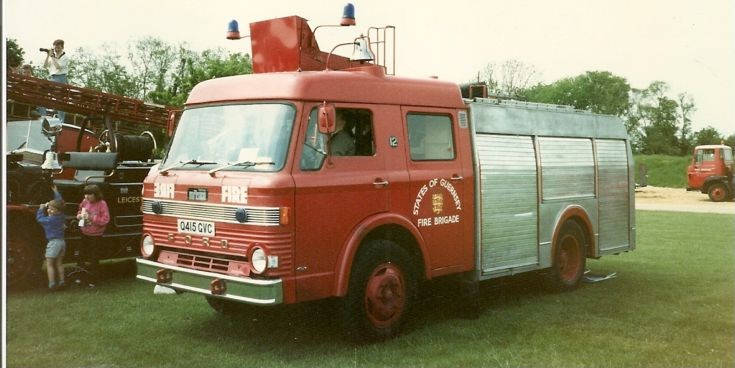
The Merryweather crew cab was designed as a full tilt cab, with rear styling very well integrated into the original Ford cab, but with a higher roof to incresae headroom.
The HCB-Angus bodied units supplied to Lancashire was a split tilt design. The original Ford truck cab tilted, but the rear crew cab was fixed. Carmichael, Pyrene and other bodybuilders also built split-tilt Ford D series fire appliances, as well as a few which had a SVO fixed cab configuration. I think the Merryweather was probably the only fully tilting crew cab offered on the D series chassis.
I suspect that it was more expensive to build than the split-tilt designs and did not offer any significant practical benefits over the split tilt offerings. The first D series fire pumpers, which I sold to Gloucestershire in 1966, had a boxy rear body and crew cab, with a standard Ford factory tilt cab. Not very pretty, but they worked! You can see several examples in photos on this site.
Personally, I think this is the best-looking D series fire engine, but it is my understanding that only a small number were manufactured.
Added by Rob Johnson on 10 January 2014.
The HCB-Angus bodied units supplied to Lancashire was a split tilt design. The original Ford truck cab tilted, but the rear crew cab was fixed. Carmichael, Pyrene and other bodybuilders also built split-tilt Ford D series fire appliances, as well as a few which had a SVO fixed cab configuration. I think the Merryweather was probably the only fully tilting crew cab offered on the D series chassis.
I suspect that it was more expensive to build than the split-tilt designs and did not offer any significant practical benefits over the split tilt offerings. The first D series fire pumpers, which I sold to Gloucestershire in 1966, had a boxy rear body and crew cab, with a standard Ford factory tilt cab. Not very pretty, but they worked! You can see several examples in photos on this site.
Personally, I think this is the best-looking D series fire engine, but it is my understanding that only a small number were manufactured.
Added by Rob Johnson on 10 January 2014.
Lancashire's first Fords were a batch of Merryweather WrTs as per the photo.
Added by Neal Glover on 11 January 2014.
Added by Neal Glover on 11 January 2014.
Yes, Lancashire switched to the much later and very well integrated HCB Angus split tilt cab body style afterwards. This may have been because they came to dislike the full tilt cab, as it could not be tilted inside some appliance rooms, or possibly because of problems with the Merryweather build quality - or perhaps also because of cost. Their first HCB Angus units were also on the heavy sixteen ton D1617 chassis which was wider, so that it could not accept the Reliant four door crew cab which was designed for the narrower D1014 and later 1317 variants. At that time the Perkins V8 was not available in the 1317, which was a later SVO build. So, as the county wanted the more powerful engine, they had to buy the 1617.
The 1317 introduction required quite a bit of engineering to shoehorn the fatter Perkins V8 into the narrower 13 ton chassis, but it still enabled Ford to offer the same engine as Dennis, Dodge, ERF and Shelvoke in a competitively priced chassis with a very comprehensive factory service and parts network to back it up. This was a major concern for many county brigades, and with fire services in numerous export markets too. I am not sure about exact dates, but Merryweather could have already been well on their way out of business by the time they bought the HCB Angus units, which would have been an even more obvious reason there was not another batch of Merryweathers.
Added by Rob Johnson on 30 December 2025.
The 1317 introduction required quite a bit of engineering to shoehorn the fatter Perkins V8 into the narrower 13 ton chassis, but it still enabled Ford to offer the same engine as Dennis, Dodge, ERF and Shelvoke in a competitively priced chassis with a very comprehensive factory service and parts network to back it up. This was a major concern for many county brigades, and with fire services in numerous export markets too. I am not sure about exact dates, but Merryweather could have already been well on their way out of business by the time they bought the HCB Angus units, which would have been an even more obvious reason there was not another batch of Merryweathers.
Added by Rob Johnson on 30 December 2025.
Ford


Added by Peter Williams on 17 February 2010.