
Upload a Picture
About this Site | Links | Random Pic | Advanced Search
Home | Latest Additions | Contributors
| Visitors
Fire Engine Photos
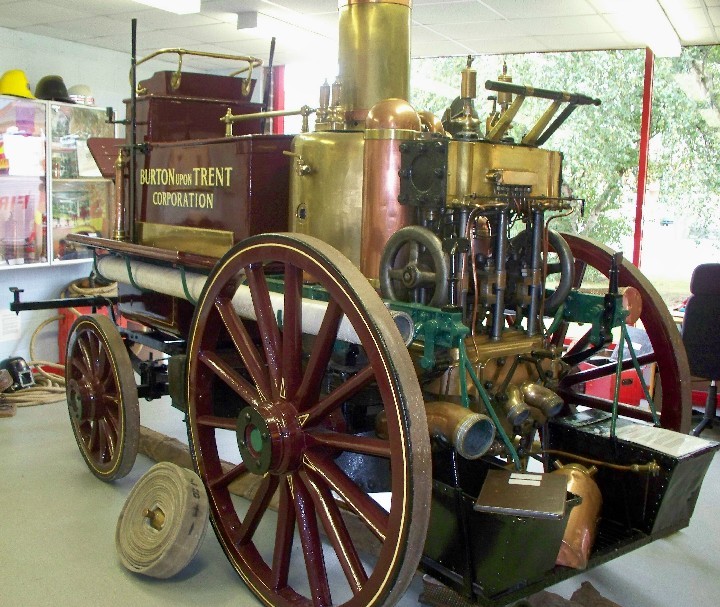
No: 19011 Contributor: Yelp Bullhorn Year: 2009 Manufacturer: Shand Mason & Co Country: United Kingdom
Most of us have had rather limited experience with Steamers ( er, like, 'Totally Zero'); so, what would be the apparent differences, between the 2 makes ?
Can this engine be fired (stoked) on the move ? Hard to see the fire-box door...somewhere under the Hose Manifold ?
2 cylinder pump ?
Great to see one, on this 'Site.
Regards, from Canada,
Pat_R-B
Added by Pat Rivers-Bowerman on 13 November 2009.
Can this engine be fired (stoked) on the move ? Hard to see the fire-box door...somewhere under the Hose Manifold ?
2 cylinder pump ?
Great to see one, on this 'Site.
Regards, from Canada,
Pat_R-B
Added by Pat Rivers-Bowerman on 13 November 2009.
Firebox is right down the bottom and can just be seen through the rear wheels, it can not be stoked on the move but what used to happen was that burning coals would be removed from the station fire before turning out. The boiler tubes 'criss-cross the boiler area which helps for fast steam raising. Our Shand Mason takes about 20 minutes to be able to pump from cold. By the time horses would be harnessed and the journey to the fire the steam would be raised. Hope this helps Pat
Added by Barrie Green on 14 November 2009.
Added by Barrie Green on 14 November 2009.
HI Pat. THe three upright tubular supports to the engine are indicative of a Willam Rose engine. THey are located between the two flywheels, the small size of these also shows it to be a WR. Also if you look carefully at the base of the chimney you can see a small hole between the Cylinder and the safety valve in the picture. Shand Mason's did not have this feature which was to improve drafting. Also the spokes on the wheels are squared off only at the hub end, on a Shand these were squared off at both ends. THe hand rails along the body top have little uprights above the rail where the supports are for attaching the rails to the body. Not seen in this shot but the hand brake is also much shorter on a WR machine. Please note I do not profess to be an expert on these matters but I do have colleague who probably knows more about them than anyone, he has be tutoring me into the differences since we discovered this picture! regards
Barrie
Added by Barrie C. Woods on 15 November 2009.
Barrie
Added by Barrie C. Woods on 15 November 2009.
Barrie,
I would like to come over and have a look at the grate arrangement on your boiler, I am restoring a similar boiler and need a better undertanding of the bottom end.
Added by Sam leese on 25 November 2009.
I would like to come over and have a look at the grate arrangement on your boiler, I am restoring a similar boiler and need a better undertanding of the bottom end.
Added by Sam leese on 25 November 2009.
Barrie C. Woods, I am only going by what the plaque said of this old beauty. It definitely said Shand Mason. I think the machine even had a brass plaque on it saying Shand Mason too!
So, either you're wrong or, curiously, the Staffs Fire Museum are!
Added by Yelp Bullhorn on 02 December 2009.
So, either you're wrong or, curiously, the Staffs Fire Museum are!
Added by Yelp Bullhorn on 02 December 2009.
Yelp Bullhorn. Having recently examined the vehicle I can now confirm it is a Wiilliam Rose. However it appears to have had some considerable changes in its long life as the Fore-carriage is SHand Mason as are a few other bits. Although someone else has determined that inside the wheel hubs there is evidence of the William Rose origins the actual wheels are Merryweather. As for other signs of Shand Mason or William Rose there are many indicating the latter. Oneof the most significant is on the nearside ofthe boiler, where both companies used to put their plaqes there is evidence of around 16 screw holes which have been expertly filled in and are barely noticeable these prescribe and arc in the shape of the old 'METROPOLITAN' name that Willaim Rose affixed to their machines. Shand Mason had an oval plate which was affixed by two large bolts or rivets. To me there is little doubt about this machine, it is a Rare William Rose
Added by Barrie C. Woods on 03 December 2009.
Added by Barrie C. Woods on 03 December 2009.
Hi Yelp,
What a superb find! It's usually the other way round. Someone thinks they a have a rare item but it turns out common, nice to have it the othere way round this time! Barrie Woods
Added by Barrie C. Woods on 03 December 2009.
What a superb find! It's usually the other way round. Someone thinks they a have a rare item but it turns out common, nice to have it the othere way round this time! Barrie Woods
Added by Barrie C. Woods on 03 December 2009.
Since I have working knowledge of more than my own Shand Mason and restoration experience of every nut and bolt, this engine has bits similar to a Shand, but others pure William Rose. I believe Shands used to contract out to Rose in Manchester and it looks to me that the latter bought up obsolete Shand fittings and created their own product. Someone once told me that Mr Rose had been apprenticed to Shand Mason. I saw the engine with Barrie and I am convinced about the matter. I believe that there are Three William Rose engines in existence; one on the continent,ex- Fleggburgh theme park, one in Belfast and this one.....unles anyone know differently!
Added by Derek Wheeler MBE on 29 December 2009.
Added by Derek Wheeler MBE on 29 December 2009.
Really enjoyed the info and discussion, on this beautiful machine, Gents.
Back in the days, when such machines were hand-built; wonderful examples of craftsmanship.
Regards, from Canada,
Pat_R-B
Added by Pat Rivers-Bowerman on 30 December 2009.
Back in the days, when such machines were hand-built; wonderful examples of craftsmanship.
Regards, from Canada,
Pat_R-B
Added by Pat Rivers-Bowerman on 30 December 2009.
A few days ago I came across this photograph and read the comments beneath it with great interest as I have a fondest for preserved steam fire engines produced by British companies. I am not great at telling one make from another but several points strike me this one.
I believe Shand Mason introduced the Double Vertical in 1889 and Rose & Co introduced their Metropolitan model in 1897. Neither dates tie in with that of the steamer in question. The brigade did however purchase Shand Mason in 1876 but according a Shand Mason catalog this was a No 4 size Equilibrium which has three cylinders. A curious engine indeed.
Added by Ken Jones on 03 January 2010.
Can anyone advise on what has happened to the W. Rose Engine 'SHADWELL COURT' Cheers
Added by Barrie C. Woods on 13 April 2010.
Added by Barrie C. Woods on 13 April 2010.
The "Shadwell Court" engine was sold at auction by Bonhams for £31,050 (including premiums) in 2007. Although restored to working order it had no current boiler certificate. It had apparently be an exhibit in a private Yorkshire Car Collection museum since 1977.
Added by Ken Jones on 13 April 2010.
Added by Ken Jones on 13 April 2010.
To get the 'Shadwell Court' engine in steam; would she have to be re-boilered? where she was apparently idle since 1977, at least...
Or, could she pass Hydrostatic Test; and other non-destructive testing (Ultrasound, etc); and gain her Boiler Certificate.
I really enjoy seeing the few old Steamers, that are able to steam up; versus being a dusty static museum exhibit....
Added by Pat Rivers-Bowerman on 13 April 2010.
Or, could she pass Hydrostatic Test; and other non-destructive testing (Ultrasound, etc); and gain her Boiler Certificate.
I really enjoy seeing the few old Steamers, that are able to steam up; versus being a dusty static museum exhibit....
Added by Pat Rivers-Bowerman on 13 April 2010.
Many thanks for that, Have you any idea where it is now and whether it can be visited?
Ta
Barrie
Added by Barrie C. Woods on 13 April 2010.
Ta
Barrie
Added by Barrie C. Woods on 13 April 2010.
Assuming that the engine had been left without water since 1977, a hydraulic test, a visual inspection and an ultrasonic test should reveal the boiler's suitability for a steam test.In reality, one would assume the worst, undo the top and bottom flange nuts, take the boiler apart and do a thorough inspection. A country house steamer would have had little use, and as I said, if the boiler was left dry for generations, should still be theoretically steamable. When found, was the boiler drain tap open?
Added by Derek Wheeler MBE on 13 April 2010.
Added by Derek Wheeler MBE on 13 April 2010.
Anyone taking a boiler out of the Shand Mason double vertical? Need some help on the best way of geting it out because it doesn't look as simple as just LIFTING it out! Regards Sam.
Added by Sam Ellerton on 12 August 2011.
Added by Sam Ellerton on 12 August 2011.
The easiest way is to use a garage ramp and drop it out. Otherwise, you've got to do it the way I used to do it; dig a big hole, put a rope round the boiler tubes, and attach the rope to a tractor bucket. Let the Fordson take the strain and drop the firebox into the 6ft. hole benmeath the engine!
Best wishes!
Derek Wheeler MBE
Added by Derek Wheeler MBE on 12 August 2011.
Best wishes!
Derek Wheeler MBE
Added by Derek Wheeler MBE on 12 August 2011.
Editor : Please exchange your information about the removal of the boiler and further workshop instructions by private e-mail. Thank you
Added by Marcel Sloover on 17 August 2011.
Added by Marcel Sloover on 17 August 2011.
Derek can I have your personal email need to ask you a few questions about shand mason!
Added by Sa M Ellerton on 19 August 2011.
Added by Sa M Ellerton on 19 August 2011.
As far as I know, there are five William Rose engines still in existence.
Added by David Parfitt on 13 February 2013.
Added by David Parfitt on 13 February 2013.
Shand Mason & Co





Added by Barrie C. Woods on 12 November 2009.