
Upload a Picture
About this Site | Links | Random Pic | Advanced Search
Home | Latest Additions | Contributors
| Visitors
Fire Engine Photos
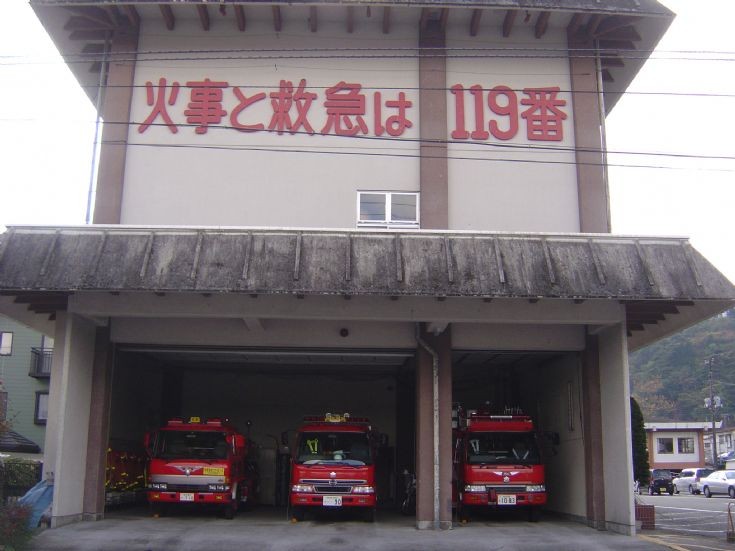
Well Yelp, it might to you mate. What I see is a smart turnout, smart red machines ( with no silly stripes!) And knowing the Japanese, a good standard of service to the public.
Added by John Stott on 24 June 2009.
Added by John Stott on 24 June 2009.
John Stott, I was referring to the actual building. I can believe the Japanese offer a faultless public service, as is the norm in Japan. But I have to disagree about the appliances. They look like toys to me.
Added by YelpBullhorn on 31 July 2009.
Added by YelpBullhorn on 31 July 2009.
Yelp, the buildings designed to collapse in its own surface area mate, earthquakes. As for the machines each country designs what they need and to me, they seem to have got it right for Japan.
Added by John Stott on 01 August 2009.
Added by John Stott on 01 August 2009.
Yelp - if you can find any Japanese firefighting videos on Youtube, you will see why their trucks look like toys. They have to contend with very narrow streets and alleys, jam-packed with wooden buildings and posing a risk of conflagration which simply does not exist anywhere I have seen in Europe or North America.
The solution is to respond with large numbers of these compact little pumpers, to hit the fire from all sides and to get in really close.
These guys are really good and their equipment is ideal for the job they have to do. As for the fire station design, John has said it all!
Added by Rob Johnson on 26 August 2013.
I also think the japanese have hit the nail on the head with pump design and may I say we could take a leaf out of their book as we use hand me down wholetime station pumps to some retained stations that are totally unsuitable for the task, when we could be using the smaller pumps. These guys have and a 9 m ladder and hey presto , good for the job and half the cost , no need to renew wholetime pumps so often either so cost savings all round including not having to train drivers to hgv standard , well worth thinking about
Added by Donald Maclean on 27 August 2013.
Added by Donald Maclean on 27 August 2013.
I went to several fires when stationed in Sasebo, Japan, and it appeared that regardless of the alarm, everyone responded. For that area, that was 3 ambulances, a ladder, a snorkel, 3 triple combination appliances (pump, hose, water), a triple combination foam appliance, 4 dual combination pumpers (pump, hose, no water tank), a dual combination rescue pumper, and at least 13 volunteer dual combination pumpers. Alarms were made by sirens back then.
One thing that cracked me up at the time, I was talking with one of the career firefighters at their main station. He "complained" that whenever there was an alarm, all the volunteers would respond. So I asked who dispatches them, and he answered "we do". I asked why they didn't just dispatch the appliances required, instead of everybody, and he said "we never thought of that".
The other thing I found interesting was, and this went for both the career and volunteer appliances, was the differences in size. My local career station had an appliance just larger than a jeep, the local volunteer appliance was just as large an a WTL, though it didn't carry water. Nor too much of anything, except for what their appliances nnormally carry. But, it had alot of room for carrying firefighters. The main station had large appliances, and the surrounding volunteer stations had the newer pumpers. A 6 man cab over, with room for 2-3 more in the hose bed area. That seemed to be the way the volunteer pumps were headed, when I transferred out.
Added by David L on 27 August 2013.
In Tokyo the volunteer fire companies do indeed have different specification pumpers. These are mainly very compact units which often carry portable pumps and are well designed for use in the extremely congested and inacessible local residential districts.
Another international example is to be found in large Geramn cities, where the numerous volunteer fire compamies who back up the full-time stations are also mainly equipped with purpose-built trucks, which tend to be simpler specifications. These are also less costly and require less specialized training.
Added by Rob Johnson on 27 August 2013.
Because of their experience, it seems Japanese fire services do take the number and type of first response units very seriously. It is also cultural - a Japanese fire officer will often be reluctant to call in a second alarm, as there is a tacit assumption that he should be able to get the job done with the first alarm assignment.
Athough the Sasebo example may be a bit extreme, first response in many Japanese cities does seem to be well ahead of anything you would find in the US or Europe, and a lot of very small fires are attended by several pumpers, two or three ladders, two or more rescues, three or four ambulances and two or more command vehicles, with around sixty firefighters and medics.
Fires are much less frequent there, but they do tend to be potentially a lot more serious because of building materials and access problems - so we probably should not second-guess their approach.
Added by Rob Johnson on 28 August 2013.
Donald you have a very salient point in HGV training, apart from the fact the appliances would suit many British towns with older, narrow streets.
I had the good fortune to give a small Mitsubishi pumper the once over a few years ago. It was a grey import, to drive it was a pleasure and generally I thought it well equipped and handled very well. Think it was based on a Cantor extended chassis and around 6 tons GVW.
Added by John Stott on 28 August 2013.
Yes john it is a big issue where I am from , it takes around two years from getting the pack through training and test , efad and hours requires before a new driver gets on the bell , it would solve a lot of problems all round , when did we last use a 13.5 in anger ? And there are loads of small gear that could be dispensed with , brigades just tinker at the issue , time it was sorted out really but as it makes sense doubtful really, must say though , the Japanese appliances look nice and clean , well looked after and obviously some pride involved , our pumps all look jaded after a couple of years , in fact we don't get car wax any more!
Added by Jack Donaldson on 29 August 2013.
Added by Jack Donaldson on 29 August 2013.
Many German volunteer fire services operate a Mercedes Vario 8 ton GVW based pumper as their first responder, for the same reason - it does not require a HGV driver's license. So, if there is no HGV license holder among the first squad to arrive at the fire station, it can still respond, with the heavier pumper and/or tanker to follow on when one or more HGV drivers get there.
These light pumps have a 2000 LPM pump at 10 AT, a 1000 liter tank, one hosereel, an 8 meter extension ladder, two scaling ladders, hyraulic rescue gear, BA and the usual collection of 52 and 75 MM hoses. They can accommodate either five or six, depending on the seating arrangement.
I believe that one or two British brigades have bought Varios, but I am not sure how they are specced out, or whether they are at full-time or retained stations.
The Japanese fire truck chassis - Mitsubishi, Nissan, Fuso and Hino are very popular in Australia and New Zealand as well as most of the far east. In some respects they are even better adapted to firefighting because they are all full forward-control configuration chassis and some are quite capable off-road.
Added by Rob Johnson on 30 August 2013.
Latest Pics




Added by YelpBullhorn on 23 June 2009.