
Upload a Picture
About this Site | Links | Random Pic | Advanced Search
Home | Latest Additions | Contributors
| Visitors
Fire Engine Photos
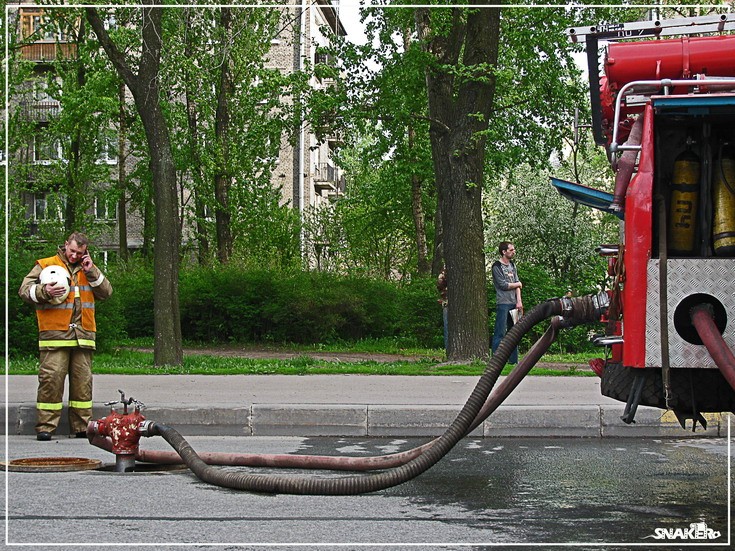
Neat to see how underground hydrant is connected to the Pumper.
Regards, from Canada,
Pat_R-B
Added by Pat Rivers-Bowerman on 28 May 2009.
Regards, from Canada,
Pat_R-B
Added by Pat Rivers-Bowerman on 28 May 2009.
Anyone know why in russia they not only connect a length of canvas feed hose from from a hydrant but also a length of hard suction hose,i have rarely if ever seen this done in any other country,if the main was running reasonable pressure and you didnt over run the supply at the pump then why would you need to do this,any ideas pavel or pat.
Added by Colin Mcqueen on 24 April 2010.
Added by Colin Mcqueen on 24 April 2010.
Yes, Colin...looking at the "Hard Suction Hose"; it appears creased in, near the hydrant coupling; I think maybe that it is not a "Hard Suction" type; but a flexible solid rubber-type hose, the corrugations allow it to bend.....
Added by Pat Rivers-Bowerman on 24 April 2010.
Added by Pat Rivers-Bowerman on 24 April 2010.
seems like the 'hard suction hose' is the typical suction hose used by sewage tankers which is semi hard
Added by Bomba Boy on 24 April 2010.
Added by Bomba Boy on 24 April 2010.
Thanks pat,seen russian firefighters doing pump drill on youtube and it seems to be sort of standard practice to park very close to a hydrant and use a short length of fire hose from one outlet of the standpipe and then use this semi rigid rubber hose,just don't understand the concept,thanks for your input.
Added by Colin Mcqueen on 25 April 2010.
Added by Colin Mcqueen on 25 April 2010.
SNAKER, Snaker - are you here, to help us with this question, above ?
Added by Pat Rivers-Bowerman on 26 April 2010.
Added by Pat Rivers-Bowerman on 26 April 2010.
Colin, I see what you mean - being standard practice, shown in picture 17396 and picture 17397, to use the both types of hose.
I am wondering if the Russian Pumper crews can never be sure of what a particular fire hydrant will produce in water flow and water pressure.
So, when they roll up to a hydrant; they hook up in this fashion, that if:
a) hydrant can deliver full flow - great -there are 2 delivery hoses to the Pump intake...(with only 1 hydrant valve, not possible to add the second hose later, without shutting down the flow in first hose, entirely)
b) reduced flow, and/or, reduced by another Pumper coupling up on same water-main; well - still good - the soft hose might collapse a bit, with the pump's suction; but the rigid hose will not.
c) little or no pressure at all; the soft hose will collapse completely; the rigid hose will stay open; even to extent that the pump can 'suck' from the water-main (like a rural 'dry hydrant')
I think that the fire-crews here, do not have the benefit of a fully maintained and inspected water-mains system; and may have had the dismaying experience of hooking up to a hydrant, that produces no water at all.....and have to go on, and try another hydrant.
Would anyone correct, or add, to this, please?
Added by Pat Rivers-Bowerman on 26 April 2010.
I think that makes sense and it is a reasonable thing to do to ensure a good water supply.
Added by Les Davis on 03 October 2011.
Added by Les Davis on 03 October 2011.
Zil


Added by Pavel Zaremba on 26 May 2009.