
Upload a Picture
About this Site | Links | Random Pic | Advanced Search
Home | Latest Additions | Contributors
| Visitors
Fire Engine Photos
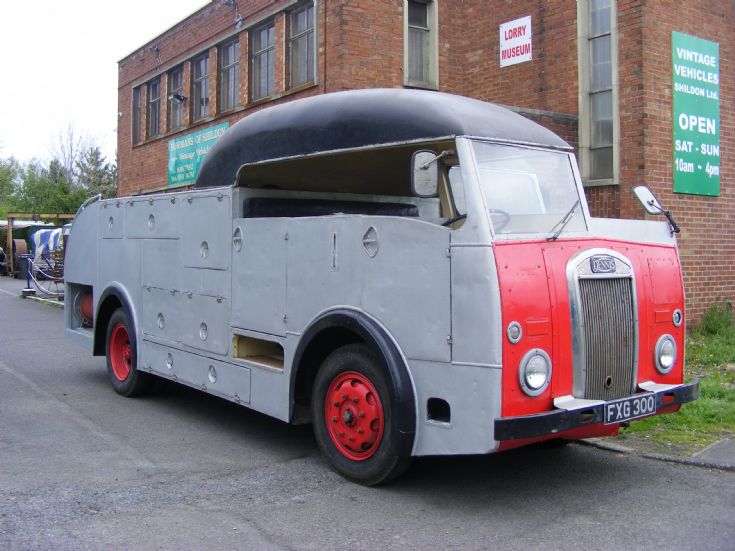
Hi Ian, They need a hand with it. it's missing some sort of injector/fuel pump. I'm going to see if I can make up a display board for it soon.
Added by Chris Hall Teesside. on 06 May 2009.
Added by Chris Hall Teesside. on 06 May 2009.
Thanks for this one Ian. After all the uncertainty about the location and condition of this machine in recent months, it is great to see her safe and sound.
Added by Chris Wood on 09 May 2009.
Added by Chris Wood on 09 May 2009.
Standing outside I understand.....if there is one machine which needs restoring it is this one....a one off...totally unique
Added by Barrie Green on 09 September 2013.
Added by Barrie Green on 09 September 2013.
I do hope they will bring it back up to its original condition, after being outside for so long. It is truly a unique - if rather odd - machine, and needs to be preserved. All that one-off low-profile bodywork to accommodate a 35 foot ladder, which could easily have been replaced by a set of scaling ladders!
Added by Rob Johnson on 09 September 2013.
Added by Rob Johnson on 09 September 2013.
Rob !
I struggle to see how a 35' ladder would fit in ANY of those hinged side lockers... therefore your comment the bodywork is built solely to accomodate a 35' ladder is completly wrong !! don't forget its a water tender with a 400 gallon tank it has a Dennis pump at the rear, carries a full crew and all the ancilliary equipment required of a 1950's water tender !
Added by Rick Loudon on 10 September 2013.
Rob...I believe that the JDC spec for a water tender required a 35 foot ladder to be carried
Added by Barrie Green on 10 September 2013.
Added by Barrie Green on 10 September 2013.
It is indoors now, in a shed at Sunderland Docks so at least it is out of the elements..
Added by Ronald Henderson on 10 September 2013.
Added by Ronald Henderson on 10 September 2013.
Sorry Rick! The 35 foot ladder was stored on its side inside the bodywork above the left side front and rear wheels, and would be slid out from the rear if needed. This is why there are no doors on the left side of this unit, no front passenger seat, and you will also see the rear seat is about nine inches shorter than usual on the left side - check the backrest in this photo.
This full-length rear-access 35 foot ladder storage locker can be identified on both a left side view or a rear view of this appliance, both of which can be seen on this site.
Barrie - I know it was done because of the JDCC requirement for a type B water tender to carry a 35 footer, because this was explained to me by the Third Officer at Middlesborough when I first set my (incredulous) eyes on this machine. But it did take a lot of one-off custom bodywork to make it happen - which is after all what makes it so unique!
As a practical matter, building it around the rather unusual ladder stowage solution may not have been all that necessary, because all of Middlesborough's other appliances were fully laddered up. The Third Officer at the time told me it would have been a lot cheaper and easier to get Dennis to build a low-profile pump if they did not have to work out how to include the ladder.
By the way, I was also told the bubble roof was not original, but was a later addition, as the appliance was meant to be open cab. It was made after complaints by the Union, which were initially resisted by the Brigade because they were still operating ywo open-cab Leylands at the time!
Shorter ladders were carried in a similar slide-in locker on the right side, which also explaims the height of the two small right-side lockers, above this second ladder stowage locker.
As for the crew accommodation, the OIC sat behind the driver with two other crew members, but this four man crew often dropped down to three! Why? Whenever it arrived at a low clearance bridge, the bubble came off and one member stayed with it - presumably to prevent it being stolen, although of course there was not another single vehicle in the World it would fit! Bizarre SOP.
It is such a fun story and I do hope it is going to be restored to its original eye-popping condition!
Added by Rob Johnson on 11 September 2013.
That method of storing ladders was used on one of the Leyland's St.Helens CB Fire Service had. The roof and short extension ladders were stored on edge behind the lockers and between the water tank in the pump bay. very handy as you could get them without having to climb up the rear of the appliance.
Added by Dave Price on 11 September 2013.
Added by Dave Price on 11 September 2013.
Dave - some US pumpers have similar rear slide-in ladder accommodations, between the side lockers and the tank, although a powered overhead rack which lowers to the side is most common, and some fire departments still continue to just hang them on the side. One manufacturer once offered "through the tank" ladder stowage, but I do not think it caught on.
Of course, stowing ground ladders in one or more rear slide-in compartments has been very common on aerial trucks here for more than a century.
Added by Rob Johnson on 11 September 2013.
Of course, stowing ground ladders in one or more rear slide-in compartments has been very common on aerial trucks here for more than a century.
Added by Rob Johnson on 11 September 2013.
Rob.....I have ridden and driven FXG.....yes the roof was fabricated about a year or so after the machine was delivered, I have never seen it crewed with less than four. When the roof came off it was slid to the back of the bodywork and the machine proceeded .... I have never known it to be left behind on the roadside as suggested.
Added by Barrie Green on 11 September 2013.
Added by Barrie Green on 11 September 2013.
The roof was made of glassfibre and is removeable , it was added some time after delivery and looks odd , has anyone a photo of how it was originally?
Added by Mick Thompson on 11 September 2013.
Added by Mick Thompson on 11 September 2013.
Barrie - Thanks! This makes more sense than the tale I was told.
Added by Rob Johnson on 12 September 2013.
Added by Rob Johnson on 12 September 2013.
Rob
My comment about the ladder and lockers was 'tongue in cheek' ! The bodywork was not designed just to fit a 35' ladder but to accommodate everything else a 1950's 'major pump' needed to carry ! As Barrie says it never ran with less than a crew of four.
Added by Rick Loudon on 12 September 2013.
My comment about the ladder and lockers was 'tongue in cheek' ! The bodywork was not designed just to fit a 35' ladder but to accommodate everything else a 1950's 'major pump' needed to carry ! As Barrie says it never ran with less than a crew of four.
Added by Rick Loudon on 12 September 2013.
Rick - my point was that it would have been a lot less unique if the Brigade had not needed to get Dennis to design and build a low profile pump which could fit a 35 foot ladder. Without the ladder, it would probably have looked just like any of the open cab pumps supplied to Australia - and much less of a unique historic treasure than it turned out to be.
As for the bubble story, Barrie has burst that bubble, although it came from a credible source (Third Officer, Middlesborough Fire Brigade) and seemed so ridiculous that it just had to be true!
Added by Rob Johnson on 12 September 2013.
As for the bubble story, Barrie has burst that bubble, although it came from a credible source (Third Officer, Middlesborough Fire Brigade) and seemed so ridiculous that it just had to be true!
Added by Rob Johnson on 12 September 2013.
Mick.....the roof was originally painted red.....It was subsequently fitted with a 'lighthouse' type of blue beacon on the centre of the roof (with a plug and socket electrical supply) An electric bell was fitted on the platform to the left of the drivers cab and later a Francis rolling siren was added,
Added by Barrie Green on 12 September 2013.
Added by Barrie Green on 12 September 2013.
Barrie.. I have a photo (unfortunately I cannot post on here, as I don't own it) that shows FXG 300 with it's original red roof. At that time it had lengths of suction hose (stacked 3 high) running the length of the offside upper surface of the body. These appear to be held in place with fixed brackets. My confusion is how could the roof be slipped back easily without interfering with this fitting and how was the roof then secured in place for onward journey, especially considering that the F12 chassis that this machine was built on was popular for being quick on the road?
Added by Paul Hassan on 14 September 2013.
Added by Paul Hassan on 14 September 2013.
Does anyone have any updates on the state of this unique machine? I have made enquiries about having it shipped to the Hall of Flame in Arizona, as they only have one British appliance there - an ERF HCB Angus WTE.
So far, no feedback - I may have to settle for an F 12 PE, which is I suppose a more typical classical British appliance, but of course not unique...
If I have to go that way, I will have it plated and signwritten to replicate my childrood favorite, PHN 999, Darlington's No 1 machine. Sorry, purists out there!
Added by Rob Johnson on 03 March 2018.
Rob.....its now in the Washington Aviation Museum next to the Nissan car plant....I believe an attempt is being made to preserve it but not sure how far they have got...at least its under cover now.
Added by Barrie Green on 06 March 2018.
Added by Barrie Green on 06 March 2018.
It’s in pretty good condition the rear body work on the drivers side from the rear wheel is very spongy so Ian Rutter is hoping to replace the panels.
Added by Ianmc on 07 March 2018.
Added by Ianmc on 07 March 2018.
Dennis


Added by Barrie Green on 06 May 2009.