
Upload a Picture
About this Site | Links | Random Pic | Advanced Search
Home | Latest Additions | Contributors
| Visitors
Fire Engine Photos
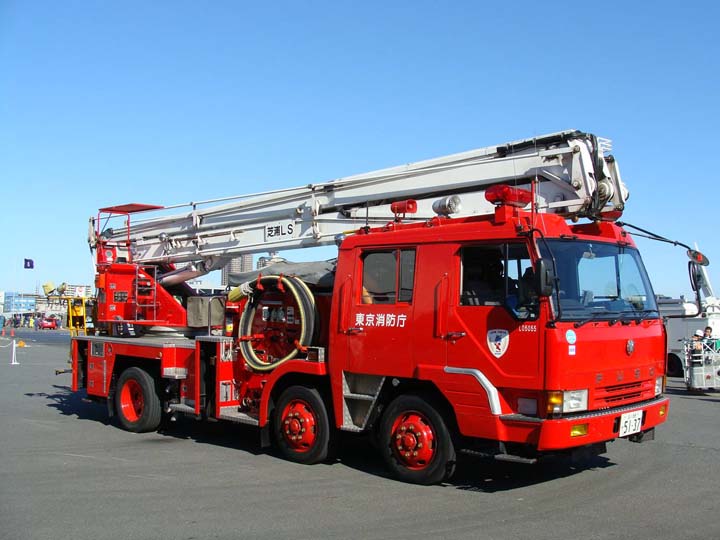
JP - It always seemed to me that the Japanese SOP of using hard suction to hook up heir pumpers to hydrants posed few problems. But if the crew of this kind of truck are both trying to position the ladder or platform properly and then supply a monitor from the pump, the need to be really close to the hydrant seems to mean that positioning the aerial optimally will inevitably become compromised.
I have visited Japan around a dozen times, and visited a lot of fire stations, but I never saw one of these combination pumper-aerials being operated. Did you ever get an opportunity to see how they managed the water tower role?
Added by Rob Johnson on 12 December 2013.
I have visited Japan around a dozen times, and visited a lot of fire stations, but I never saw one of these combination pumper-aerials being operated. Did you ever get an opportunity to see how they managed the water tower role?
Added by Rob Johnson on 12 December 2013.
When I was stationed in Sasebo, I drove out to several fires. One, where a snorkel was in use. The structure was located on a cliff, at the bottom of which was a 4 lane highway. The fire was being fought on the clifftop, but the fire dept had limited access to it. So, they located the the snorkel on the highway, below the house. The basket was raised to the level of the house, and its monitor used on the back of the house. The snorkel itself, was supplied by a pumper, located in a shipyard on the other side of the highway.
At a fire in the city, I saw their aerial ladder in use, and it was using its hard suction, connected to a street plug. The only other time I saw the ladder in use, it was functioning as a pumper, not using its ladder.
While I never measured the distance between the street plugs, it seemed they were rather close together. Closer than what I see in the U.S.
Added by David L on 13 December 2013.
Thanks, David. Very interesting that this type of rig was in fact used as a pumper some of the time. I know this happens when quints respond to fires here, but it was never common practice in Europe in the old days when quite a few ladder trucks had pumps - many of them did not carry enough hose or crew members for it to be a practical idea.
These six wheeled combination trucks were once pretty much the standard issue ladder all over Japan, but more recent aerials nowadays seem to be being built without pumps, just as in Europe, although they mostly still have a four door crew cab.
Added by Rob Johnson on 13 December 2013.
These six wheeled combination trucks were once pretty much the standard issue ladder all over Japan, but more recent aerials nowadays seem to be being built without pumps, just as in Europe, although they mostly still have a four door crew cab.
Added by Rob Johnson on 13 December 2013.
Fuso


Added by John Stott on 08 January 2009.