
Upload a Picture
About this Site | Links | Random Pic | Advanced Search
Home | Latest Additions | Contributors
| Visitors
Fire Engine Photos
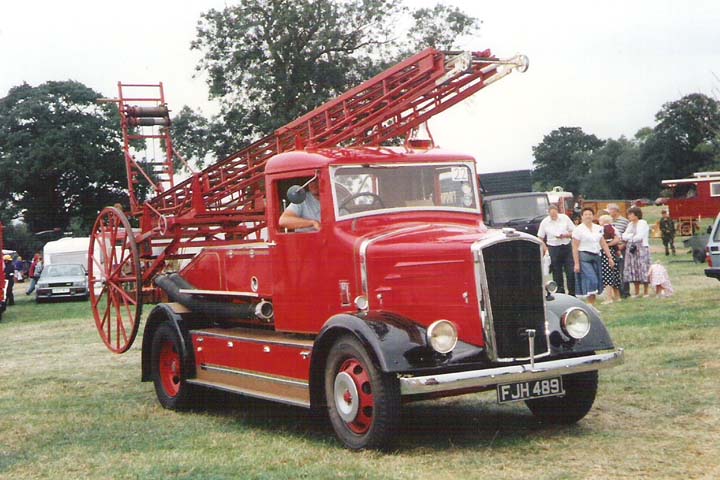
1940 Dennis Light-Four Pump Escape.
1940 Dennis Light-Four Pump Escape.
This Dennis Light-Four Pump Escape(reg-FJH 489)was supplied new to Hertford Corporation(Hertfordshire,England)fire
brigade in 1940.It had a four-cylinder Dennis side-valve 3769cc engine,and was fitted with a five-speed gearbox and
carried a Dennis No2 500-gpm rear mounted turbine pump.The appliance had a 35 gallon first-aid water tank and
carried a 50ft wheeled escape ladder.
The appliance had an unusual design in that it featured an enclosed cab on a braidwood body and measured just 19'
in length by 8'8'' in height and was designed to carry a crew of four.
This war-period appliance saw active service with the NFS before going out of service during the mid 1950's and into
presevation,and is one of the few in this design of Dennis Light-Four in presevation today.
Hallo Bob, Reference Yat Ming British Fire Models.
First, the 1938 Dennis Light-Four pump escape released by Yat Ming is actually owned by Dr B.A.Hutchinson(Barry).He had a visit from rep's from China a little
while back.They took details/photo's, etc of his appliance(see picture 1612)and
the 1921 Dennis'N'Type pump escape and the 1934 Leyland FK-1 whilst over here.
Also take a look at Archie Mckinnon's photo(see picture 708)showing again the
enclosed cab version, but this Dennis actually carries a 35'Ajax ladder.I think
in actual fact there were only around six such appliances beleaved to have ever been built.I'm not sure whether that means pumps/pump escapes, or both?.Pete.
Added by Pete Matten on 21 October 2008.
Hello Pete:
Definitely, another intriguing rig that you have for us.
Some interesting thinking back there in 1939-40 as to Crew Comfort/ Lack Thereof ; the Driver and the Officer in a fully enclosed cab, with Cushion Seats, Wind-up Windows and maybe even some heat from the Window De-Mister - the remaining 2 crew still jolting around, perched high in back, on the hard bench. Snugging up against the cab would give some wind-protection, and maybe a grab-handle there, to help hang on.
Almost could be said, a very conservative step towards trying the idea of an Fully-Enclosed Cab eg "let's just try putting only 2 people under a roof, and see how it goes......" although I suspect design-constraints, and the Exigencies of WW-2, had something to do with it.
Mind you, I am saying this, coming from a country where the Crew still rode, in the open, in winter's snows and cold, standing on the rear-step ("Look out for big bumps in the road..."), getting their long rubber boots on, long coats fastened and gloves on; long after their brethren in other countries were all sensibly riding around, up front, in comfie Fully-Enclosed Cabs.
Could you explain a bit on The Braidwood Body, New World Body, etc ?
Regards, from Canada,
Pat_R-B
Added by Pat Rivers-Bowerman on 21 October 2008.
The motor vehicle evolved during the two world wars and the fire engine(appliance)evolved with it, and although the horse-drawn era with firemen
sitting or standing along the sides of'Braidwood'style open-bodied pumps
(named after James Braidwood-the first Superintendent of the London Fire
Brigade Establishment between 1833 and 1861), early designs in motorized
appliances still reflected the old horse-drawn era with firemen sitting
on the sides of open appliances(see picture 5965)facing outwards.
The Dennis Light-Four'New World'body was introduced in 1936 and production
continued until the end of the war.Dennis, Merryweather, Bedford, Leyland, etc
from the mid to the late 1930's all started introducing a body style of
appliance which enabled the crew to have sitting positions inside the open
body on inward/forward facing seats(see picture 7141)of appliances.
Hope this answers some of your questions.Pete.
Added by Pete Matten on 03 November 2008.
I have a question on the ladder length. Was the length of the ladder (50 to 60 feet) determined by the brigade when ordering the appliance or by the various ladder manufacturers? Did they make shorter length ladders or were they all this length during this era.
Added by Richard Yokley on 26 December 2008.
Added by Richard Yokley on 26 December 2008.
Wheeled escapes were normally 50ft but the odd one was 60ft...as ordered by the chief officer. I never heard of one less that 50ft. The advent of the none wheeled alloy 'Lacon' ladder which was 45ft marked the beginning of the end of the wheeled escape. The Lacon was the forrunner of the modern 13.5
Added by Barrie Green on 27 December 2008.
Added by Barrie Green on 27 December 2008.
Barry, thanks for helping me out on Richard Yokleys question.I've tried answering
some of his questions via E.Mail(he's in Tucson Arizona)but I can't answer all of his questions and lets be honest, this site is not just for showing photo's
but it helps with info, history, and all general topics on the fire service.
Added by Pete Matten on 27 December 2008.
some of his questions via E.Mail(he's in Tucson Arizona)but I can't answer all of his questions and lets be honest, this site is not just for showing photo's
but it helps with info, history, and all general topics on the fire service.
Added by Pete Matten on 27 December 2008.
Barrie, thanks for the info on the ladders, much appreciated. And to Pete thank you as well as you have been most helpful.
Richard
Added by Richard Yokley on 27 December 2008.
Richard
Added by Richard Yokley on 27 December 2008.
Could anybody tell me why the New world engine had eight spark plugs and only four had caps on.What were the other four plugs used for? I have seen a 1940 Dennis Light 4 New world exhibited in Calbourne Mill on the Isle Of Wight Sept 2011
Added by CLIFF BERRY on 09 September 2011.
Added by CLIFF BERRY on 09 September 2011.
Cliff, The Dennis engine could be run on either a coil or magneto - decided by a choice of switches on the dash. Therefore each cylinder had 2 plugs! The one you saw must have only had one set of leads fitted.
Added by Paul Stevens on 10 September 2011.
Added by Paul Stevens on 10 September 2011.
I think the name "New World" came about because it was thought to be based on a north American pattern. Leeds had a batch of new world bodied F8s in the 50s.
Added by Neal Glover on 11 September 2011.
Added by Neal Glover on 11 September 2011.
The machine was based at Hertford from 1939 till 1968. Then bought by Lord Cranford for his country estate. At Banham zoo playground till 1984. Then breifly at Lakeland motor museueum. Purchased in to private preservation 1985.
Added by Ian Fullbak on 16 October 2016.
Added by Ian Fullbak on 16 October 2016.
Enclosed fire appliances first turned up in the Netherlands, Portugal and France in the early 1920s. The first enclosed units in Britain went to Edinburgh and Darlington in 1931. Germany had some examples of them by 1932 and Mack supplied an enclosed pumper in 1935 - although there may have been earlier ones in the USA.
But they were not always immediately very popular, and conservative fire chiefs continued to buy open cab trucks well into the 1960s in some countries, especially in the Americas...
Added by Rob Johnson on 12 July 2020.
But they were not always immediately very popular, and conservative fire chiefs continued to buy open cab trucks well into the 1960s in some countries, especially in the Americas...
Added by Rob Johnson on 12 July 2020.
Lancaster had an enclosed Albion in 1934, it formed the basis for the Dinky Toys "Streamlined Fire Engine".
Added by Neal Glover on 13 July 2020.
Added by Neal Glover on 13 July 2020.
Neal: I had one of those. It seemed to have a piston pump (Hatfield?) - but I could never figure out why it had both side lockers and a rear window?
Added by Rob Johnson on 14 July 2020.
Added by Rob Johnson on 14 July 2020.
The real one did have a reciprocating pump and 2 windows behind the cab doors. The hosereel was at the back.
Added by Neal Glover on 16 July 2020.
Added by Neal Glover on 16 July 2020.
I really liked the Supertoys 555 Commer Carmichael B type water tender, a very accurate model of an appliance supplied to York City, and later used by Rowntrees. It is illustrated in two different photos on this site, showing both the front and rear aspects.
My home town, Darlington, had a very similar machine (RHN 999), but with a different layout for the hosereels, which were very low mounted amidships. I think this may have been a brigade requirement after their experience with their first Commer water tender (NHN 999). This was a Whitson bodied machine, which had the hosereels mounted very high above the rear bodywork - requiring someone to climb up all the way up there to rewind them! It also had a rather strange locker design, with a large rear access locker running the length of the body on each side. There are a few examples of these Whitsons on this site.
Added by Rob Johnson on 17 July 2020.
Barrie: A bit of history about escape ladders, from my 1913 LCC Fire Brigade Notebook. "The brigade operates 89 horsed or motor and 102 manual escape ladders. These are 50, 55 or 70 feet, all built in three sections. Most of the 55 foot ladders were originally constructed as 40 foot ladders, in two sections, and subsequently had a third ladder section fixed to them.
"The first escape horsed escape carrier, using the ladders wheels attached to a two wheeled hose cart, was introduced in 1893, and a four wheeled horse drawn "escape van" was introduced in 1897.
"With improvements on 1905 and 1911 these also had a small water tank, and a soda acid chemical or compressed air operated first aid hose reel.
"The first motor escape van was purchased in 1906 and in 1913 the brigade had 26 motor escape vans - many of which were battery electric powered".
By 1913 there were only eighteen 70 foot ladders, as these were being rapidly replaced by turntable ladders after 1905. The turntable ladder achieved greater height and - importantly - required far fewer firefighters to maneuver and operate than the very heavy 70 foot escape.
By 1913 the brigade had plans for no less than 23 82 foot wooden horse drawn, electric or petrol powered turntable ladders.
This was a time of great transformation in firefighting technology, but the wooden 50 foot fire escape ladder survived the introduction of both the 45 foot alloy ladder and its 50 foot steel successor - and continued in service with some brigades well into the 1970s...
Added by Rob Johnson on 20 July 2020.
I’d like to get in touch with current keeper for a bit of history. My light 4 (on here as GXN 782) also has a 50’ Merryweather steel ladder #4333 but not the original 60’. This one looks older but pretty similar. Any info appreciated
Added by Peter McCombie on 12 April 2021.
Added by Peter McCombie on 12 April 2021.
I was pleased to see this appliance FJH 489 at a recent classic vehicle meet near Kettering. My father served with the Hertford Fire Brigade during the 2nd world war and his name was John Foley. I am sure he would have driven this appliance as he did occasionally drive. Does any one else have any connection with the Herford Fire Brigade during the this time?
Added by Brian John William Foley on 24 September 2023.
Added by Brian John William Foley on 24 September 2023.
Dennis


Thanks for sharin g this photo with us. The new Yat Ming model in 1:43 scale must have used this as its prototype except the model has red fenders. Seeing this is the 100th Anniversary of Dennis Brothers I wonder if a book has been released on this interesting, now gone, company. It would be most helpful as there were so many diverse names used: Light Six, etc. The Winchester Dennis, an open Braidwood body of 1940/41 was a big four. Too, there must have been quite a large number of machines released such as in your photo, some pump escapes and some pumps with 35' ladder; I have a couple of the latter.
Bob Graham
Added by Bob Graham on 20 October 2008.