
Upload a Picture
About this Site | Links | Random Pic | Advanced Search
Home | Latest Additions | Contributors
| Visitors
Fire Engine Photos
No: 11515 Contributor: Stephen Kirkpatrick Year: 2001 Manufacturers: Angloco, Shelvoke Country: United Kingdom
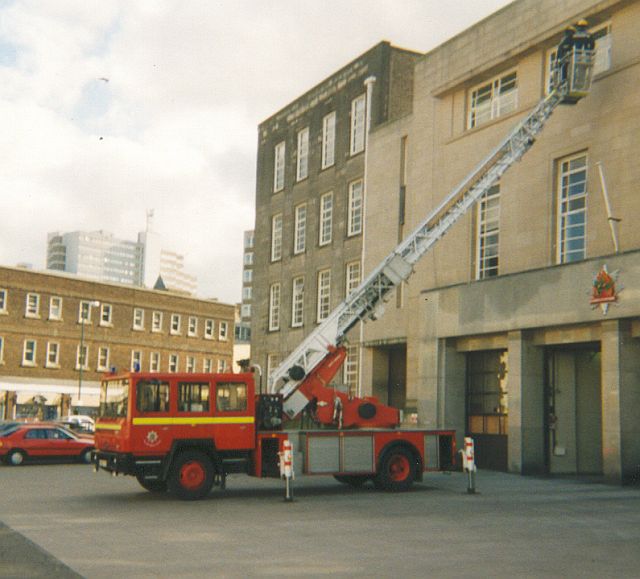
Shelvoke & Drewry TL
Pictured in 2001 is Nottingham Centrals reserve TL A52CTV which spent its whole life at Nottingham Central, where pictured training on the forecourt. This Shelvoke & Drewry WY with angloco bodywork and a Metz DLK30U ladder. This vehicle has a full crew crab. If anyone knows where this is today, please share.
Pictured in 2001 is Nottingham Centrals reserve TL A52CTV which spent its whole life at Nottingham Central, where pictured training on the forecourt. This Shelvoke & Drewry WY with angloco bodywork and a Metz DLK30U ladder. This vehicle has a full crew crab. If anyone knows where this is today, please share.
Thankyou for that Rick, i will notify one of the brigades mechanics I know who would be pleased to see it being preserved.
Added by Stephen Kirkpatrick on 21 February 2009.
Added by Stephen Kirkpatrick on 21 February 2009.
Stephen
I never understood why aerials had full crew cabs? Are you able to explain?
Many thanks
David
Added by David Jones on 14 October 2010.
I never understood why aerials had full crew cabs? Are you able to explain?
Many thanks
David
Added by David Jones on 14 October 2010.
i always understood that, back then, it was a driver, an operator at the bottom, and an operator at the top (in the cage/basket or whatever else it may be called)
Added by Sean Griffiths on 15 October 2010.
Added by Sean Griffiths on 15 October 2010.
Full crew-cabs ? ... simples. They were the original "Casualty Holding Areas" ! When the mythical scantily clad damsel in distress was rescued with her lover from a top floor bedroom window, her modesty and dignity were protected by being sheltered in the rear of the crew cab prior to being handed over to the ambulance service ! On a more serious note, hard to believe it now but TL crews were (presumably) originally four-man. Even the 1960's versions of TL drills in the FS Drill Book refer to three-men plus Oi/c. We always ran with one plus the Oi/c except on the very rare occasion when there happened to be a spare man on the Watch and we would run with two plus Oi/c. Some of the ex-London guys will be able to confirm but did they not run with three / four-man crews way back ?
Added by Keith Richardson on 20 October 2010.
Added by Keith Richardson on 20 October 2010.
The original horse drawn London Turntable ladders had a three person crew, including the coachman, the operator and the ladder man. This continued when motor ladders were introduced, even when the jobs of driver and operator were combined. When ladders with pumps were first bought in the 1930s, this further reinforced the idea that the crew should number three men.
During WWII NFS crews were often four, five or even six, as TLs were usually in short supply and very often got called to major incidents - to operate mainly as water towers.
When TLs and TLPs started to be acquired in the 1950s, it was still a requirement that they operated with three crew, so canopy or four door cabs were the norm. They died out in the 1970s and 80s, after brigades dropped specifying built in pumps and general reductions in manpower made for a crew of two becoming the norm.
Some countries still crew aerial trucks with five or even six personnel. In North America, the ladder crew perform rescue, ventilation and overhaul duties, and assist as necessary with engine operations.
In most large cities, the vast majority of aerials do not have pumps but do carry extensive rescue equipment including hydraulic extrication gear as well as a wide assortment of ground ladders.
In smaller communities, they often have a dual role as pumpers as well as ladder trucks, which also creates a need for a full crew.
In Japan, aerial crews have a similar set of rescue responsibilities, and in Tokyo they are considered to be specialist rescue personnel.
In most of Europe, the two man ladder is the norm, with ground ladder and rescue activities in the hands of pumper crews and specialist rescue teams, often with their own vehicles.
Added by Rob Johnson on 14 December 2017.
When I lived in Kuwait, the Fire services Directorate operated several aerials with crew cabs.
This was because the second due pumper at structure fires was a high capacity water tender, and these did not have space for a crew cab. They were needed because many areas of the city did not have water mains, so the fire fighters had to bring their own water with them.
I recently noticed a similar set of trucks at a fire station in Tehran, including a TL with a crew cab and a big tanker, presumably for the same reasons....
Added by Rob Johnson on 16 December 2017.
This appliance is still in good working order with a private owner and Is used as part of the East mids preservation group.
Added by Dan on 18 May 2018.
Added by Dan on 18 May 2018.
Angloco


Yes this vehicle is currently in preservation in Staffordshire with a friend of mine
Added by Rick Loudon on 05 October 2008.